
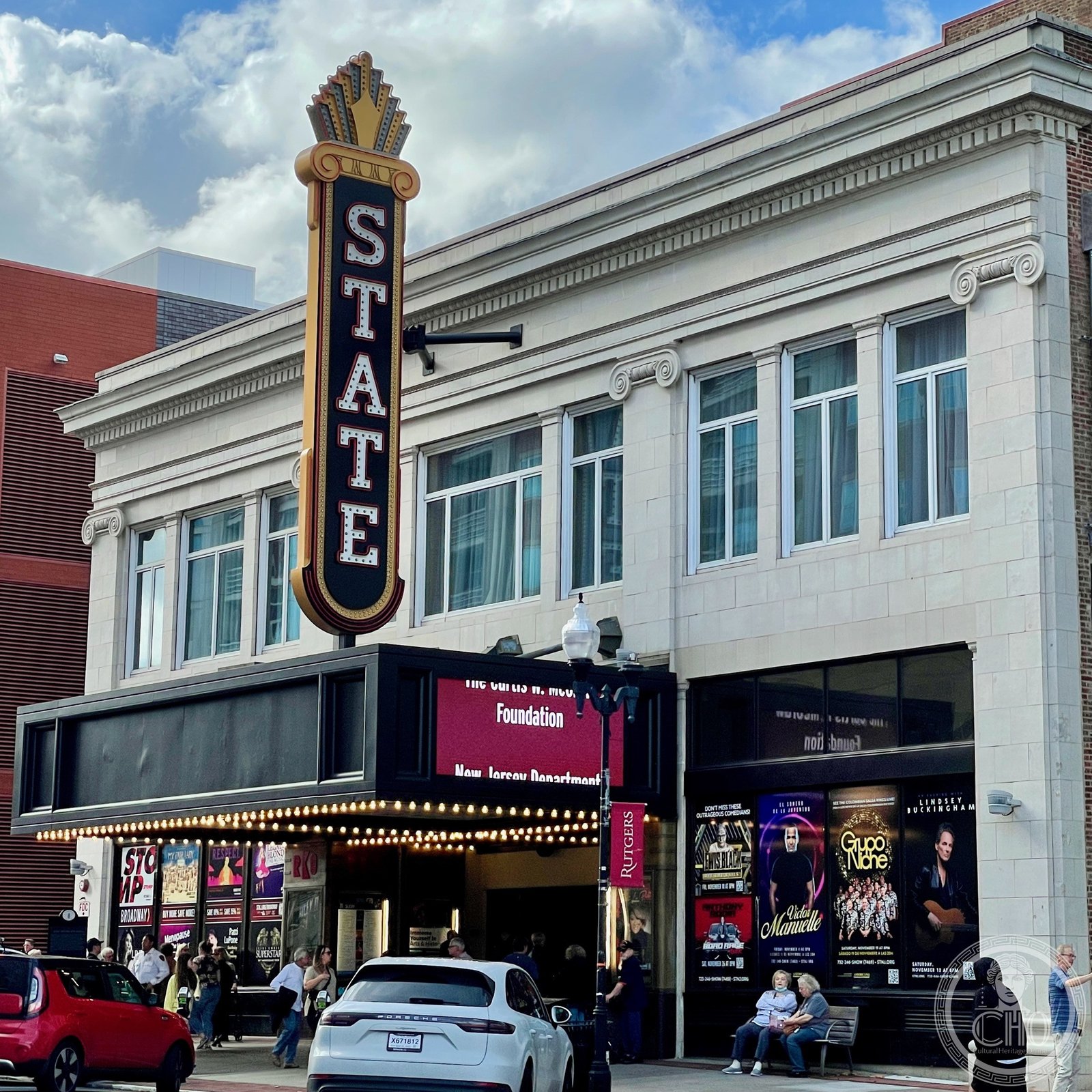
A century-old performing arts anchor on the edge of Rutgers University, its brick facade and Art Deco marquee still drawing audiences to the same Livingston Avenue address where vaudeville once played to packed houses.
At a glance
State Theatre New Jersey opened in 1921 as a vaudeville and film palace in downtown New Brunswick, then a prosperous industrial city on the Raritan River. Decades of programming shifts and urban change threatened the building more than once, but each time the community reasserted its claim. Today the theater operates as a regional performing arts center presenting dance, orchestral concerts, Broadway touring productions, and family programming. The restored interior retains the warmth of its original plasterwork alongside the bold geometry that architects of the 1920s were beginning to absorb from the emerging Art Deco idiom.
Key facts
- Address: 15 Livingston Avenue, New Brunswick, NJ 08901
- Opened: 1921
- Style: 1920s theater architecture with Art Deco decorative elements
- Current use: Performing arts center (State Theatre New Jersey)
- Capacity: approximately 1,800 seats
- GPS: 40.4957° N, 74.4508° W
- NRHP: contributing building within New Brunswick historic context
History
New Brunswick was riding a wave of commercial confidence in 1921 when the State Theatre opened its doors. The city’s position on the main rail line between New York and Philadelphia, combined with the growing Rutgers campus, gave local impresarios a reliable audience for touring variety acts, silent films, and later the talkies that swept the industry after 1927. The theater was built to capture that market, part of a national building boom in purpose-designed entertainment venues that transformed American downtowns between 1915 and 1935.
During the 1930s the theater, like most of its contemporaries, was updated to reflect the streamlined aesthetic that audiences had come to associate with modernity — simplified moldings, bolder geometric ornament, the confident lettering of a well-lit marquee. These Art Deco adjustments sit alongside the original structure without contradiction, a layered history readable in the building’s surfaces. After decades of decline in the postwar era, the theater was restored and relaunched as a performing arts institution, positioning itself as the cultural hub of Middlesex County.
Rutgers University, chartered in 1766 as Queen’s College and the eighth-oldest university in the United States, has long been the intellectual backdrop to New Brunswick’s civic life. The State Theatre and the university share the same audience: students, faculty, and the surrounding communities who value live performance as a counterweight to screens.
What you see
The exterior presents a confident red-brick face to Livingston Avenue, the marquee projecting above the sidewalk in the manner of the great urban cinemas: a luminous sign that reads as invitation even from a block away. The brick itself carries a visual warmth absent from the glass towers that have risen around it, and at street level the proportions retain the human scale of the 1920s commercial block. Inside, the preserved plasterwork details — shallow relief panels, geometric friezes, stylized floral motifs at the cornice — document the transitional moment when Beaux-Arts ornament was being simplified into the bolder vocabulary of the Deco decade.
The auditorium’s sight lines are steep enough to give even the upper balcony an intimate connection to the stage, a quality that modern hall designers still struggle to replicate. The lighting rigs and technical infrastructure have been modernized, but the basic geometry of stage-to-seating remains as the original builders conceived it — a room shaped by the acoustics of the human voice and the geometry of unobstructed sight lines.
Practical information
- Access: Public performances; tickets via State Theatre New Jersey box office
- Season: Year-round programming; check statenj.org for schedule
- Duration: Performances typically 1.5–2.5 hours depending on production
- Parking: Municipal garages within one block on Livingston and George Streets
Getting there
NJ Transit’s Northeast Corridor line serves New Brunswick station, which is a short walk north of the theater along George Street; travel time from New York Penn Station is approximately 50 minutes, from Philadelphia about 55 minutes. Newark Liberty International Airport (EWR) lies roughly 30 miles north via the New Jersey Turnpike (I-95), and Philadelphia International Airport (PHL) is approximately 55 miles southwest. By road, New Brunswick is accessible from I-287 and Route 1, both of which funnel traffic into the downtown grid.
Nearby
- Rutgers University campus — Hamilton Street, a short walk; the Zimmerli Art Museum at Rutgers holds one of the largest public art collections in New Jersey
- George Street Playhouse — intimate theater company in downtown New Brunswick, complementing the State Theatre’s larger programming
- Raritan River waterfront — Johnson Park and the Landing along the river, two miles east via Route 27
- Princeton — approximately 18 miles south via Route 1; home to McCarter Theatre and the Princeton University Art Museum
Sources
- State Theatre New Jersey — statenj.org (official programming and history)
- New Jersey Historic Preservation Office — theater documentation, Middlesex County
- Wikimedia Commons — State Theatre New Jersey, New Brunswick, NJ (CC BY-SA 4.0, Zeete)
- NJ Transit Northeast Corridor schedules — njtransit.com
- Rutgers University history — special.lib.rutgers.edu
Find it on the map
See this place and what’s around it →Record researched and written by Luigi De Marchi for Cultural Heritage Online, 2026.
📷 Become a Cultural Heritage Online photographer
Share your photos of places: they stay published under your name as the author. The more they're seen, the more you get noticed — and soon a contest will reward the most appreciated photos.
Log in or sign up free to add a photoIs this page about you?
This page is read by travellers and heritage enthusiasts who find it on Google. Tell us how you are connected to this place and we will take it from there.