
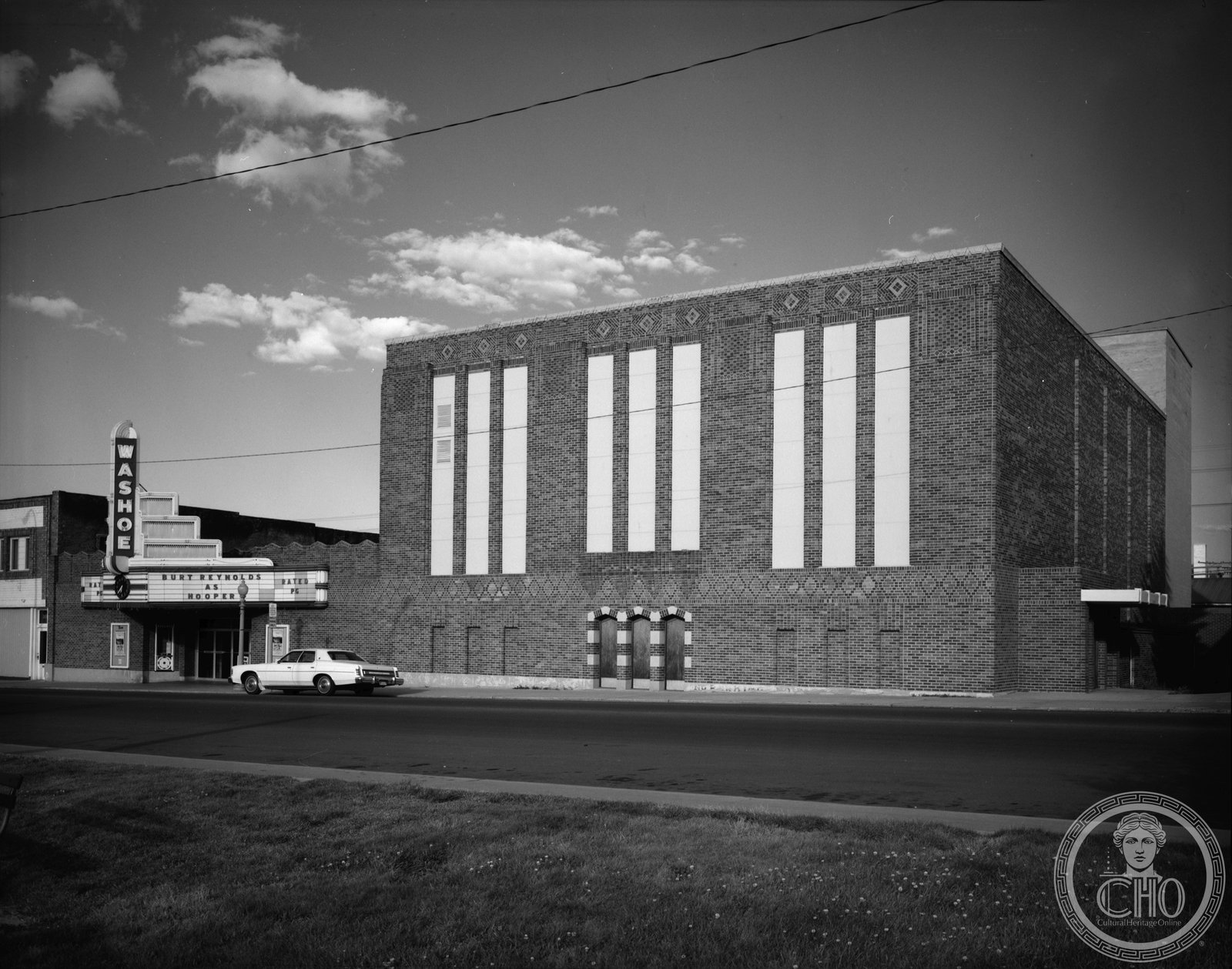
Built in 1936 for a copper-mining company town of fewer than ten thousand people, the Washoe Theatre brought Art Deco architecture to the Montana Rocky Mountain interior at a scale and quality of finish that would have suited a city twenty times the size.
At a glance
The Washoe Theatre stands on Main Street in Anaconda, Montana as one of the most unexpected architectural finds in the American West: an ornate, fully intact Art Deco movie palace in a small smelter town in the Rocky Mountain foothills. The building was commissioned by the Anaconda Company — the copper-mining corporation that had built the town, employed most of its residents, and controlled its economy for decades — and designed by B. Marcus Priteca, a Seattle-based architect responsible for some of the most celebrated theater interiors of the 1920s and 1930s. The resulting building is a monument to the prosperity that copper mining brought to this corner of Montana, and to a specific moment in the history of American entertainment architecture when the movie palace was the civic institution that expressed a community’s sense of its own ambitions. Today the Washoe operates as a functioning movie theater, its murals, plasterwork, and original Art Deco detailing in a state of preservation rare among buildings of its vintage.
Key facts
- Built: 1936.
- Style: Art Deco / Moderne.
- Architect: B. Marcus Priteca.
- Address: 305 Main Street, Anaconda, Montana 59711.
- Patron: The Anaconda Company (Anaconda Copper Mining).
- Current use: Operating movie theater.
- GPS: 46.1275° N, −112.9440° W.
- Status: National Register of Historic Places.
History
Anaconda was Marcus Daly’s town. The copper magnate founded it in the 1880s as the industrial base for his mines at Butte — a city of smelters, workers’ housing, and company infrastructure laid out on the Deer Lodge Valley floor. By the time the Washoe Theatre was built in 1936, Daly had been dead for more than three decades, but the Anaconda Company that bore his name still dominated the town’s economy, employing most of its working residents and maintaining control of local institutions at a level rare even in an era of company towns.
The decision to build a major movie palace in a town of Anaconda’s size reflected both the company’s paternalistic investment in worker amenity and the broader cultural moment: by the mid-1930s, going to the movies had become the defining leisure activity of American working-class life, and a proper cinema was as much a civic necessity as a school or a church. B. Marcus Priteca, who had designed theaters for the Pantages circuit and other major operators, brought to Anaconda the same level of design attention he applied to his urban commissions. The result was a building whose ornate plasterwork, painted murals, and Deco-geometric ornament would not have been out of place in Seattle or Denver.
The theater opened in 1936 and operated through the full arc of the American movie-going era: the golden age of Hollywood through the 1940s and 1950s, the decline of downtown theaters as suburban multiplexes drew audiences outward, and the preservation effort that kept the building operating into the twenty-first century. The Anaconda Company itself ceased copper smelting in 1980, leaving the town to redefine its economy; the Washoe remained as one of the most intact monuments to the industrial prosperity that had built it.
What you see
The Washoe’s Main Street facade is a stepped Art Deco composition in brick and terracotta, the vertical thrust of the entrance tower balanced against the horizontal bands of the auditorium block. The lobby interior is where the ambition of the commission becomes fully visible: the plasterwork ceiling, the original terrazzo floor, the painted murals on the upper walls depicting Montana landscapes in a style that blends regional subject matter with the decorative language of the Deco period. The auditorium continues the program: painted ornament on the soffits, original seats in the main floor and balcony, a proscenium arch whose geometric detailing belongs to the same vocabulary as the lobby.
Walking Main Street in Anaconda, the Washoe reads as a building that has not been altered to survive. It did not become a bingo hall, a warehouse, or a church, as many theaters of its generation did; it remained a movie theater, and the relative lack of commercial pressure on a Main Street that declined with the smelter has paradoxically protected its fabric from the kind of renovation that destroys historic interiors in more economically active environments.
Practical information
- Cinema schedule: current-release films; check the Washoe Theatre calendar — the schedule reflects a small-town market, typically one or two films per week.
- Guided tours: contact the theater in advance; staff can walk visitors through the lobby and auditorium during non-screening hours.
- Time needed: allow a full afternoon — the theater, the smelter stack, and Washoe Park form a coherent itinerary of Anaconda’s industrial heritage.
Getting there
Bert Mooney Airport (BTM) in Butte serves Anaconda from approximately 25 miles east; regional connections link to Salt Lake City and Denver. Helena Regional Airport (HLN) is approximately 70 miles northeast via Interstate 90 and US Route 12. Anaconda sits on US Route 1 (Montana Highway 1) and is reached from Interstate 90 at the Warm Springs interchange. There is no passenger train service to Anaconda; Amtrak’s Empire Builder route, which crosses northern Montana on the Hi-Line corridor, is over 150 miles north.
Nearby
- Anaconda Smelter Stack State Park — the 585-foot brick smokestack, visible from miles away, is the tallest masonry structure in the United States and a monument to the scale of Anaconda copper production; 1 mile east of the theater.
- Washoe Park — company-built park adjacent to the original Washoe reduction works site, with ponds, a botanical greenhouse, and picnic areas; 0.5 miles east.
- Georgetown Lake — a mountain reservoir at 6,400 feet elevation in the Flint Range, approximately 16 miles southwest via Anaconda-Pintlar Wilderness Road; popular for sailing, fishing, and skiing at Discovery Mountain.
- Old Montana Prison, Deer Lodge — 1871 territorial prison with castle-like stone walls, now a museum complex; approximately 25 miles northeast via US Route 12.
Sources
- Washoe Theatre, Anaconda — operating history and venue documentation.
- National Register of Historic Places — Anaconda Historic District nomination.
- Montana Historical Society — Anaconda Company records and architectural surveys.
- B. Marcus Priteca — theater design documentation in Pacific Northwest archives.
- Wikimedia Commons — building image (Historic American Buildings Survey).
Find it on the map
See this place and what’s around it →Record researched and written by Luigi De Marchi for Cultural Heritage Online, 2026.
📷 Become a Cultural Heritage Online photographer
Share your photos of places: they stay published under your name as the author. The more they're seen, the more you get noticed — and soon a contest will reward the most appreciated photos.
Log in or sign up free to add a photoIs this page about you?
This page is read by travellers and heritage enthusiasts who find it on Google. Tell us how you are connected to this place and we will take it from there.