
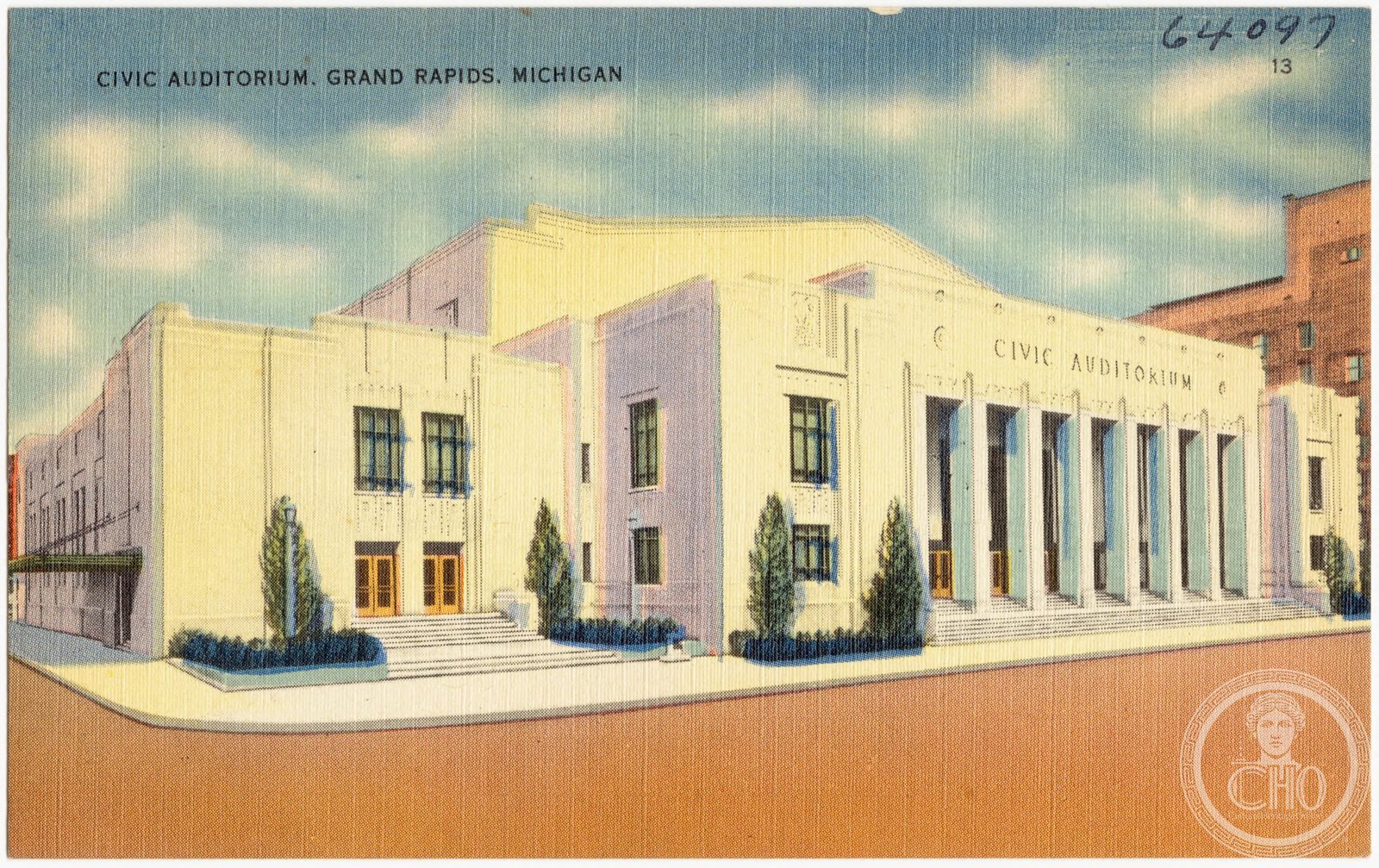
A landmark of New Deal civic architecture completed in 1933, the Grand Rapids Civic Auditorium — today DeVos Performance Hall — embodies the PWA Moderne style that brought Art Deco ambition to American public buildings during the Depression era.
At a glance
The Grand Rapids Civic Auditorium opened in 1933 as one of Michigan’s most significant Public Works Administration projects, a moment when federal investment in civic infrastructure gave American cities buildings of metropolitan scale and architectural ambition. Positioned on Monroe Avenue near the Grand River in the city’s downtown core, the building served generations of Grand Rapids residents as the primary venue for large concerts, conventions, sporting events, and community gatherings. Its PWA Moderne exterior combines the classical symmetry and monumental massing characteristic of New Deal civic architecture with Art Deco ornamental detailing — geometric reliefs, stylized pilasters, and a restrained palette of limestone-faced concrete that reads as authoritative without sacrificing elegance. Renamed DeVos Performance Hall in 1997 after a comprehensive renovation, the building continues to anchor Grand Rapids’s performing arts scene as part of the larger DeVos Place convention and performing arts complex.
Key facts
- Opened: 1933
- Current name: DeVos Performance Hall (renamed 1997)
- Address: 303 Monroe Ave NW, Grand Rapids, Michigan 49503
- Style: PWA Moderne (Public Works Administration), Art Deco detailing
- Capacity: Approximately 2,000 seats (post-renovation configuration)
- NRHP: Listed on the National Register of Historic Places
- Part of: DeVos Place, Grand Rapids’s downtown convention and arts complex
- Resident companies: Grand Rapids Symphony, Grand Rapids Ballet, Broadway touring productions
History
Construction of the Grand Rapids Civic Auditorium began in the depths of the Great Depression, part of President Franklin Roosevelt’s New Deal program to stimulate the economy through federal investment in public infrastructure. The Public Works Administration funded thousands of civic buildings, post offices, courthouses, and schools across the United States between 1933 and 1939, and the Grand Rapids Auditorium was among the earliest and most significant in Michigan. The building gave a city already grieving the collapse of its furniture manufacturing economy a monument to civic confidence and collective ambition.
For decades the building served as the heart of public life in Grand Rapids: the home of major concerts from classical to country, a venue for political rallies and community conventions, and the arena where the city’s professional basketball team played before the NBA era. The postwar decades tested the building’s relevance as competition from new suburban entertainment venues grew, but Grand Rapids’s commitment to preserving its downtown cultural district sustained the Auditorium through periods of reduced use.
In the 1990s, the DeVos family — founders of the Amway Corporation and major civic benefactors in Grand Rapids — funded a comprehensive renovation that restored the building’s architectural fabric while updating its technical systems and reconfiguring the auditorium to optimize acoustics for orchestral performance. The renamed DeVos Performance Hall reopened in 1997 as a world-class venue, anchoring a broader investment in Grand Rapids’s downtown arts infrastructure that also included the adjacent Van Andel Arena (1996) and the expanded DeVos Place convention center (2005).
What you see
The Monroe Avenue facade presents the characteristic vocabulary of PWA Moderne civic architecture: a symmetrical composition of limestone-faced concrete whose central mass rises above flanking bays behind a colonnade of pilasters that runs the full height of the main block. The geometric ornamental program — stylized plant forms at capital level, chevron banding at cornice height, and low-relief panels flanking the main entrance — applies Art Deco surface treatment to a classically proportioned base, a combination that signals both institutional gravity and contemporary modernity. The bronze entrance doors and the carved stone details above them reward close examination: the ornament is restrained rather than exuberant, calibrated for a building that needed to project permanence for decades rather than novelty for a season.
Inside, the renovated auditorium preserves key original spatial volumes while incorporating the acoustic panels, stage technology, and seating refinements of a contemporary performing arts hall. The ceiling treatment, with its coffered sections and applied molding, references the original PWA decorative program. The lobby sequence — from the colonnaded approach through the vestibule to the inner foyer — gives visitors the processional experience that was central to 1930s civic design philosophy.
Practical information
- Hours: Open on performance evenings; box office hours vary by event — check the DeVos Performance Hall website for current programming
- Tickets: Available online and at the box office; Grand Rapids Symphony season subscriptions sold separately
- Access: Accessible entrances, seating sections, and hearing loop systems available; contact the venue for details
- Time needed: 1.5 to 2.5 hours per performance; allow 15 minutes before curtain to explore the lobby and original architectural details
- Parking: Multiple downtown parking garages within two blocks; surface lots on surrounding streets
Getting there
The DeVos Performance Hall sits on Monroe Avenue NW in the heart of downtown Grand Rapids, one block from the Grand River. By car, US Highway 131 and Interstate 196 provide direct access from north and south; take the Ottawa Avenue exit into downtown. Gerald R. Ford International Airport (GRR) — named for Grand Rapids’s most famous native son — is approximately 10 miles southeast of downtown, served by major carriers with connections to Chicago, Detroit, Atlanta, and Denver. Amtrak’s Pere Marquette service runs daily from Chicago to Grand Rapids, with the station at 431 Wealthy Street SW, approximately one mile from the performance hall. From Chicago, the train journey takes roughly 3.5 hours.
Nearby
- Gerald R. Ford Presidential Museum — The presidential library and museum of America’s 38th president, located on the west bank of the Grand River two blocks from DeVos Performance Hall
- Grand Rapids Art Museum — A major art museum in a LEED Gold-certified contemporary building (2007) at 101 Monroe Center NW, two blocks east
- Van Andel Arena (1996) — Major sports and entertainment venue immediately adjacent to DeVos Place, sharing the same downtown arts and convention complex
- Michigan Theatre (1930), Jackson MI — Art Deco movie palace approximately 60 miles southeast on I-94, illustrating the statewide reach of 1930s entertainment architecture
Sources
- DeVos Performance Hall official history, Grand Rapids Civic Theatre Records
- National Register of Historic Places nomination, Michigan State Historic Preservation Office
- Tichnor Brothers postcard collection, Wikimedia Commons
- Z.Z. Lydens, ed., The Story of Grand Rapids (1966)
- Historic Grand Rapids reference collection, Grand Rapids Public Library
Find it on the map
See this place and what’s around it →Record researched and written by Luigi De Marchi for Cultural Heritage Online, 2026.
📷 Become a Cultural Heritage Online photographer
Share your photos of places: they stay published under your name as the author. The more they're seen, the more you get noticed — and soon a contest will reward the most appreciated photos.
Log in or sign up free to add a photoIs this page about you?
This page is read by travellers and heritage enthusiasts who find it on Google. Tell us how you are connected to this place and we will take it from there.