
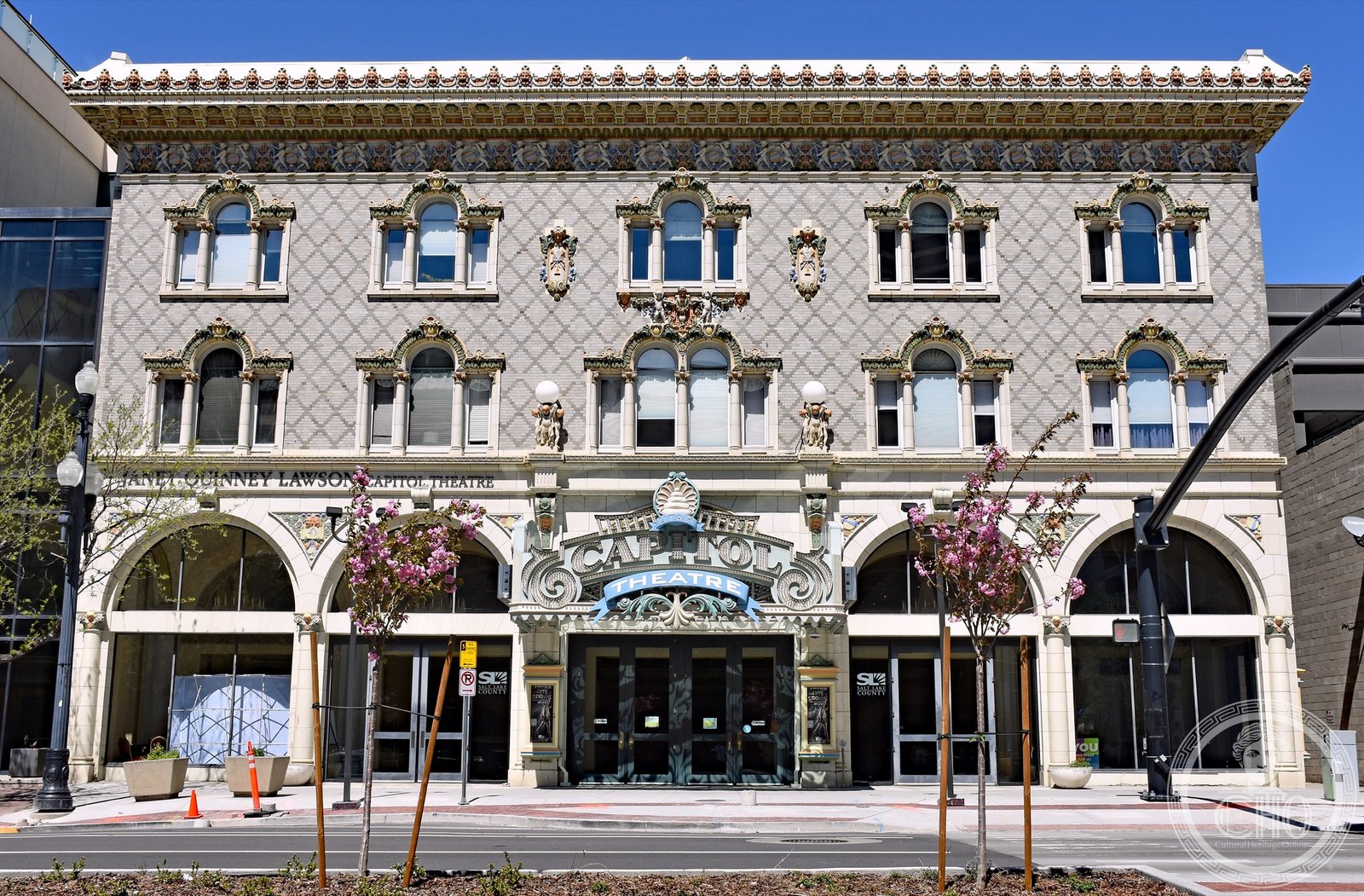
The Capitol Theatre in Salt Lake City is the anchor of Utah’s performing arts community — a restored 1913 Classical Revival theater on West 200 South that serves as home to Ballet West, Utah Opera, and Repertory Dance Theatre and represents the most important historic performing arts venue in the Intermountain West.
At a glance
The Capitol Theatre at 50 W 200 South in downtown Salt Lake City opened in 1913 under the name Orpheum Theatre, part of the national Orpheum vaudeville circuit. The building’s Classical Revival exterior and elegantly decorated interior were among the most sophisticated in the mountain West at the time of opening. Renamed the Capitol Theatre after the Orpheum association ended, the building underwent a comprehensive restoration in the 1970s that brought it to the attention of a new generation of arts patrons and established its role as Salt Lake City’s primary venue for resident performing arts organizations. Today the Capitol Theatre is home to Ballet West, Utah Opera, and Repertory Dance Theatre, and hosts visiting national companies.
Key facts
- Address: 50 W 200 South, Salt Lake City, UT 84101
- Opened: 1913 (as Orpheum Theatre)
- Style: Classical Revival / Adamesque
- Seating: approximately 1,880
- Listed: National Register of Historic Places
- Resident companies: Ballet West, Utah Opera, Repertory Dance Theatre
History
Salt Lake City’s position as the commercial hub of the Intermountain West made it a natural stop on the national vaudeville circuits that crisscrossed the country in the first decades of the twentieth century. The Orpheum Theatre, opened in 1913 as part of the Orpheum circuit’s expansion into western markets, was built to the standards of a first-class urban entertainment venue: Classical Revival architecture with elaborate plasterwork and a well-appointed auditorium capable of attracting the circuit’s top-billing performers.
As vaudeville declined in the 1920s, the theater transitioned to film exhibition and variety programming. Renamed the Capitol Theatre after the Orpheum affiliation ended, the building continued to serve Salt Lake City’s entertainment needs through the mid-century period before facing the same competitive pressures from suburban multiplexes that affected historic movie houses across the country. A restoration effort in the 1970s, supported by the state of Utah and the Salt Lake County arts community, returned the building to live performance use and established its current identity as the home of the region’s major performing arts organizations.
The Capitol Theatre sits within Salt Lake City’s compact downtown grid, laid out by Brigham Young to a block structure significantly larger than the standard American urban grid. Temple Square, headquarters of the Church of Jesus Christ of Latter-day Saints and one of the most visited sites in the western United States, is approximately three blocks north of the theater.
What you see
The Capitol Theatre’s 200 South facade presents a three-story Classical Revival composition with Adamesque detailing, featuring pilastered bays, decorative swags and urns in the frieze, and a modillioned cornice. The central entry bay projects slightly from the building face and is topped by a decorative panel with classical ornament. The building’s material palette of light brick and terracotta with cream-colored trim is characteristic of the Edwardian Classical manner applied to American commercial theater construction of the 1910s.
The restored interior follows the horseshoe plan typical of vaudeville-era theaters, with a deep balcony and stage adequate for opera and dance productions. The plasterwork in the auditorium was carefully conserved as part of the 1970s restoration, maintaining the decorative program of the original design.
Practical information
- Programming: Ballet West, Utah Opera, Repertory Dance Theatre; check ArtTix or company websites for current calendar
- TRAX access: TRAX light rail Green/Blue lines serve the Gallivan Plaza station, approximately 5 minutes on foot; Free Fare Zone covers the downtown TRAX corridor
- Parking: Gallivan Center and 200 South garages within walking distance
- Time needed: 15 minutes for the exterior; 2–3 hours for a performance
Getting there
The Capitol Theatre is at 50 W 200 South in downtown Salt Lake City, accessible from Salt Lake City International Airport (SLC) approximately 7 miles west via I-80; the TRAX light rail connects SLC airport to downtown. The 200 South TRAX corridor runs through the Free Fare Zone, making the theater accessible at no cost from major downtown hotels. Amtrak’s California Zephyr stops at Salt Lake City’s Union Pacific Depot.
Nearby
- Temple Square — headquarters of the Church of Jesus Christ of Latter-day Saints, including the Salt Lake Temple (1893) and the Tabernacle (1867); 3 blocks north and open to the public daily
- Utah Museum of Fine Arts (UMFA) — the state art museum at the University of Utah, approximately 4 miles east; the institution’s collection spans ancient to contemporary
- Gallivan Center — the outdoor public plaza at 200 S Main Street, directly adjacent; the site of summer festivals and the Salt Lake City Farmers Market
Sources
- Capitol Theatre, Salt Lake City (artshub.utah.gov)
- National Register of Historic Places nomination, Capitol Theatre
- Alexander, Thomas G. Utah, the Right Place: The Official Centennial History. Salt Lake City: Gibbs Smith, 1996.
Find it on the map
See this place and what’s around it →Record researched and written by Luigi De Marchi for Cultural Heritage Online, 2026.
📷 Become a Cultural Heritage Online photographer
Share your photos of places: they stay published under your name as the author. The more they're seen, the more you get noticed — and soon a contest will reward the most appreciated photos.
Log in or sign up free to add a photoIs this page about you?
This page is read by travellers and heritage enthusiasts who find it on Google. Tell us how you are connected to this place and we will take it from there.