
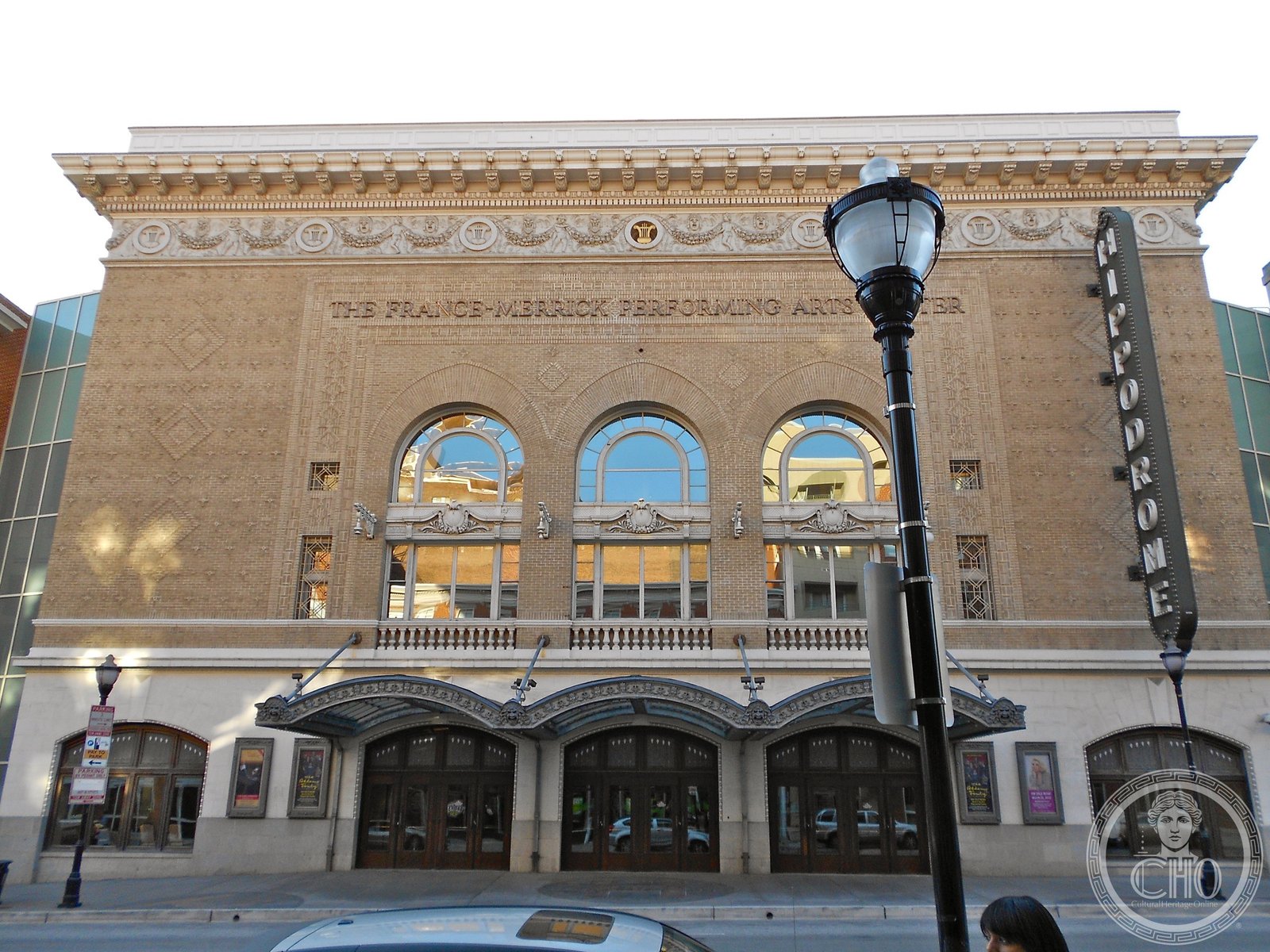
Opened in 1914 as Baltimore’s grand vaudeville palace, the Hippodrome Theatre on Eutaw Street is the surviving centerpiece of the France-Merrick Performing Arts Center, a landmark of Baltimore’s downtown cultural revival after a comprehensive restoration and expansion that reopened in 2004.
At a glance
The Hippodrome Theatre at 12 N Eutaw Street in downtown Baltimore opened in 1914 as a vaudeville and entertainment palace and established itself over the following decades as one of the premier variety and theatrical venues in the mid-Atlantic region. Following closure in 1990 and a decade of threatened demolition, a major public-private partnership restored and expanded the historic theater within the new France-Merrick Performing Arts Center, reopening in 2004. The Hippodrome now serves as Baltimore’s primary venue for Broadway touring productions, hosting the longest-running touring Broadway series on the East Coast.
Key facts
- Address: 12 N Eutaw Street, Baltimore, MD 21201
- Opened: 1914
- Style: Beaux-Arts / Classical Revival
- Seating: approximately 2,250
- Listed: National Register of Historic Places
- Closed: 1990; Reopened: 2004 as France-Merrick Performing Arts Center
- Current use: Broadway touring productions; the Hippodrome Foundation
History
The Hippodrome Theatre opened in May 1914 as a house dedicated to the Keith-Albee vaudeville circuit, offering variety entertainment to a Baltimore audience then served by a dense commercial entertainment district along Howard and Eutaw Streets. The Beaux-Arts Classical design, with its elaborate marquee and ornamental facade, positioned the Hippodrome as a prestige venue in a city with multiple competing entertainment palaces. Through the 1920s and 1930s the theater transitioned to film exhibition while maintaining a live entertainment component; by the postwar era it had become a film house.
The Hippodrome closed in 1990 as the downtown entertainment district declined and the theater’s infrastructure deteriorated. A period of advocacy and planning produced the France-Merrick Performing Arts Center project, which wrapped the historic theater building within a new construction that added back-of-house facilities, rehearsal space, and an expanded lobby complex. The restored Hippodrome auditorium, maintained at its historic scale of approximately 2,250 seats, reopened in 2004 and anchored the broader revitalization of the Bromo Seltzer Arts District on the west side of downtown Baltimore.
Baltimore’s position at the northern edge of the Chesapeake Bay and its history as a major port and industrial city shaped the character of its entertainment culture. The Hippodrome served a working-class as well as a middle-class audience through most of its history, and its vaudeville programming in the early decades brought performers of national stature — including Sophie Tucker, Jack Benny, and Bob Hope — to Baltimore stages.
What you see
The Hippodrome Theatre’s Eutaw Street facade presents a multi-story Beaux-Arts composition in terracotta and brick, with classical pilasters, decorative cornices, and arched openings organized around a projecting central bay. The street-level marquee and vertical sign structure identify the building from along Eutaw Street. The France-Merrick expansion, designed to integrate with the historic fabric, extends the public face of the complex along the block.
The restored auditorium interior preserves the horseshoe plan and ornamental plasterwork of the original Hippodrome, with a deep balcony providing elevated sight lines to the large proscenium stage. The technical infrastructure — lighting, rigging, acoustic systems — was comprehensively upgraded for Broadway touring productions while respecting the historic spatial character of the house.
Practical information
- Programming: Broadway touring productions and special events; check France-Merrick Performing Arts Center for current calendar
- Box office: open during performances and limited advance sale hours
- Metro access: Baltimore Light Rail and Metro SubwayLink serve downtown; the Convention Center station is approximately 5 minutes on foot
- Time needed: 15 minutes for the exterior; 2–3 hours for a performance
Getting there
The Hippodrome Theatre is at 12 N Eutaw Street in Baltimore’s Bromo Seltzer Arts District, near the intersection of Eutaw and Fayette Streets. Baltimore Penn Station is approximately 1.5 miles northeast, served by Amtrak and MARC commuter rail; the Light Rail Howard Street station is 5 minutes on foot. Baltimore/Washington International Airport (BWI) is approximately 10 miles south via I-95; a direct rail link from BWI to Penn Station is available.
Nearby
- Bromo Seltzer Arts Tower (1911) — Baltimore’s iconic clock tower, formerly the Emerson Drug Company headquarters; now studios for local artists, 3 minutes on foot at 21 S Eutaw Street
- Lexington Market (1782) — one of the oldest continuously operating public markets in the United States, 5 minutes on foot at 400 W Lexington Street
- Walters Art Museum — one of the few museums in the world to span antiquities through the nineteenth century in a single collection, at 600 N Charles Street, 15 minutes on foot northeast
Sources
- France-Merrick Performing Arts Center official site
- National Register of Historic Places nomination, Hippodrome Theatre
- Hayward, Mary Ellen and Charles Belfoure. The Baltimore Rowhouse. New York: Princeton Architectural Press, 1999.
Find it on the map
See this place and what’s around it →Record researched and written by Luigi De Marchi for Cultural Heritage Online, 2026.
📷 Become a Cultural Heritage Online photographer
Share your photos of places: they stay published under your name as the author. The more they're seen, the more you get noticed — and soon a contest will reward the most appreciated photos.
Log in or sign up free to add a photoIs this page about you?
This page is read by travellers and heritage enthusiasts who find it on Google. Tell us how you are connected to this place and we will take it from there.