
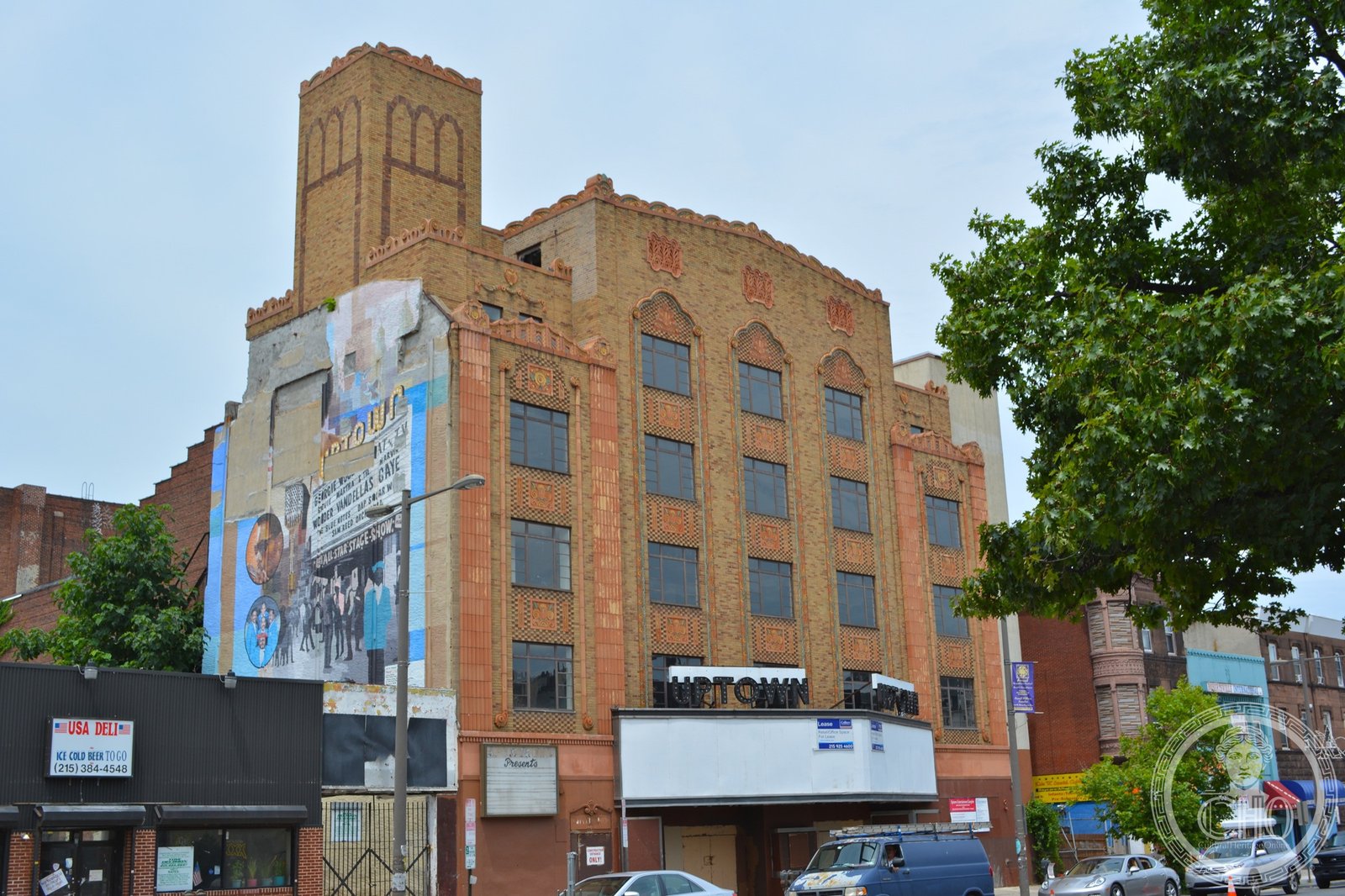
Built in 1929 as a North Philadelphia neighborhood cinema, the Uptown Theatre became in the 1960s one of the most important rhythm-and-blues performance venues in America, presenting James Brown, Stevie Wonder, Marvin Gaye, and The Temptations to sold-out houses before closing in 1978.
At a glance
The Uptown Theatre at 2240 N Broad Street in North Philadelphia opened in 1929 as an Art Deco neighborhood picture palace. From the mid-1950s through 1978, the Uptown functioned as the leading R&B and soul music venue in the Northeast, booking virtually every major African American recording artist of the era for residencies that shaped the development of popular American music. Listed on the National Register of Historic Places and designated a Philadelphia historic landmark, the theater is currently vacant and awaiting restoration, with several proposals for its revival having advanced at various points since the 1990s.
Key facts
- Address: 2240 N Broad Street, Philadelphia, PA 19132
- Opened: 1929
- Style: Art Deco
- Seating: approximately 1,800
- Listed: National Register of Historic Places; Philadelphia historic landmark
- Closed: 1978; currently vacant, restoration pending
- Notable programming: James Brown, Stevie Wonder, Marvin Gaye, The Temptations, Aretha Franklin
History
North Broad Street in the 1920s was a major commercial artery through Philadelphia’s densely populated North Philadelphia neighborhoods, and the Uptown Theatre opened in 1929 as a first-run neighborhood cinema in the Art Deco idiom then dominant in large American theater construction. The theater served its surrounding community as a film house through the studio system era.
The shift to live music programming in the 1950s transformed the Uptown into one of the most important concert venues in American popular music history. Working with promoter Herb Slotkin and later with national touring circuits, the Uptown presented the major African American artists of the 1950s through 1970s: James Brown, who performed marathon shows running four or more hours, recorded live albums that captured the Uptown’s particular energy; Stevie Wonder, Marvin Gaye, Aretha Franklin, The Temptations, and The Supremes all performed extended engagements. The Uptown occupied a position in the Northeast analogous to the Apollo Theatre in Harlem, serving as a proving ground for artists building national audiences and as a primary destination for Black Philadelphians in an era of systematic exclusion from other entertainment venues.
The theater closed in 1978 as live performance economics changed and the surrounding North Philadelphia neighborhoods experienced the deindustrialization and population loss that affected much of the urban North. The building has been vacant since then, and its deterioration is a recurring subject in Philadelphia’s ongoing debates about the preservation of African American cultural heritage sites.
What you see
The Uptown Theatre’s North Broad Street facade presents an Art Deco composition in brick and terracotta, with stylized geometric ornament at the upper levels and a projecting marquee at the ground floor that once carried the theater’s name and programming. The vertical proportions of the composition, with stepped upper sections and decorative cornices, are characteristic of the commercial Art Deco vocabulary of the late 1920s. The building’s current condition reflects decades of deferred maintenance, with the exterior deteriorated but the structural envelope substantially intact.
The auditorium interior has not been accessible since closure; preservation assessments have documented significant water intrusion and deterioration of the ornamental plasterwork. The theater’s restoration would require comprehensive structural and systems work alongside careful attention to the Art Deco decorative program.
Practical information
- Status: the Uptown Theatre is currently closed and not accessible to the public; the exterior is viewable from North Broad Street
- Exterior viewing: the North Broad Street facade can be seen from the sidewalk; the theater is 15 minutes on foot north of Temple University
- Context: the theater is best visited as part of a walk along North Broad Street’s historic commercial corridor
- Restoration updates: follow the Uptown Entertainment and Development Corporation for restoration progress
Getting there
The Uptown Theatre is at 2240 N Broad Street in North Philadelphia, accessible by SEPTA Broad Street Line (Orange Line) to Cecil B. Moore station, approximately 10 minutes on foot north. By car, the theater is approximately 2.5 miles north of Philadelphia City Hall via Broad Street; street parking is available in the surrounding blocks. Philadelphia International Airport (PHL) is approximately 9 miles southwest.
Nearby
- Temple University — one of the nation’s largest urban research universities, whose main campus on North Broad Street is 10 minutes on foot south; the Boyer College of Music is particularly relevant to the Uptown’s musical legacy
- Shibe Park / Connie Mack Stadium (demolished 1976) — the historic baseball stadium at 2601 N 20th Street (now a church) where the Philadelphia Athletics and Phillies played was a few blocks west; the neighborhood’s sporting and entertainment history converged in this section of North Philadelphia
- Philadelphia Museum of Art — Beaux-Arts landmark at the head of the Benjamin Franklin Parkway, 20 minutes on foot southwest; the Rocky Steps are the museum’s best-known exterior feature
Sources
- National Register of Historic Places nomination, Uptown Theatre
- Uptown Entertainment and Development Corporation
- Sullivan, James. The Hardest Working Man: How James Brown Saved the Soul of America. New York: Gotham Books, 2008.
- Benson, Kathleen and James Haskins. Rhythms of Black Life. New York: Alfred A. Knopf, 2001.
Find it on the map
See this place and what’s around it →Record researched and written by Luigi De Marchi for Cultural Heritage Online, 2026.
📷 Become a Cultural Heritage Online photographer
Share your photos of places: they stay published under your name as the author. The more they're seen, the more you get noticed — and soon a contest will reward the most appreciated photos.
Log in or sign up free to add a photoIs this page about you?
This page is read by travellers and heritage enthusiasts who find it on Google. Tell us how you are connected to this place and we will take it from there.