
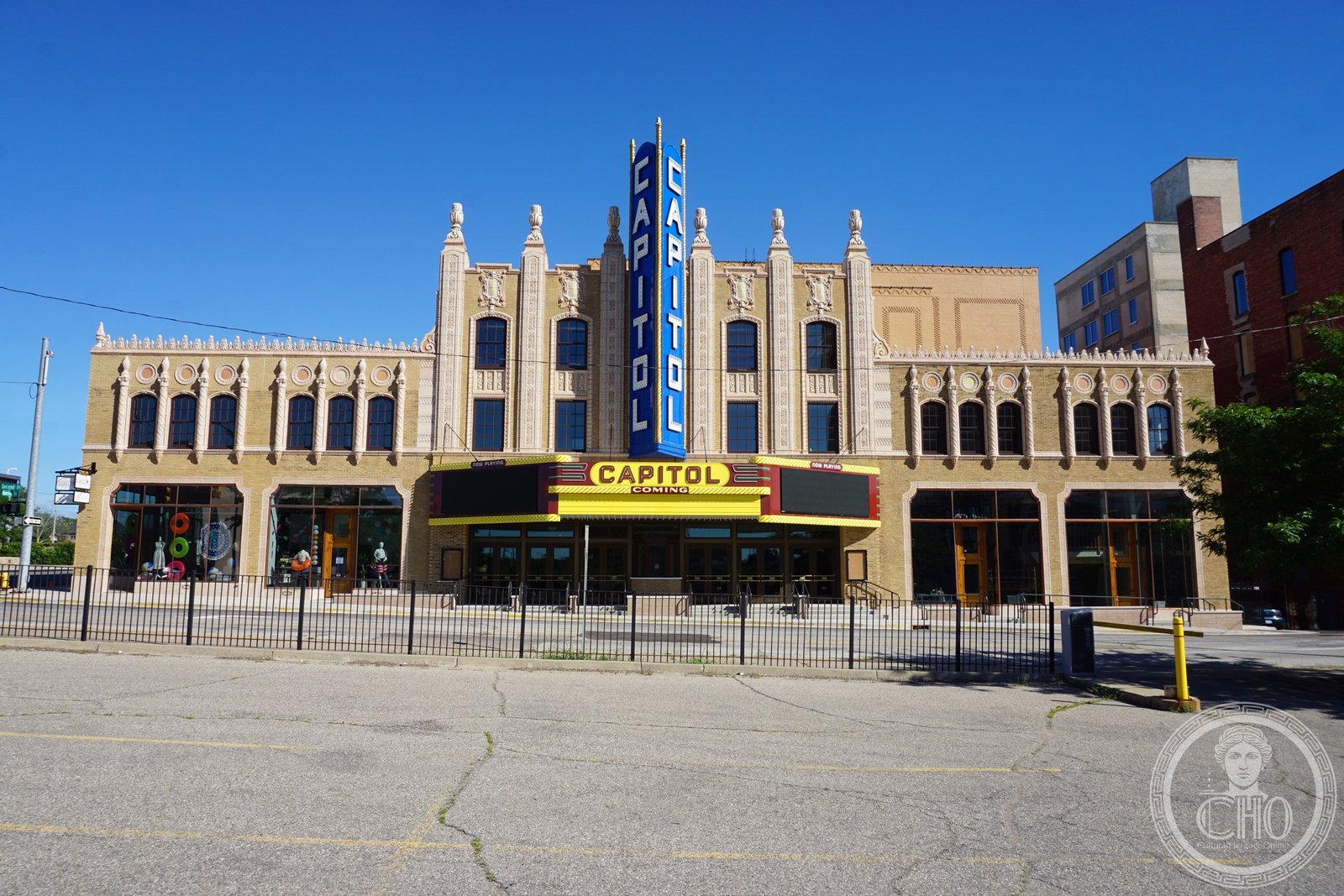
Built at the height of the Flint automobile economy in 1928, the Capitol Theatre brought a French Renaissance picture palace to Saginaw Street that has endured through the city’s economic reversals and is now undergoing restoration.
At a glance
The Capitol Theatre stands on North Saginaw Street in downtown Flint, Michigan, built in 1928 during the city’s peak years as the production center of the American automobile industry. At that moment, Flint’s General Motors plants employed tens of thousands of workers and the city’s downtown was one of the most commercially active in Michigan. The Capitol Theatre’s grand facade and elaborately decorated interior were a direct expression of that prosperity. Listed on the National Register of Historic Places, the theater closed in the late twentieth century and has been the focus of sustained restoration efforts backed by community organizations and philanthropic investment.
Key facts
- Address: North Saginaw Street, downtown Flint, MI 48502
- Opened: 1928
- Style: French Renaissance Revival / Classical Revival
- Capacity: approximately 1,700 seats (original)
- Listed: National Register of Historic Places
- Status: restoration in progress
- Significance: largest surviving movie palace in Genesee County
History
The Capitol Theatre opened in 1928, a year before the United States Automobile Club and two years before the Sit-Down Strike that would reshape American labor relations. In 1928 Flint was still at the apex of its automotive prosperity: General Motors Corporation, headquartered in Detroit but with its largest production operations in Flint, drove wages and consumer spending that supported a thriving downtown commercial district along Saginaw Street. The Capitol Theatre was the most ambitious entertainment venue in this district, seating nearly 1,700 patrons in an auditorium decorated with French Renaissance-inspired plasterwork, gilded coffered ceilings, and plush furnishings.
The theater operated through the 1930s depression and the wartime boom, but the post-war suburbanization and subsequent industrial contraction that struck Flint harder than almost any American city eventually eroded the downtown’s commercial base. The Capitol Theatre closed in the latter decades of the twentieth century. In the early twenty-first century, as Flint’s story became internationally known through the water crisis and ongoing urban recovery efforts, the Capitol Theatre became a focus for reinvestment. Restoration funding from community foundations, state historic preservation programs, and private donors has been assembled to return the theater to active use.
Flint’s automotive history is embedded in its urban fabric: the site of the 1936–37 Sit-Down Strike at the Fisher Body Plant No. 1 is a National Historic Landmark, and the Flint Cultural Center campus on Kearsley Street includes the Flint Institute of Arts and the Sloan Museum of Discovery.
What you see
The Capitol Theatre’s Saginaw Street facade presents a classical composition in brick and terracotta, with arched entrance bays at ground level and decorative pilasters rising through the upper stories. A projecting marquee canopy and vertical sign structure identify the building as a theater along the commercial streetscape. The ornamental vocabulary draws on French Renaissance motifs — cartouches, swags, and classical moldings — applied with the theatrical generosity typical of the Atmospheric and classical theater styles of the 1920s.
The interior retains significant historic fabric despite its years of closure, including decorative plasterwork in the lobby and portions of the auditorium. Restoration work has focused on stabilizing and recovering this material, with the goal of returning the theater to its original atmospheric grandeur.
Practical information
- Status: restoration in progress; not currently open for regular performances
- Exterior: the facade on N Saginaw Street is accessible for viewing at any time
- Updates: check local Flint arts organizations for news on the reopening timeline
- Nearby visit: combine with the Flint Cultural Center campus on Kearsley Street, 10 minutes on foot
Getting there
The Capitol Theatre is located on North Saginaw Street in downtown Flint, approximately 1 mile north of I-69 via I-475. Bishop International Airport (FNT) is approximately 5 miles southwest of downtown. Street parking is available along Saginaw Street and adjacent blocks; the downtown transit center is within walking distance.
Nearby
- Flint Institute of Arts — major regional art museum at 1120 E Kearsley Street, 10 minutes on foot east
- Sloan Museum of Discovery — local history museum adjacent to the Flint Institute of Arts on the Cultural Center campus
- Fisher Body Plant No. 1 (1936–37 Sit-Down Strike site) — National Historic Landmark at 923 W Hamilton Avenue, 15 minutes by car west
- Durant-Dort Carriage Company Office — National Historic Landmark where William Durant co-founded General Motors; 315 W Water Street, 5 minutes on foot
Sources
- National Register of Historic Places nomination, Capitol Theatre, Flint, Michigan
- Fine, Sidney. Sit-Down: The General Motors Strike of 1936–1937. Ann Arbor: University of Michigan Press, 1969.
- Highsmith, Andrew R. Demolition Means Progress: Flint, Michigan, and the Fate of the American Metropolis. Chicago: University of Chicago Press, 2015.
Find it on the map
See this place and what’s around it →Record researched and written by Luigi De Marchi for Cultural Heritage Online, 2026.
📷 Become a Cultural Heritage Online photographer
Share your photos of places: they stay published under your name as the author. The more they're seen, the more you get noticed — and soon a contest will reward the most appreciated photos.
Log in or sign up free to add a photoIs this page about you?
This page is read by travellers and heritage enthusiasts who find it on Google. Tell us how you are connected to this place and we will take it from there.