
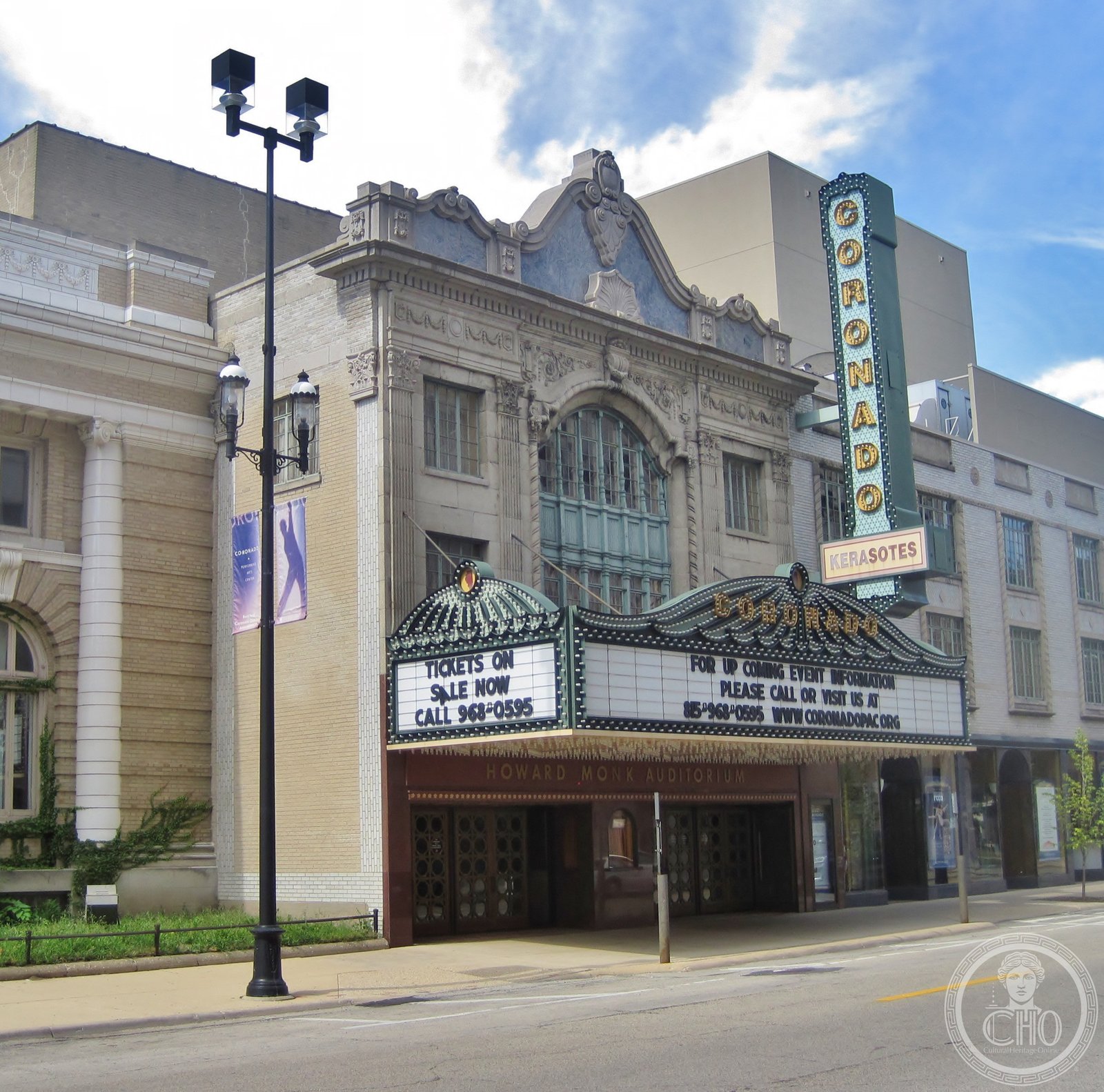
John Eberson—the architect who invented the atmospheric theater concept—applied his full Spanish-Moorish fantasy to the Coronado in 1927, giving Rockford an auditorium where the seats face a simulated Andalusian night sky and the side walls recede into plaster towers and arches; the Coronado survives as one of the best-preserved examples of Eberson’s atmospheric work anywhere in America.
At a glance
The Coronado Theatre on North Main Street is Rockford, Illinois’s most celebrated architectural landmark—a 1927 movie palace designed by John Eberson, the architect who developed the atmospheric theater format and built hundreds of examples of it across the United States through the 1920s. The Coronado is considered one of his finest surviving works: the auditorium ceiling simulates an open Spanish sky at dusk with stars and drifting clouds, the side walls present an elaborate Moorish courtyard in plaster, and the entire interior was executed with a richness of detail and consistency of design that sets the building apart from simpler applications of the atmospheric formula. Restored and operating as a performing arts center, the Coronado today serves Rockford as an entertainment venue and a testament to the ambition of the picture palace era.
Key facts
- Address: 314 N Main Street, Rockford, IL 61101
- GPS: 42.2711° N, 89.0940° W
- Built: 1927
- Architect: John Eberson
- Style: Atmospheric theater / Spanish-Moorish Revival
- Capacity: approximately 2,700 seats
- Status: Active performing arts venue (Coronado Performing Arts Center)
- NRHP: Listed on National Register of Historic Places
History
John Eberson developed the atmospheric theater concept in the early 1920s, building on a premise that an audience watching films would enter a more receptive, imaginative state if the auditorium itself created the feeling of being outdoors at night in an exotic, romantic location. His first major atmospheric theater opened in Houston in 1923; by 1927, when the Coronado was commissioned in Rockford, he had built dozens of examples across the country and refined his design vocabulary to a high degree of fluency.
Rockford’s position as a major manufacturing city in northern Illinois—second only to Chicago in population—supported the investment a first-class picture palace required in 1927. The Coronado was commissioned for a city whose industrial base in machine tools, furniture, and textiles was at its peak. Eberson’s design for the Coronado deployed the full Spanish-Moorish atmospheric vocabulary: the auditorium presents a Moorish palace courtyard open to the sky, with tiered balconies and arched colonnades on the side walls, decorative towers breaking the roofline, and the ceiling open to a blue-black field of stars and drifting cloud forms. The Spanish-Moorish theme was one of Eberson’s preferred formulas—the plasterwork vocabulary of Andalusia provided an architectural language sufficiently exotic to feel escapist while remaining legible enough for a Midwestern audience to read as “old world beauty.”
The Coronado ran first-run Hollywood programming through the studio era. It was saved from demolition through community advocacy and has undergone multiple restoration phases since the 1980s. The Coronado Performing Arts Center operates the building today, programming concerts, theater productions, comedy, and community events. The atmospheric interior—plasterwork, ceiling painting, balcony detailing—was restored to a condition that reflects Eberson’s original design intent with considerable fidelity.
What you see
The North Main Street facade presents a commercial composition in brick and terra cotta that announces the theater’s presence with a vertical sign and marquee without the full architectural statement that a freestanding theater might offer—the Coronado occupies a building within the downtown streetwall. The entrance portal carries Moorish detail in the arch moldings and decorative tile inserts that introduces the Spanish theme before the auditorium begins its full performance.
Inside, the atmospheric illusion is immediate and complete. The auditorium side walls are built and painted to simulate a Moorish palace exterior: crenellated towers, arched colonnades with carved plaster column capitals, niches with decorative urns and figures, and receding balcony tiers that suggest a deep Andalusian courtyard. The ceiling overhead is painted dark blue and dotted with electric stars behind a scrim that produces their atmospheric depth. Cloud machines could project drifting cloud forms across the ceiling surface, completing the outdoor-sky illusion. The proscenium arch carries Moorish ornamental plasterwork in high relief, framing the stage with confidence and symmetry. The Coronado is large enough that the atmospheric details read clearly from the rear of the house—a mark of Eberson’s skill in calibrating the scale of ornament to the viewing distance of the audience.
Practical information
- The Coronado Performing Arts Center books concerts, Broadway touring productions, comedy, and special events; check coronadopac.com for the current calendar.
- Tours of the atmospheric interior are offered on selected dates; contact the box office for the current tour schedule.
- Fully accessible; ADA seating at orchestra level and mezzanine.
- Parking along Main Street and in downtown Rockford parking structures.
- Arrive well before curtain to inspect the atmospheric plasterwork at close range before the house lights dim.
Getting there
The Coronado Theatre is at 314 N Main Street in downtown Rockford, Illinois, 90 miles northwest of Chicago via I-90 (Jane Addams Tollway). From Chicago, allow 90 minutes by car accounting for toll plaza traffic. Rockford-Chicago Passenger Rail connects the two cities with Amtrak service to Rockford Station (Union Pacific Depot, 1 mile from the theater). Chicago O’Hare Airport is the nearest major airport, 75 miles southeast via I-90. Downtown Rockford has adequate surface and structure parking within two blocks of the theater on Main and State Streets.
Nearby
- Rockford Art Museum (1 block west): the regional art museum at 711 N Main Street holds American and European collections with particular strength in prints and drawings.
- Discovery Center Museum (0.5 miles north): the children’s science museum on N Madison Street includes interactive exhibits on the engineering and manufacturing history that built Rockford’s industrial base.
- Tinker Swiss Cottage (1 mile north): the 1865 home built by Robert Hall Tinker in the Swiss chalet style is a designated National Historic Landmark and one of the few surviving examples of the style in the Midwest.
- Midway Village Museum (5 miles east): the museum’s outdoor living history component recreates early 20th-century Rockford; its collection documents the machine tool and hardware manufacturing that funded the Coronado’s commission.
Sources
- Coronado Performing Arts Center, coronadopac.com — venue history and tour information
- National Register of Historic Places, “Coronado Theatre Rockford” nomination
- Cinema Treasures, “Coronado Theatre, Rockford” database entry
- Illinois Historic Preservation Agency records
Find it on the map
See this place and what’s around it →Record researched and written by Luigi De Marchi for Cultural Heritage Online, 2026.
📷 Become a Cultural Heritage Online photographer
Share your photos of places: they stay published under your name as the author. The more they're seen, the more you get noticed — and soon a contest will reward the most appreciated photos.
Log in or sign up free to add a photoIs this page about you?
This page is read by travellers and heritage enthusiasts who find it on Google. Tell us how you are connected to this place and we will take it from there.