
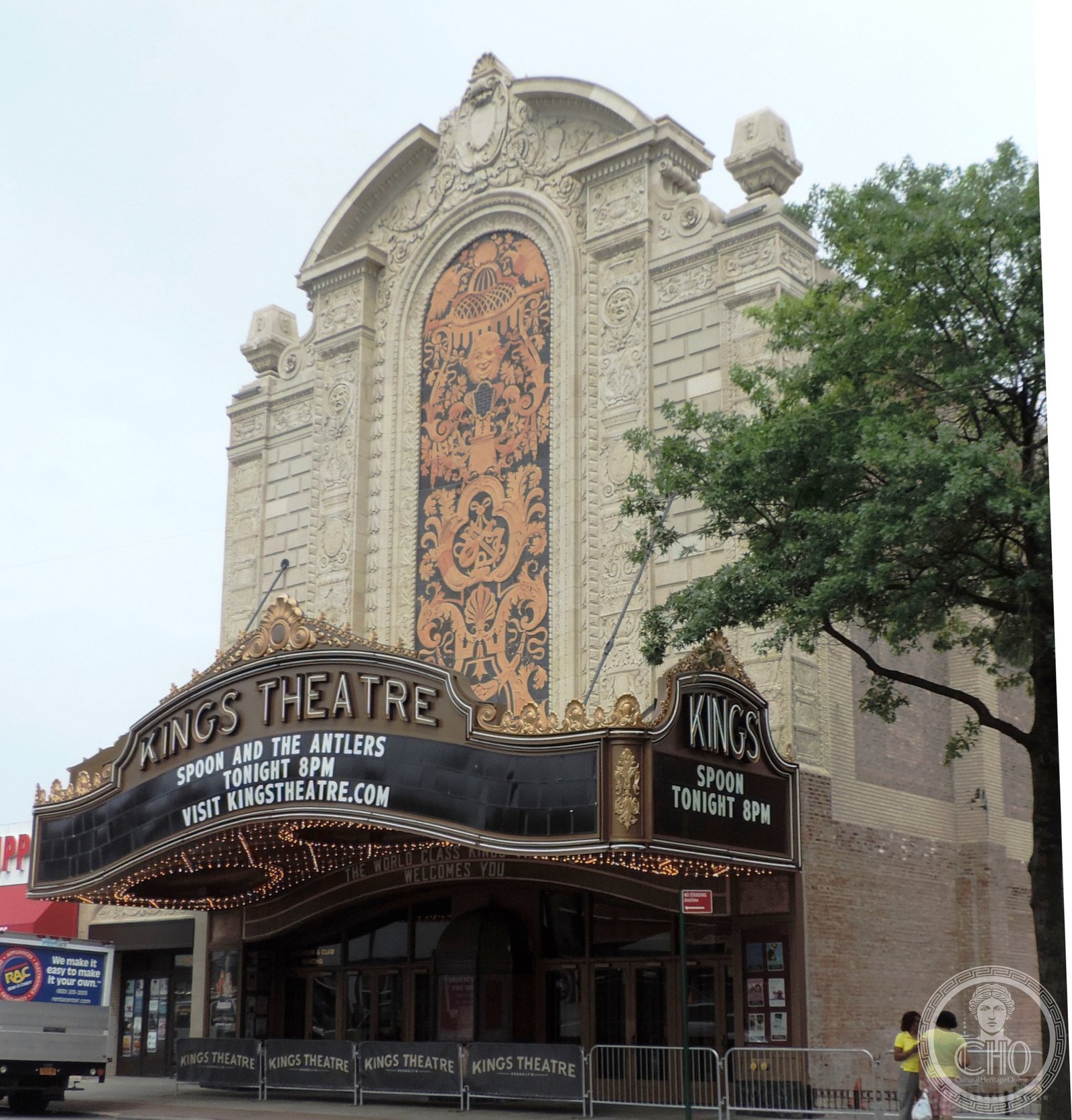
The Kings Theatre was one of the five “Wonder Theatres” that Loew’s built across New York City and New Jersey in 1929—palaces on the scale of grand opera houses dropped into working-class neighborhoods—and after three and a half decades of abandonment it returned in 2015 as one of the most gloriously restored movie palaces in America.
At a glance
The Kings Theatre stands at 1027 Flatbush Avenue in the Flatbush neighborhood of Brooklyn, a massive movie palace whose French Baroque and Italian Renaissance interior was designed to overwhelm the daily visual experience of its working-class audience. Designed by Rapp & Rapp and opened in December 1929, the Kings was the anchor of a chain of five “Wonder Theatres” that Loew’s built simultaneously across the metropolitan area. It seated over 3,000 people and was one of the largest theaters in the United States. After closing in 1977 it sat abandoned for 38 years, its ornate interior slowly deteriorating behind boarded facades. A $95 million restoration completed in 2015 returned the auditorium to a condition that surpasses its original appearance; the Kings now operates as a concert and performing arts venue serving the Flatbush community it first served in 1929.
Key facts
- Address: 1027 Flatbush Avenue, Brooklyn, NY 11226
- GPS: 40.6485° N, 73.9592° W
- Built: 1929
- Architects: Rapp & Rapp (C.W. & George Rapp)
- Style: French Baroque / Italian Renaissance Revival
- Capacity: approximately 3,200 seats
- Restored: 2015, $95 million
- Status: Active concert and performing arts venue
- NRHP: Listed on National Register of Historic Places
History
Loew’s Theatres entered 1929 with an ambition to build five major picture palaces simultaneously—one each in the Bronx, Queens, Brooklyn, New Jersey, and Upper Manhattan—at a moment when the picture palace format was at its commercial peak and before the Depression would end that era of investment. The brief was explicit: theaters as large and as opulent as anything in Broadway or Times Square, sited in the residential neighborhoods of the outer boroughs and New Jersey where working-class audiences lived and where the transit infrastructure could deliver them cheaply.
Rapp & Rapp received the commission for the Kings and Jersey City buildings. The Kings on Flatbush Avenue was the flagship of Brooklyn’s entertainment corridor—a neighborhood that had developed rapidly through the 1920s as subway lines connected it to Manhattan. The theater’s exterior, with its Flatbush Avenue facade of white terra cotta, signaled its ambitions before audiences entered. Inside, the lobby and auditorium deployed French Baroque ornament on the scale of state architecture: coffered ceilings, gilded plasterwork, colonnaded balconies, and a proscenium arch scaled to a 3,200-person house.
The Kings ran first-run Hollywood films through the 1940s and 1950s. As Flatbush declined through the 1960s—white flight, urban disinvestment, the suburban migration of its original audience—the theater struggled to maintain programming. It closed in 1977 and was subsequently vandalized and deteriorated through exposure. For 38 years the Kings sat empty, a spectacular ruin on Flatbush Avenue. The city and a nonprofit coalition assembled funding for a $95 million restoration completed in 2015; the contractor preserved and restored original plasterwork where possible and replicated missing elements from historical records. The reopened Kings now books major touring acts and community events, returning the role the original theater played in the neighborhood.
What you see
The Flatbush Avenue facade extends across a full city block, its white terra cotta composition presenting arched entrance portals, full-height pilasters, and an attic story with decorative panels. The marquee and vertical sign anchor the middle of the elevation. The scale is civic rather than commercial—this is a building designed to read as an institution from across the street, not as a storefront among storefronts.
Inside, the lobby deploys the vocabulary of French Baroque state rooms: pilasters with gilded capitals, coffered vault overhead, marble floors, and chandeliers of operatic scale. The auditorium is the most elaborate expression of the Wonder Theatre brief: gilded plaster walls articulated as colonnaded arcades and balustrades, a ceiling painted and modeled in coffered panels, and a proscenium arch that frames the stage with the confidence of an opera house. The 2015 restoration returned the gilding, repaired the plasterwork, and rebuilt the original chandelier system. The result is one of the most intact expressions of the late picture palace aesthetic surviving in American entertainment architecture.
Practical information
- Kings Theatre is an active concert venue; check kingstheatre.com for the current season calendar.
- Events range from major pop and hip-hop touring acts to classical concerts and film screenings.
- Fully accessible; ADA seating at orchestra and mezzanine levels.
- Several bars and concession areas in the lobby during events.
- The lobby and foyer are worth an extended pre-show visit; arrive 30-40 minutes early to study the restored ornament without the crowd.
Getting there
Kings Theatre is at 1027 Flatbush Avenue in Flatbush, Brooklyn, served by the B and Q subway lines at Newkirk Avenue station (one block south) or Church Avenue station (two blocks north). From Midtown Manhattan, take the Q train from Times Square or Herald Square south to Newkirk Avenue, approximately 35 minutes. From JFK Airport, take the AirTrain to Jamaica, then the Q train to Flatbush; total approximately 50 minutes. Street parking is limited on Flatbush Avenue; the Kings Flatbush parking garage on Marlborough Road is the nearest structured option.
Nearby
- Brooklyn Museum (1.5 miles north): one of the largest art museums in the United States, with strong collections of Egyptian, American, and feminist art.
- Prospect Park (1 mile north): Frederick Law Olmsted’s 585-acre Brooklyn park; the Boathouse and band shell are adjacent to the park’s eastern edge.
- Brooklyn Botanic Garden (1.5 miles north): 52 acres of cultivated garden including a renowned Japanese hill-and-pond garden and cherry allée.
- Loew’s Jersey Theatre, Jersey City (across the Hudson): the sister Wonder Theatre built simultaneously by Rapp & Rapp in 1929, now under intermittent restoration.
Sources
- Kings Theatre, kingstheatre.com — venue history and restoration documentation
- National Register of Historic Places, “Kings Theatre, Brooklyn” nomination
- Cinema Treasures, “Kings Theatre, Brooklyn” database entry
- New York City Landmarks Preservation Commission, Kings Theatre designation report
Find it on the map
See this place and what’s around it →Record researched and written by Luigi De Marchi for Cultural Heritage Online, 2026.
📷 Become a Cultural Heritage Online photographer
Share your photos of places: they stay published under your name as the author. The more they're seen, the more you get noticed — and soon a contest will reward the most appreciated photos.
Log in or sign up free to add a photoIs this page about you?
This page is read by travellers and heritage enthusiasts who find it on Google. Tell us how you are connected to this place and we will take it from there.