Anuradhapura served as the capital of Sri Lanka from 380 BCE to 1017 CE — over thirteen centuries of continuous royal occupation — and remains one of the most concentrated ancient monument complexes in Asia. Ten UNESCO-protected structures stand within its sacred precinct, including a stupa whose dome measures 103 metres in diameter and a living Bodhi tree planted in 288 BCE. Three additional UNESCO World Heritage Sites lie within 215 kilometres, making northern and central Sri Lanka one of the densest heritage corridors in South Asia.
Anuradhapura: Capital for Thirteen Centuries Sacred Precinct — on-site
Sri Lanka’s first recorded capital city received UNESCO World Heritage status in 1982, protecting a complex that had already been functioning as a royal and religious centre for more than a millennium before it was sacked by the South Indian Chola dynasty in 1017 CE. Ten monuments within the sacred precinct fall under the inscription’s protection, and the urban fabric they inhabit extended at its peak across an estimated 40 square kilometres.
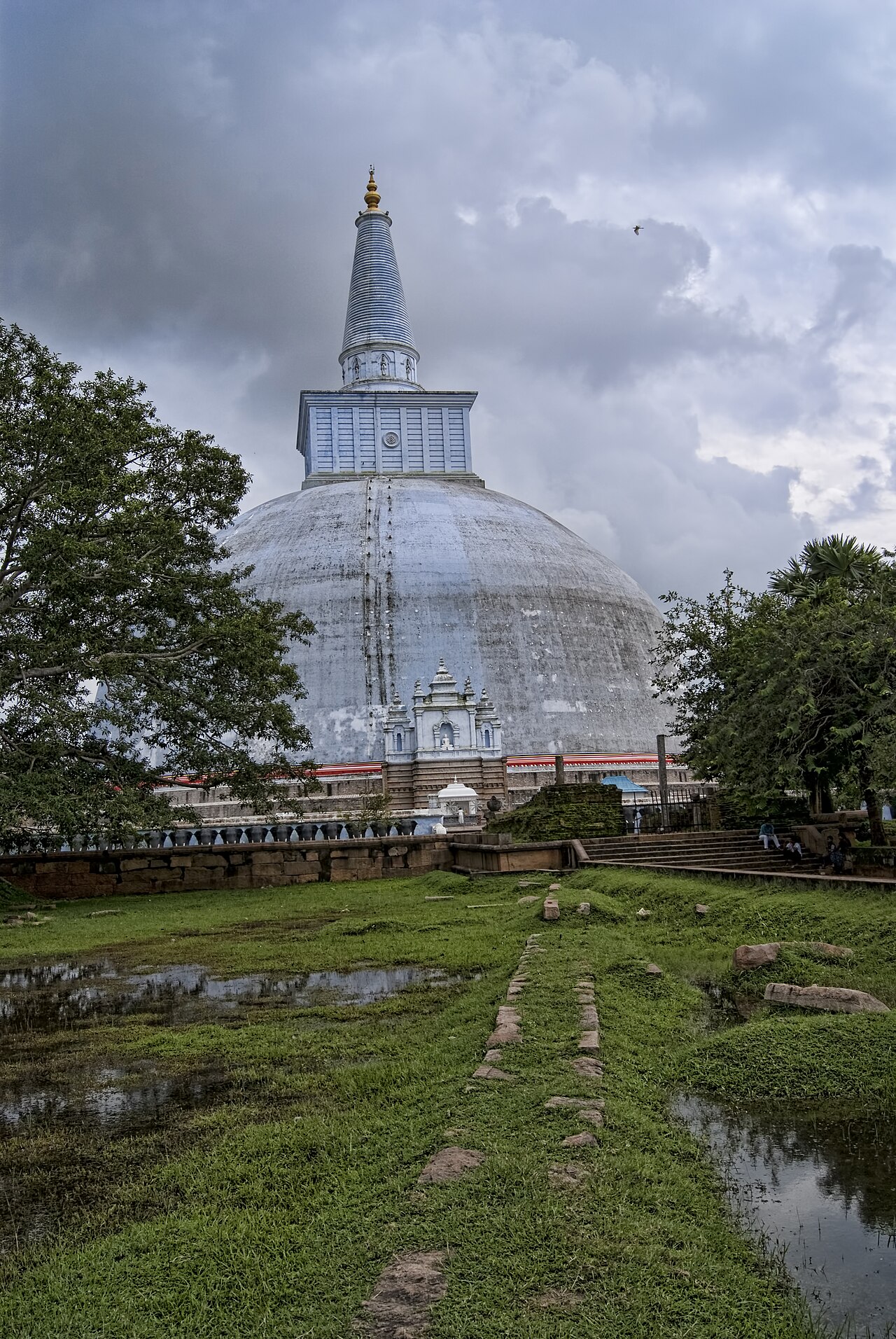
The Ruwanwelisaya Stupa stands as the precinct’s most visible structure: a white dome 103 metres in diameter and currently 55 metres tall (partial restoration from a greater original height), built by King Dutugamunu between 161 and 137 BCE. Dutugamunu had unified the island by defeating the South Indian king Elara at the Battle of Vijithapura in 161 BCE, and construction of the stupa — intended to enshrine relics of the Buddha — began the same year. Ancient chronicles record that the king died before its completion; his son Saddha Tissa finished it. The stupa’s elephant wall, a frieze of 338 stone elephants encircling the base, survives intact.
Older still is the Thuparama Dagoba, the earliest surviving dagoba in Sri Lanka, raised in the 3rd century BCE by King Devanampiya Tissa to enshrine the right collar bone of the Buddha — a relic sent from the Mauryan Emperor Ashoka’s court in India. It was originally constructed in the bell shape that became canonical across Southeast Asia. The monument has been rebuilt and modified several times since antiquity, but the site itself has received continuous veneration for over two thousand years.
At the north end of the sacred city stands the Jetavanaramaya, built during the reign of King Mahasena in the 3rd century CE. At its original height of approximately 122 metres, it ranked as the third tallest structure in the ancient world, behind only the Great Pyramid of Giza and the Red Pyramid. Today 71 metres of the stupa survive. Construction required an estimated 93 million baked bricks — the largest quantity deployed in any single pre-modern structure in South Asia outside of Egypt.
The Sri Maha Bodhi, the Sacred Bodhi Tree, occupies a separate category: it is neither masonry nor sculpture, but a living organism with a documented history stretching back to 288 BCE. Buddhist chronicles record that Princess Sanghamitta, daughter of the Mauryan Emperor Ashoka, carried a sapling from the original Bodhi tree at Bodh Gaya — the tree under which Siddhartha Gautama attained enlightenment — to Sri Lanka at the invitation of King Devanampiya Tissa. The sapling was planted at Anuradhapura and has been under continuous monastic care ever since. At over 2,300 years old, it is the oldest historically documented tree in the world; its genealogy is unbroken in written records from the Mahavamsa, the Great Chronicle of Sri Lanka compiled in the 5th century CE. The original Bodhi tree at Bodh Gaya was destroyed in the 7th century CE, making the Anuradhapura tree the oldest surviving specimen of the line.
Polonnaruwa and Sigiriya 100 km east and 85 km southeast by road
The ancient city of Polonnaruwa lies approximately 100 kilometres east of Anuradhapura along the A11 road, a drive of roughly two hours. Polonnaruwa received UNESCO inscription in 1982 in the same year as Anuradhapura, and the two cities represent consecutive chapters in Sri Lankan political history: when the Chola invasion ended Anuradhapura’s dominance in 1017 CE, Polonnaruwa became the island’s second capital, a role it held until 1215 CE.
The most photographed monument at Polonnaruwa is Gal Vihara, a 12th-century rock temple in which four colossal Buddhist figures were carved from a single face of granite. The largest — a 14-metre reclining Buddha in the parinirvana (final passing) posture — and a 7-metre standing figure are the largest carved-stone Buddhist images in Sri Lanka. The seated Buddha measures 4.6 metres and the smaller seated figure 1.5 metres. The carvings were commissioned under King Parakramabahu I (r. 1153–1186 CE), whose reign saw the construction or consolidation of approximately 12,000 irrigation tanks across the dry zone. The Parakrama Samudra — the Sea of Parakrama — is his largest surviving hydraulic project: a reservoir covering 22 square kilometres that remains in agricultural use today.
Sigiriya, 85 kilometres southeast of Anuradhapura, is a granite inselberg rising 200 metres above the surrounding plains. King Kashyapa I built his palace on its summit between 477 and 495 CE after killing his father, King Dhatusena, and seizing the throne. The site’s hydraulic gardens, covering 40,000 square metres at the base of the rock, include gravity-fed fountains that still operate during the rainy season — the only ancient fountain system still functional in Asia. A sheltered gallery halfway up the cliff face preserves 22 frescoes depicting women, likely members of the royal court or apsaras; these are among the best-preserved ancient paintings in South Asia, painted in natural mineral pigments at an elevation of approximately 100 metres above ground. The polished Mirror Wall below the frescoes carries over 600 Sinhala-language graffiti inscriptions, dating from the 8th to 10th centuries CE, that constitute some of the oldest surviving literary texts in the Sinhala language.
Kandy 210 km south of Anuradhapura by road
The Sacred City of Kandy, 210 kilometres south of Anuradhapura on the A9 and A1 highways (approximately four to five hours by road), received UNESCO inscription in 1988. It served as the last capital of the Sinhalese kings from 1592 to 1815, when the British annexed the Kandyan Kingdom under the Kandyan Convention — the final independent Sri Lankan polity to fall to colonial administration.
The Temple of the Tooth Relic (Dalada Maligawa) is the centrepiece of Kandy’s UNESCO-protected core zone. It houses the left canine tooth of Siddhartha Gautama, reportedly brought to Sri Lanka in the 4th century CE by Princess Hemamala concealed in her hair. Across the long history of Sri Lankan kingship, possession of the relic was understood to confer the right to rule; any king who held it commanded greater political legitimacy. The temple complex as it stands today was largely built or reconstructed between the 17th and 19th centuries, though the site’s association with the relic is attested from the 4th century onwards. Daily puja ceremonies — offerings of flowers, incense, and drumming — occur three times per day and are open to visitors outside of ceremony periods.
The annual Esala Perahera, held in July or August over ten nights, is among the largest Buddhist processions in the world. Dozens of elaborately caparisoned elephants process through the city, and the relic casket — though not the relic itself — is carried among them. Attendance at the procession runs into the hundreds of thousands. The surrounding Udawattekele Sanctuary, a 104-hectare forest reserve adjacent to the royal palace grounds, shelters giant squirrels, purple-faced langurs, and several endemic bird species within the urban perimeter.
Practical information
Anuradhapura is best visited between December and April, when the North Central Province receives minimal rainfall and temperatures remain manageable at 26–32°C. The monsoon season (May–September) brings heavy rain but also reduced crowds. The sacred precinct requires modest dress — shoulders and knees covered — and shoes must be removed before entering temple platforms; carry a cloth bag for footwear. The nearest international airport is Bandaranaike International Airport (CMB) at Colombo, approximately 200 kilometres south on the A13 highway (roughly four hours by road). Intercity bus and rail services connect Colombo to Anuradhapura; the train journey on the Northern Line takes approximately four to five hours and terminates at Anuradhapura railway station, within walking distance of the main monuments.
Sri Lanka’s standard tourist visa (Electronic Travel Authorisation, ETA) is available online for citizens of most countries at a cost of USD 20 for a 30-day single-entry visa. Citizens of SAARC countries receive a free visa on arrival. The local currency is the Sri Lankan Rupee (LKR); major monuments charge separate entry fees, and a Cultural Triangle Round Ticket covering Anuradhapura, Polonnaruwa, Sigiriya, Dambulla, and Kandy offers savings for visitors planning to tour multiple sites. Accommodation in Anuradhapura ranges from guesthouses near the railway station to mid-range hotels adjacent to the archaeological zone.
Frequently Asked Questions
How old is the Sacred Bodhi Tree at Anuradhapura, and is it really the oldest tree in the world?
The Sri Maha Bodhi at Anuradhapura was planted in 288 BCE according to the Mahavamsa, the Pali-language chronicle of Sri Lankan royal and Buddhist history compiled in the 5th century CE. That would make the tree approximately 2,312 years old as of 2024. The distinction “oldest historically documented tree in the world” applies specifically to trees whose planting date is recorded in written historical sources, not trees whose age has been estimated through dendrochronology or radiocarbon dating. Several trees measured through scientific dating methods — including a Bristlecone Pine in California dated to over 5,000 years old — are older in absolute terms, but their planting dates are not recorded in any historical document. The Sri Maha Bodhi’s recorded lineage, traceable through Buddhist chronicles to 288 BCE, is what makes it unique. The tree’s significance is further amplified by the fact that the original Bodhi tree at Bodh Gaya in India — the tree under which Buddhist tradition holds that Siddhartha Gautama attained enlightenment — was destroyed during the 7th century CE, making the Anuradhapura specimen the oldest surviving tree of that particular lineage. The Sri Maha Bodhi is maintained by monks of the Mahiyangana tradition and is surrounded by a golden fence; visitors may circumambulate the enclosure and offer flowers and incense.
What was the Jetavanaramaya’s original height, and why did it collapse?
Ancient inscriptions and the Mahavamsa record that the Jetavanaramaya stupa, built during the reign of King Mahasena (r. 277–304 CE), originally stood approximately 122 metres tall — a height that, at the time of construction, made it the third tallest structure ever built, behind only the Great Pyramid of Giza (146.5m original) and the Red Pyramid at Dahshur (105m). Today only 71 metres survive. The stupa was not so much destroyed as it was degraded over a millennium of abandonment: after Polonnaruwa replaced Anuradhapura as the capital in 1017 CE, the sacred precinct fell into disuse, vegetation encroached, and the laterite and brick core of the stupa suffered from root damage, rainwater infiltration, and the weight of accumulated debris. Partial restoration efforts began in the colonial era and have continued since independence in 1948. The stupa is estimated to contain approximately 93 million baked bricks — each brick individually fired in kilns, a logistical operation requiring organised labour on a scale comparable to the construction of the Egyptian pyramids. Archaeological excavation inside the stupa in the 1980s recovered a relic chamber containing gold, silver, and crystal objects, now displayed in the Jetavanaramaya Museum on site.
Can visitors enter the main temples and monuments at Anuradhapura?
Access to the Anuradhapura sacred precinct is managed by the Central Cultural Fund of Sri Lanka. Most of the ten UNESCO-protected monuments are freely accessible on foot or by bicycle — bicycle rental is widely available near the railway station and the main gate. The Ruwanwelisaya Stupa, the Thuparama Dagoba, and the precincts around the Sri Maha Bodhi are active places of worship; visitors are welcome but must remove footwear at the boundary markers (usually a white-painted line or a stone threshold) and dress appropriately with covered shoulders and knees. Photography is permitted at most monuments, though photographing worshippers or monks at close range without permission is considered intrusive. The Sri Maha Bodhi enclosure requires quiet behaviour and the purchase of an entry ticket separate from the Cultural Triangle Round Ticket. The Jetavanaramaya and Abhayagiri Dagoba complexes both have adjacent museums that are worth visiting before walking the stupa precincts, as they provide archaeological context that the outdoor monuments alone do not supply. Opening hours vary by monument but most are accessible from approximately 06:00 to 18:00 daily.