
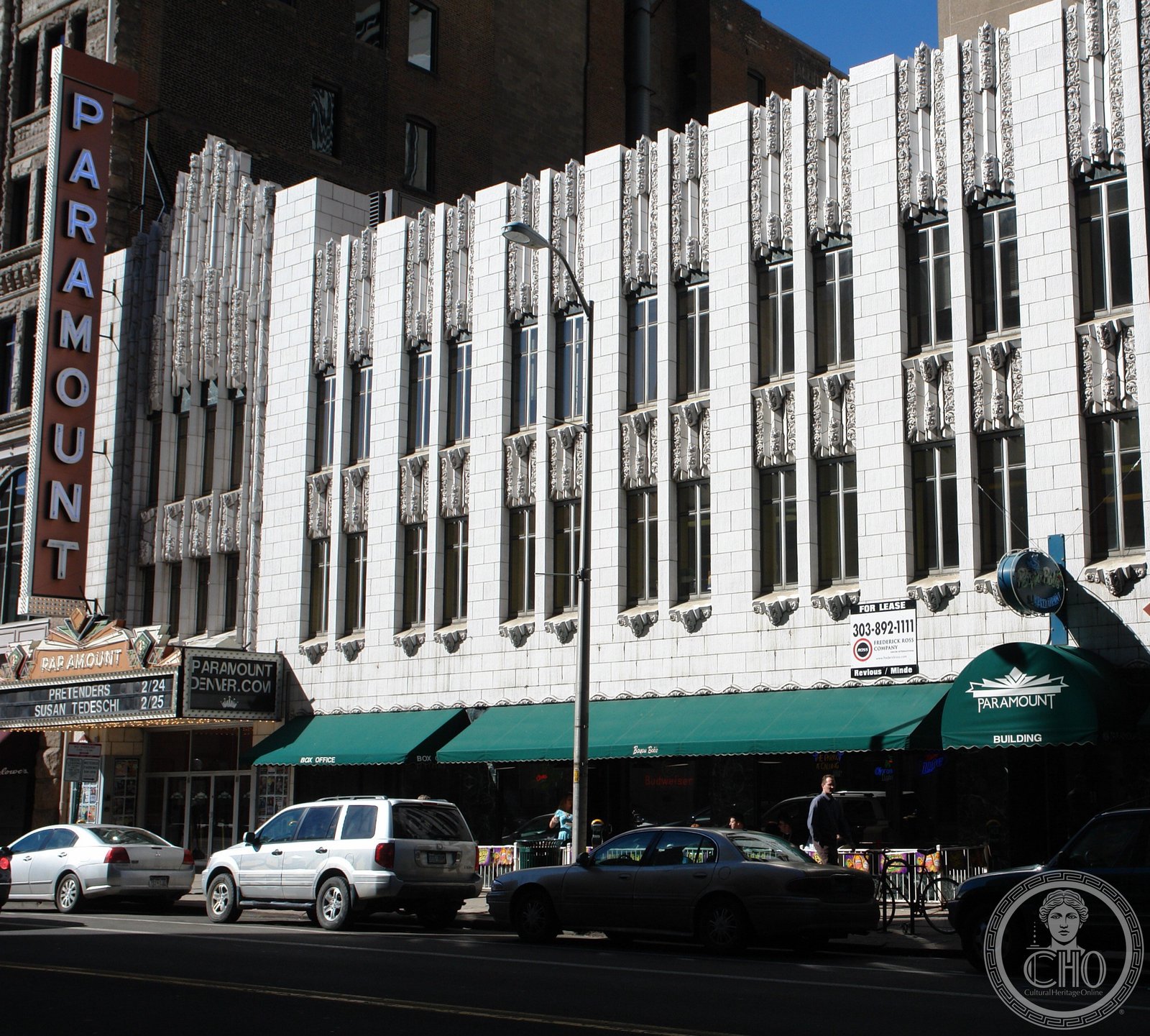

Denver’s finest Art Deco performance space has outlasted the movie-palace era to become one of the Rocky Mountain region’s premier concert venues — its vertical marquee still casting a warm glow over Glenarm Place after nearly a century.
At a glance
The Paramount Theatre at 1621 Glenarm Place opened in 1930 as one of the flagship properties of the Paramount Pictures theatre chain in the American Mountain West. Designed by Temple Hoyne Buell, the building presents a boldly vertical Art Deco street facade with a towering marquee, geometric ornament in terracotta and metal, and an auditorium interior of exceptional quality. Listed on the National Register of Historic Places and operating continuously as a performance venue, the Paramount remains both a working theatre and a landmark of Denver’s golden decade of cinema construction.
Key facts
- Address: 1621 Glenarm Place, Denver, CO 80202
- Architect: Temple Hoyne Buell
- Completed: 1930
- Style: Art Deco
- Status: National Register of Historic Places; Denver Landmark
- Current use: Concert and event venue
History
Temple Hoyne Buell (1895–1990) was Colorado’s most prolific and celebrated architect of the twentieth century, known for a career spanning from the Jazz Age movie palaces of the 1920s to the Cherry Creek shopping centre of the 1950s and beyond. The Paramount Theatre was his early masterpiece — a commission from the national Paramount-Publix cinema chain, which was building elaborate movie palaces across the country in the booming years of sound film. Denver, as the economic capital of the Rocky Mountain region, warranted a flagship building that could serve as the showpiece of the chain’s western operations.
The theatre opened in 1930 to enormous public interest. Sound film had only arrived in 1927, and purpose-built sound cinemas were still a novelty; the Paramount’s modern projection and acoustic systems were featured prominently in its opening publicity. Through the Depression and the war years, the Paramount provided affordable entertainment to Denver audiences and served as the city’s premier venue for major film premieres and live performances.
The shift from cinema to live performance that affected theatres across the United States in the television age was managed successfully at the Paramount. The building was adapted for concerts, theatrical performances, and private events without significant alteration to its 1930 character. A historic preservation campaign in the 1980s secured the building’s future and led to its listing on the National Register. Today the Paramount operates as one of Denver’s busiest mid-sized concert venues, with a programme ranging from classical to rock.
What you see
The Glenarm Place facade is a vertical composition of white terracotta panels accented with blue and gold geometric ornament — a colour scheme that references the contemporary fashion for polychrome in commercial architecture without overwhelming the building’s essential verticality. The towering marquee, a later addition to the original design but now integral to the building’s identity, projects over the pavement and frames the entrance in the classic movie-palace manner. The main lobby has been restored to its original Art Deco character: polished marble, bronze detail, and a ceiling in gilded geometric coffering.
The auditorium is the building’s great space: a shallow arc of seats focused on a stage framed by an elaborate proscenium arch with Art Deco plasterwork in low relief. Side walls carry decorative panels in the same geometric vocabulary. The seating capacity of around two thousand makes it intimate by the standards of the great cinema palaces of the period but spacious enough for major concert acts, and the acoustic properties of the original hall have proven well-suited to live performance.
Practical information
- Access: Box office open on event days; exterior viewable at all times
- Admission: Ticket required for performances; free to view exterior and lobby on event days
- Programming: Check paramountdenver.com for current schedule
- Photography: Exterior best photographed from across Glenarm Place; night lighting on the marquee is particularly effective
Getting there
The Paramount Theatre is on Glenarm Place in central downtown Denver, two blocks from the 16th Street Mall pedestrian promenade. The nearest light rail and commuter rail stops are Union Station (approximately 10 minutes’ walk) and the Civic Center station. Street parking is limited; several garages operate within two blocks. Denver International Airport (DEN) is approximately 30 minutes east by light rail.
Nearby
- Denver Art Museum — One of the largest art museums between Chicago and the Pacific Coast, three blocks south at 100 West 14th Avenue Parkway, with notable collections of Native American and Western American art.
- Colorado State Capitol (1894) — The Neoclassical state house with a gold-leaf dome at 200 East Colfax Avenue, representing Colorado’s late 19th-century civic aspirations — a generation before the Paramount Theatre expressed the city’s Art Deco moment.
- Larimer Square — Denver’s oldest block and historic entertainment district, four blocks northwest at Larimer Street and 14th, with preserved 19th-century facades housing restaurants and boutiques.
Sources
- National Register of Historic Places nomination, Paramount Theatre, Denver, Colorado.
- Denver Landmark Preservation Commission — individual landmark designation, Paramount Theatre.
- Colorado Business Hall of Fame — Temple Hoyne Buell biography and architectural legacy documentation.
- Wikimedia Commons — Paramount Theatre photograph (Hustvedt, CC BY-SA 3.0).
Find it on the map
See this place and what’s around it →📷 Become a Cultural Heritage Online photographer
Share your photos of places: they stay published under your name as the author. The more they're seen, the more you get noticed — and soon a contest will reward the most appreciated photos.
Log in or sign up free to add a photoDo you manage this place?
This page is read by travellers and heritage enthusiasts who find it on Google. Keep it accurate — and make it work for you. Free for non-profit heritage institutions.