

.jpg)
Where the Great Plains meet the Missouri River, Omaha’s Art Deco gateway still stands — now a history museum, but still wearing the terra-cotta splendour that once greeted passengers heading west toward the Pacific.
At a glance
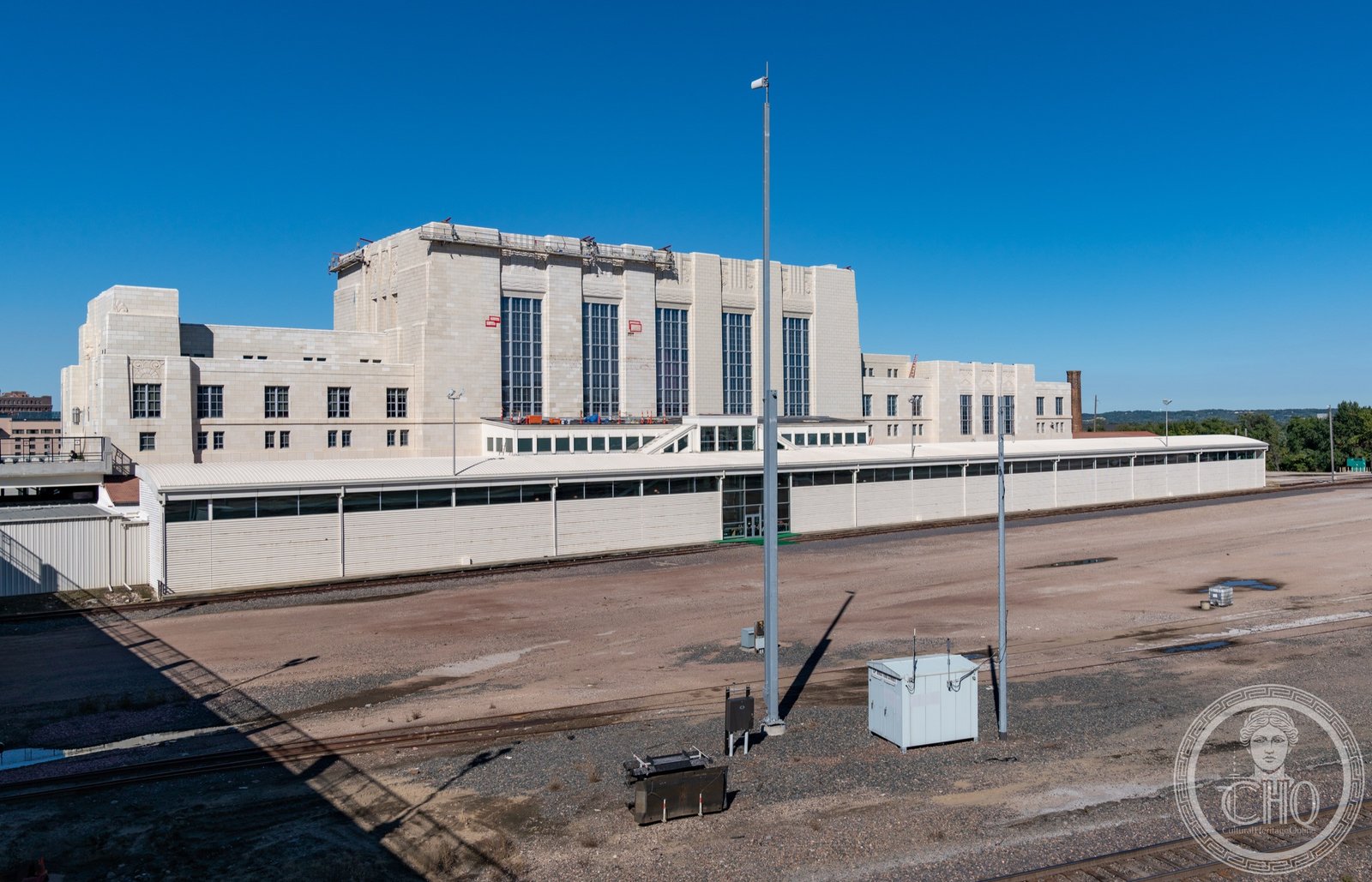
Omaha Union Station opened in January 1931 as one of the finest Art Deco railroad terminals in the American Midwest. Designed by Gilbert Stanley Underwood, the building presents a symmetrical facade with two flanking towers and a central entrance bay decorated in elaborate cream-and-buff terra cotta — sunbursts, chevrons, and stylised foliage in the geometric language of the period. Inside, the Great Hall rises to a coffered barrel-vaulted ceiling with original bronze light fixtures and terrazzo floors that have been meticulously preserved. The station closed to rail traffic in 1971 and reopened in 1975 as the Durham Museum, today one of Nebraska’s principal cultural institutions.
Key facts
- Address: 801 South 10th Street, Omaha, NE 68108
- Architect: Gilbert Stanley Underwood
- Completed: 1931
- Client: Union Pacific Railroad; Chicago, Burlington & Quincy Railroad
- Style: Art Deco
- Current use: Durham Museum (history museum, since 1975)
- Status: National Historic Landmark; National Register of Historic Places
- Feature: Historic soda fountain operating inside the Great Hall
History
Omaha’s importance as a railroad city dates to the 1860s, when it served as the eastern terminus of the Union Pacific Railroad in the first transcontinental rail connection. By the early twentieth century the city was a major hub with multiple competing stations, and plans to consolidate them into a single terminal had been discussed for decades before construction finally began in 1929. The station opened on schedule in January 1931.
Gilbert Stanley Underwood was chosen for his established relationship with the Union Pacific Railroad — he had designed several of the railroad’s lodges at national parks, bringing to those commissions the same interest in using regional character to animate modern architectural language. For Omaha he turned to Art Deco ornament and terra cotta craftsmanship. The Great Hall was designed to handle thousands of passengers at peak hours, and during World War II it fulfilled that capacity every day as Omaha became a major staging point for troop movements across the continent.
Rail travel declined sharply in the postwar decades as automobiles and airlines displaced long-distance trains. The last passenger service departed Omaha Union Station in 1971. Rather than demolish the building, civic advocates rallied to convert it to a museum purpose. The Western Heritage Museum opened in 1975 and was later renamed the Durham Museum in honour of a major donor family. The Art Deco interiors have been maintained to a high standard, and the Great Hall hosts events and exhibitions year-round while the original soda fountain continues to serve visitors.
What you see
The exterior presents a disciplined Art Deco composition in cream-coloured brick and buff terra cotta. The two flanking towers step back slightly from the central pavilion, creating a tripartite facade in the classical tradition but executed with unmistakably modern ornament — stylised eagles, zigzag banding at the cornices, and geometric reliefs around the entrance portals. The terra cotta work is extraordinary in its variety: each decorative panel was cast individually, and the range of motifs — chevrons, interlace patterns, foliated ornament abstracted almost beyond recognition — rewards patient close inspection from the 10th Street pavement.
Inside, the Great Hall is the building’s defining space: approximately sixty feet high, with a barrel-vaulted coffered ceiling in cream and gold, original bronze pendant light fixtures, and marble wainscoting along the walls. The original ticket windows, baggage counters, and telephone booths have been preserved as museum exhibits, and a soda fountain dating from the station’s peak years continues to serve visitors. The terrazzo floor, laid in a geometric pattern that echoes the exterior ornament, is among the best-preserved examples of its kind in the Midwest.
Practical information
- Open: Tuesday–Sunday; closed Mondays and major holidays — check current hours at durhammuseum.org
- Admission: Fee charged; current rates at durhammuseum.org
- Highlights inside: Great Hall ceiling; original soda fountain; permanent galleries on railroad history and Omaha’s past
- Photography: Interior photography permitted for personal use; exterior best in morning light from 10th Street
Getting there
The Durham Museum stands near the Missouri River waterfront on South 10th Street, a short drive from Omaha’s Old Market historic district. Parking is available in an adjacent surface lot and on surrounding streets. Eppley Airfield (OMA), Omaha’s main airport, is approximately fifteen minutes east by car. The building is within a ten-minute walk of the Old Market neighbourhood.
Nearby
- Old Market District — Omaha’s preserved 19th-century commercial neighbourhood, about six blocks northwest along Howard Street, with brick-paved streets, independent restaurants, and galleries in former warehouse buildings.
- Joslyn Art Museum (1931) — An Art Deco building faced in pink Georgia marble housing one of the Midwest’s finest collections, approximately twelve blocks northwest at 2200 Dodge Street.
- Missouri River waterfront — The pedestrian promenade bordering the museum site offers views across the river to Council Bluffs, Iowa, and a sense of the geography that made Omaha the continent’s pre-eminent rail gateway.
Sources
- National Register of Historic Places nomination, Union Station (Omaha), Omaha, Nebraska.
- Durham Museum official documentation — durhammuseum.org
- Historic American Buildings Survey — HABS NE-38, Union Station, Omaha.
- Wikimedia Commons — Durham Museum exterior photograph (Tony Webster, CC BY 2.0).
Find it on the map
See this place and what’s around it →📷 Become a Cultural Heritage Online photographer
Share your photos of places: they stay published under your name as the author. The more they're seen, the more you get noticed — and soon a contest will reward the most appreciated photos.
Log in or sign up free to add a photoIs this page about you?
This page is read by travellers and heritage enthusiasts who find it on Google. Tell us how you are connected to this place and we will take it from there.