Of the World Heritage sites nearest to the Sun Temple at Konârak, the Sundarbans National Park in India lies 370 km away in a straight line, followed by the Bangladeshi Sundarbans (388 km) and Santiniketan (453 km). The Sun Temple is a 13th-century Hindu sanctuary on the Bay of Bengal, conceived as the chariot of the sun god Surya, and it has been on the World Heritage List since 1984.
The World Heritage sites within reach of Konârak
The distances below are straight lines between the reference points that UNESCO publishes for each property. They show what is close, not how long the road takes, which depends on the route. Konârak stands alone on this stretch of coast: the nearest neighbour is more than 350 km away.
| Site | Country | Distance | Inscribed | Type |
|---|---|---|---|---|
| Sundarbans National Park | India | 370 km | 1987 | Natural |
| The Sundarbans | Bangladesh | 388 km | 1997 | Natural |
| Santiniketan | India | 453 km | 2023 | Cultural |
| Historic Mosque City of Bagerhat | Bangladesh | 493 km | 1985 | Cultural |
| Mahabodhi Temple Complex at Bodh Gaya | India | 546 km | 2002 | Cultural |
| Archaeological Site of Nalanda Mahavihara at Nalanda, Bihar | India | 587 km | 2016 | Cultural |
The group is a map of eastern India across time. The two Sundarbans, one on each side of the border, adjoin each other: the Bangladeshi property is a mangrove forest on the delta of the Ganges, Brahmaputra and Meghna, next to India’s. Mahabodhi and Nalanda are Buddhist: UNESCO says the first temple at Bodh Gaya was built by Emperor Asoka in the 3rd century BCE, and that Nalanda’s monastic and scholastic institution lasted from the 3rd century BCE to the 13th century CE. That last century is Konârak’s. Bagerhat answers it from another faith, a city founded in the 15th century by the Turkish general Ulugh Khan Jahan and filled with early Islamic monuments.
Who built the Sun Temple, and when?
King Narasimha Deva I did, according to UNESCO, which dates his reign to AD 1238-1264 and calls the temple a physical testimony to the 13th-century Hindu kingdom of Orissa. It reads the building as a sign of the strength and stability of the Ganga Empire. ICOMOS, the Advisory Body that evaluated the site in 1984, spells the name Narasingha Deva and dates the work to about 1250, at the apogee of a wave of foundations dedicated to the sun god Surya since the 8th century.
Popular memory keeps a human story. UNESCO records the legend that construction took twelve years and 1,200 artisans, and that the master builder, Bisu Moharana, left home to devote himself to the project. His son, born while he was away, later joined the workshop. The legend says the son built the cupola his father could not finish, then leapt to his death. UNESCO presents it as a story attached to a great work of art, not as a record.
Why is the temple a chariot?
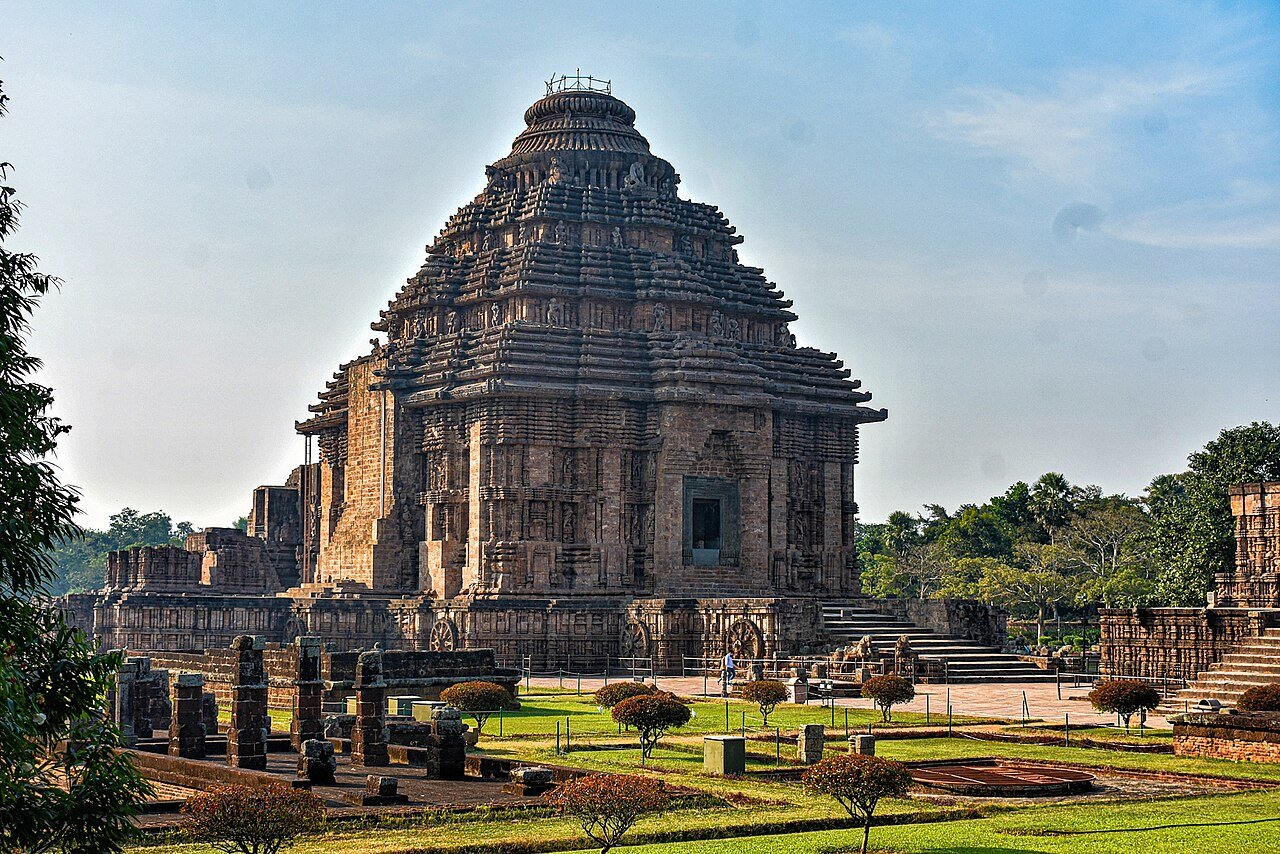
Because that is how it is designed. UNESCO describes a temple that represents the chariot of the Sun God, with twelve pairs of wheels drawn by seven horses that evoke its movement across the heavens. On the north and south sides are 24 carved wheels, each about 3 m in diameter, carrying symbols of the cycle of the seasons and the months. Between the wheels, the plinth is covered in reliefs of fantastic lions, musicians, dancers and erotic groups.
The horses need a caveat. UNESCO’s short description speaks of six horses, its longer text of seven. ICOMOS describes a team of seven, of which six survive, set on either side of the stairway to the sanctuary. It adds that the temple was built of stone on the sand and oriented so that the first rays of the sun strike its principal entry.
What happened to the main tower?
It fell. The vimana, the principal sanctuary, was surmounted by a high tower topped with a shikhara, and both UNESCO and ICOMOS say that tower was razed in the 19th century. What dominates the ruins now is the jagamohana, the audience hall, with its pyramidal mass. Further east the natmandir, the dance hall, rises on a high platform, today without a roof, and subsidiary structures remain inside a rectangular enclosure wall punctuated by gates and towers.
The Archaeological Survey of India carries out all conservation work, under the Ancient Monuments and Archaeological Sites and Remains Act of 1958. A zone of 100 m around the property is prohibited for development and a further 200 m regulated. UNESCO lists the threats as development pressure, salt breeze and sand blasting, cyclones and floods, and tourism, and records that salt air once eroded the metal cramps holding the structure together. World Heritage funding paid for an assessment of its structural stability.
Frequently Asked Questions
Which UNESCO World Heritage sites are near the Sun Temple at Konârak?
The Sundarbans National Park in India is 370 km away in a straight line, the Bangladeshi Sundarbans 388 km and Santiniketan 453 km. Further out are the Mosque City of Bagerhat (493 km), the Mahabodhi Temple Complex at Bodh Gaya (546 km) and Nalanda (587 km).
Which World Heritage criteria does the Sun Temple meet?
Criteria (i), (iii) and (vi). UNESCO cites a unique artistic achievement, an outstanding testimony to the 13th-century kingdom of Orissa, and a direct link to Brahman beliefs and to the spread of the cult of Surya, which it says reached eastern India from Kashmir.
How big are the wheels of the Sun Temple?
Each of the 24 carved wheels is about 3 m in diameter, according to UNESCO. They line the north and south sides of the plinth, twelve pairs in all, and carry symbolic motifs that refer to the cycle of the seasons and the months.
Who looks after the Sun Temple today?
The Archaeological Survey of India, which undertakes all conservation programmes through its national, regional and local offices, according to UNESCO. The site is protected under India’s Ancient Monuments and Archaeological Sites and Remains Act of 1958, with prohibited and regulated zones around the property.
Sources
- UNESCO World Heritage Centre — Sun Temple, Konârak (inscribed 1984). https://whc.unesco.org/en/list/246/
- ICOMOS, Advisory Body Evaluation of The Sun Temple, Konarak (No 246), May 1984. https://whc.unesco.org/document/153031
- UNESCO World Heritage Centre — Sundarbans National Park (1987). https://whc.unesco.org/en/list/452/
- UNESCO World Heritage Centre — The Sundarbans (1997). https://whc.unesco.org/en/list/798/
- UNESCO World Heritage Centre — Santiniketan (2023). https://whc.unesco.org/en/list/1375/
- UNESCO World Heritage Centre — Historic Mosque City of Bagerhat (1985). https://whc.unesco.org/en/list/321/
- UNESCO World Heritage Centre — Mahabodhi Temple Complex at Bodh Gaya (2002). https://whc.unesco.org/en/list/1056/
- UNESCO World Heritage Centre — Archaeological Site of Nalanda Mahavihara at Nalanda, Bihar (2016). https://whc.unesco.org/en/list/1502/
Spotted an error? Write to editorial@culturalheritageonline.com and we correct it the same day.