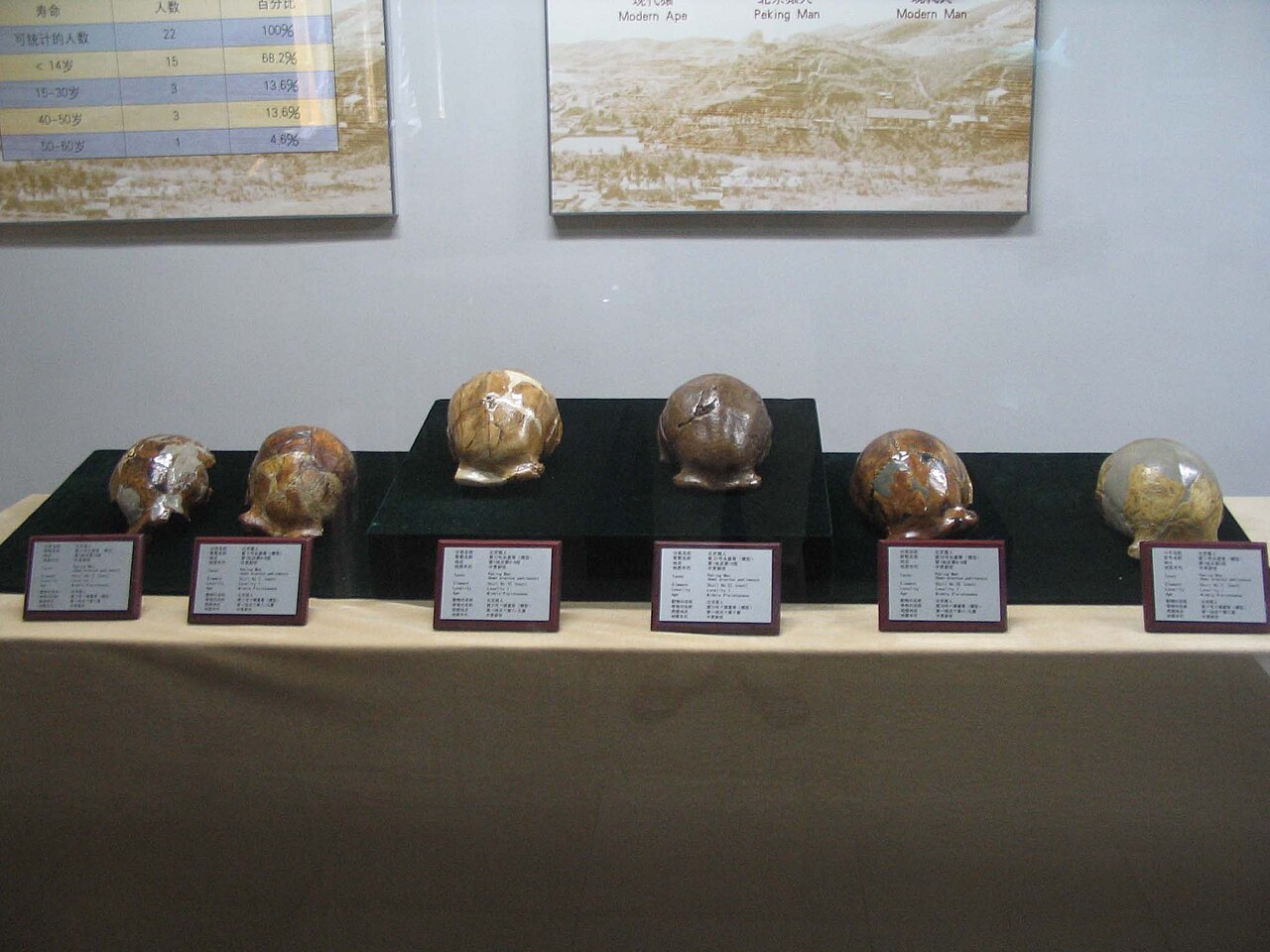
The limestone caves at Zhoukoudian, 50 km southwest of central Beijing, have yielded fossil evidence of Homo erectus occupation spanning roughly 500,000 to 200,000 years ago. Excavations begun in 1921 recovered skull fragments, teeth, and limb bones from at least 40 individuals, along with charred animal bones and stone tools that document the earliest confirmed use of fire in East Asia. The original fossils disappeared in December 1941 during an attempt to ship them to the United States; a plaster cast made in the 1930s remains the primary scientific record.
Beijing’s Imperial Core 45–50 km north / 50–60 min by car
Beijing holds three UNESCO World Heritage properties within its historical centre, each reachable from Zhoukoudian in under an hour on Beijing’s expressway network or by tourist bus services that link the southwest suburbs to the city centre.
The Imperial Palace of the Ming and Qing Dynasties — commonly called the Forbidden City — stands at the geographic and symbolic centre of old Beijing. Construction ran from 1406 to 1420, mobilising an estimated one million labourers and 100,000 craftsmen under the direction of the Yongle Emperor. The resulting complex covers 72 hectares, contains 980 surviving buildings, and is enclosed by a moat 52 metres wide. For most of its 500-year operational history the palace was closed to ordinary subjects; today it receives more than 14 million visitors annually, making it one of the highest-attendance heritage sites in the world. The southern approach along the central axis — from Tiananmen Gate through Meridian Gate to the Hall of Supreme Harmony — rewards a full morning. Distance from Zhoukoudian: approximately 50 km north via the G4 expressway, 55–65 minutes by car.
The Temple of Heaven, inscribed in 1998, occupies 267 hectares in the Chongwen District, roughly 4 km south of the Forbidden City. The Ming emperor Yongle completed the original structure in 1420 alongside the palace, intending it as the ceremonial site where the Son of Heaven communicated with Heaven to ensure good harvests. The circular Altar of Heaven (Huanqiu Tan) and the Hall of Prayer for Good Harvests (Qinian Dian), rebuilt after a lightning fire in 1889, remain intact. The complex’s north–south axis is deliberately offset from the city’s main axis, a cosmological decision encoded in the layout. From Zhoukoudian, the Temple of Heaven lies 45 km northeast; 50 minutes by car via the Fourth Ring Road.
The Summer Palace (Yiheyuan), 21 km northwest of the Forbidden City, was designated in 1998. Empress Dowager Cixi directed a major reconstruction between 1886 and 1895 using funds appropriated from the Chinese naval budget — a transaction that proved consequential during the First Sino-Japanese War of 1894–95. The 294-hectare park centres on Kunming Lake, which accounts for roughly three-quarters of the site’s area. The 728-metre Long Corridor, its painted ceiling beams depicting more than 14,000 scenes from Chinese history and legend, runs along the lake’s north shore beneath Longevity Hill. From Zhoukoudian: 45 km northeast, 50 minutes.
All three city-centre properties are accessible via Beijing Subway Lines 1, 2, and 4; the Zhoukoudian area itself connects to the city via bus route 917 from Tianqiao bus station, approximately 1.5 hours by public transit.
North and Northwest: Tombs and the Wall 90–115 km / 1.5 h by car or direct tourist bus
Two further UNESCO properties extend the heritage circuit north and northwest of Beijing, at distances that make them practical day trips when combined with a morning visit to Zhoukoudian.
The Ming Tombs (Shisanling), part of the Imperial Tombs of the Ming and Qing Dynasties inscription (extended in 2003), occupy a valley 90 km north of Zhoukoudian and roughly 50 km northwest of the Forbidden City. Thirteen of the sixteen Ming emperors who ruled from 1424 to 1644 are interred here, selected for a site bounded on three sides by mountains that Feng Shui principles identified as propitious. The approach road — the Sacred Way (Shendao) — runs 7 km through a formal gate, a stone archway (dating to 1540), and 36 stone figures of animals and officials, each carved from a single monolith. Only three tombs are open for public access: Changling (the largest, built for the Yongle Emperor), Dingling (the only one excavated, revealing the burial chamber of the Wanli Emperor, who died in 1620), and Zhaoling. The Dingling excavation between 1956 and 1958 is often cited as a cautionary chapter in Chinese archaeology: many silk and lacquer artefacts deteriorated rapidly upon exposure, and the project accelerated calls for a moratorium on imperial tomb excavation that broadly holds today. Travel time from Zhoukoudian: 90 km north, 1.5 hours by car via the G6 expressway.
The Great Wall of China, designated in 1987, extends across thousands of kilometres; the Badaling section, 115 km northwest of Zhoukoudian, is both the best-preserved Ming-era stretch and the most visited. Construction at Badaling dates to 1505 under the Hongzhi Emperor, and the walls here stand between 7.8 and 8.5 metres high with a 4.5–5.8-metre-wide walkway along the top — wide enough for five horses to ride abreast. More than 10 million people pass through Badaling annually. For visitors seeking shorter queues, the Mutianyu section (90 km northeast of Zhoukoudian) offers comparable Ming brickwork with a cable car option and attendance figures roughly one-third of Badaling’s. Direct tourist bus services run from Qianmen, near Tiananmen Square, to Badaling year-round; the journey takes about 1.5 hours each way and costs a fraction of a private car. From Zhoukoudian by car: 115 km northwest, 1.5 hours.
A logical two-day sequence: Day 1 — Zhoukoudian in the morning (allow 2–3 hours for the site museum and cave system), then drive north to the Ming Tombs for the afternoon. Day 2 — Forbidden City and Temple of Heaven. The Summer Palace fits a third day or the late afternoon of Day 1 if the Ming Tombs visit ends before 16:00.
Practical information
Zhoukoudian opens year-round; the site museum is fully accessible. The caves themselves involve uneven terrain and low headroom in sections — closed-toe shoes are advisable. Spring (April–May) and autumn (September–October) offer comfortable temperatures for both the cave site and Beijing’s open-air heritage properties. Summer (June–August) at the Forbidden City and Great Wall is extremely crowded and can reach 38°C; timed entry tickets for the Forbidden City sell out days in advance during national holidays (Golden Week, 1–7 October, and the May Day break). Winter visits between December and February are quieter, with significant snowfall occasionally closing the Badaling Wall cable car.
Getting to Zhoukoudian: Bus 917 from Tianqiao Bus Station (south Beijing, near Fayuansi subway station on Line 7) runs to the town of Fangshan, from which shared taxis or a short local bus reach the site. By car or taxi from the Forbidden City: 55–65 minutes via the G4 expressway south. No direct subway line currently connects Zhoukoudian to central Beijing.
Combined logistics: the Forbidden City, Temple of Heaven, and Summer Palace each require pre-booked timed-entry tickets purchased on the official WeChat mini-programs or official websites. The Ming Tombs do not currently require advance booking for general entry, though Dingling’s underground chamber may have queue waits exceeding one hour during peak periods. The Great Wall at Badaling does require advance ticket purchase during national holidays.
Frequently Asked Questions
What happened to the original Peking Man fossils?
The fossils recovered at Zhoukoudian between 1921 and 1937 — including skull fragments, mandibles, teeth, and postcranial bones representing at least 40 individuals — were held at the Peking Union Medical College. In late 1941, with Japanese forces closing in on Beijing, a decision was made to evacuate them to the United States for safekeeping. The fossils were packed and handed to a detachment of US Marines on 5 December 1941; two days later, Japan attacked Pearl Harbor, and the Marines were taken prisoner at Qinhuangdao. The crates containing the fossils were never recovered. Multiple investigations over the following decades — including a widely publicised search in the 1970s and a formal Chinese government inquiry in the 1990s — produced no confirmed trace. Several theories circulate: that the crates were buried at a Japanese military base, destroyed during the chaos of capture, or held in private hands. The plaster endocasts made by Franz Weidenreich in the 1930s, along with the pre-war photographs and anatomical drawings, constitute the surviving scientific record. Original fossils found at the site after 1949 — including a partial skull discovered in 1966 — remain in China and are housed at the Institute of Vertebrate Paleontology and Paleoanthropology in Beijing.
Is Zhoukoudian worth visiting if you only have two or three days in Beijing?
The answer depends on the visitor’s priorities. The site is 50 km outside the city centre, which adds at least two hours of transit to a day already competing with the Forbidden City, Temple of Heaven, and Summer Palace. The site museum is genuinely excellent: it traces human evolution in East Asia across three floors with original fossils (post-1949 finds), reconstructed cave environments, and detailed documentation of the excavation history. The cave exteriors are viewable, though the interior chambers are not publicly accessible. For visitors with a particular interest in palaeontology, prehistoric archaeology, or the history of science — including the story of the lost fossils — the excursion is rewarding. For visitors with a broad cultural interest in imperial China and limited time, the three Beijing city-centre UNESCO properties (Forbidden City, Temple of Heaven, Summer Palace) and the Great Wall are more efficient choices. A practical compromise: combine Zhoukoudian with the Ming Tombs in a single day, as both lie along the same north–south axis of Beijing’s suburban expressway network, and neither requires more than 3–4 hours on site.
How do the UNESCO properties near Beijing compare in terms of visitor numbers and crowding?
The Forbidden City leads all heritage sites in China by attendance: it recorded 19.1 million visitors in 2019 (pre-pandemic), operates a timed-entry system capping daily visits at 80,000, and still sells out on weekend mornings. The Great Wall at Badaling sees approximately 10 million visitors per year, concentrated between May and October; the site added a timed-ticket system in 2019 during peak periods. The Temple of Heaven, set within a large public park, is heavily used by Beijing residents for morning exercise and receives around 10 million annual visits. The Summer Palace draws roughly 10 million visits annually but its 294-hectare grounds distribute crowds more comfortably than the Forbidden City’s controlled corridors. The Ming Tombs receive considerably fewer visitors — approximately 3 million per year — partly because only three of the thirteen tombs are open and the site receives less tourist bus traffic than the more heavily promoted Wall and palace. Zhoukoudian is the least visited of the group: annual figures hover around 150,000–200,000, reflecting both its distance from the city and the specialist nature of its appeal. In practical terms, a visit to Zhoukoudian on a Beijing itinerary can always be done without crowds or advance booking.
Sources
- S1 — UNESCO World Heritage Centre — Peking Man Site at Zhoukoudian (Ref. 449) — https://web.archive.org/web/20230601000000/https://whc.unesco.org/en/list/449/
- S2 — Zhoukoudian Site Museum Beijing — https://whc.unesco.org/en/list/449/
- S3 — Klein, Richard G. <em>The Human Career: Human Biological and Cultural Origins</em>. University of Chicago Press, 2009. ISBN: 978-0-226-43965-5.
Spotted an error? Write to editorial@culturalheritageonline.com and we correct it the same day.