
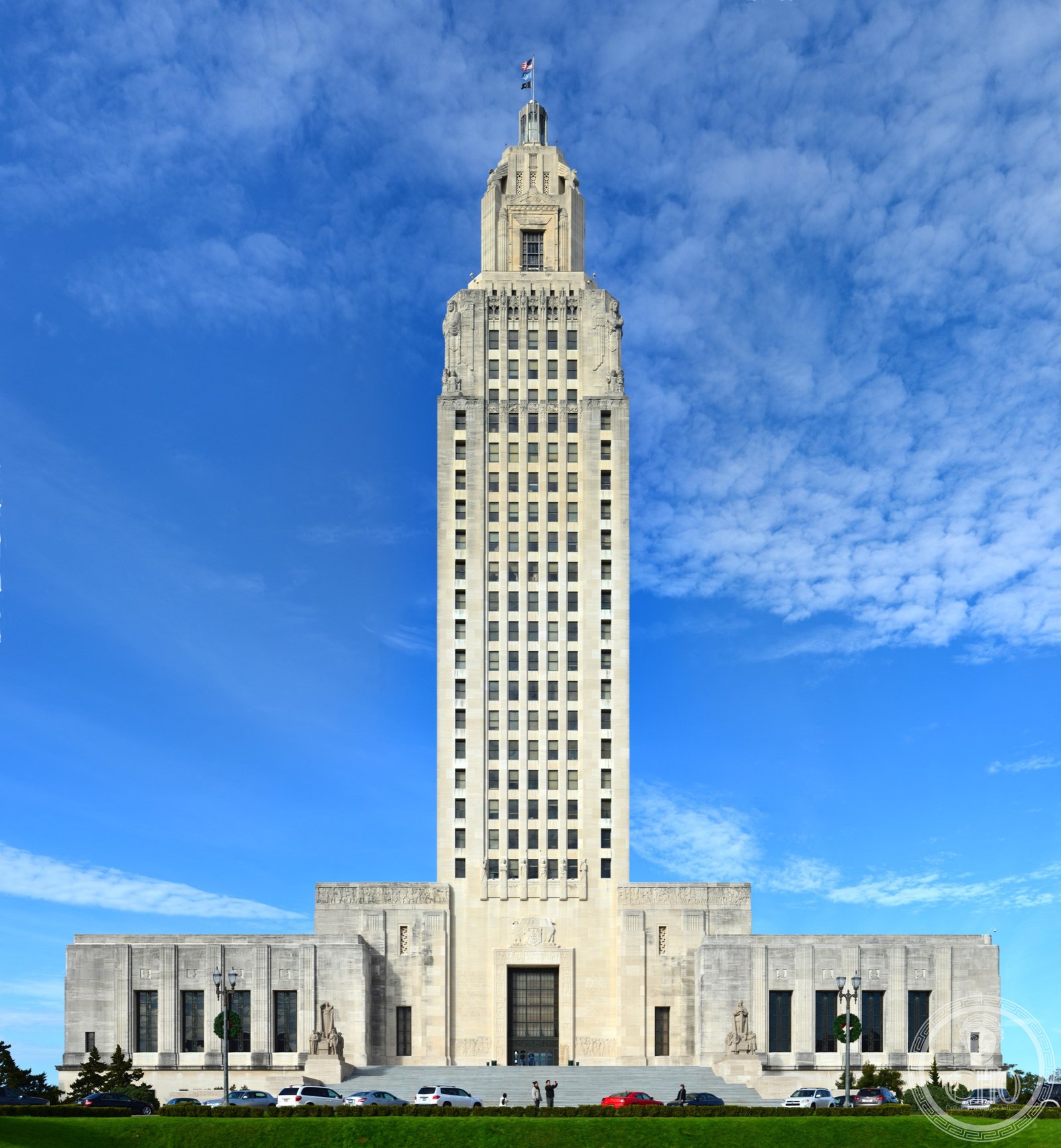
Louisiana State Capitol (1932), Baton Rouge
The tallest state capitol in the United States rises 450 feet above the Louisiana delta on a stepped limestone shaft conceived by Governor Huey Long and built in fourteen months — where Long was later assassinated, and where he is still buried.
At a glance
Completed in 1932 to designs by Weiss, Dreyfous & Seiferth, the Louisiana State Capitol stands 450 feet (137 metres) at 34 stories — by a considerable margin the tallest state capitol building in the United States. Governor Huey P. Long insisted on the skyscraper form as a symbol of his administration’s ambition, replacing a mid-nineteenth-century predecessor he considered a relic. The building’s buff limestone shaft, its Art Deco ornamental friezes, and its sunken memorial gardens give Baton Rouge a monument with no close parallel in American civic architecture.
Key facts
- Address: 900 North 3rd Street, Baton Rouge, Louisiana 70804
- Completed: 1932 (construction began 1931)
- Height: 450 feet (137 m), 34 stories
- Architects: Weiss, Dreyfous & Seiferth (Leon C. Weiss, Joseph Dreyfous, Solis Seiferth)
- Style: Art Deco
- Status: Active state capitol; National Register of Historic Places (1977)
- Distinction: Tallest state capitol building in the United States
History
Governor Huey P. Long championed the replacement of Louisiana’s antebellum statehouse and personally supervised construction, reportedly visiting the site almost daily. Long selected the Art Deco style during a period when the movement was defining American institutional architecture from coast to coast. He reportedly boasted that the new building would be the finest in the country.
The building was completed in 1932, and Long — who controlled Louisiana as governor and then U.S. Senator with extraordinary personal authority — was shot on the first floor on September 8, 1935, by Dr. Carl Weiss, and died of his wounds two days later. Bullet holes remain visible in the marble corridor where he fell. Long is buried in the memorial garden on the capitol grounds beneath a life-size bronze statue depicting him at the podium, facing the building he built.
The capitol has served as the active seat of Louisiana’s state government continuously since 1932. Its designation on the National Register of Historic Places in 1977 recognized both its architectural distinction and its significance as the site of one of the most dramatic episodes in twentieth-century American political history.
What you see
The building’s exterior is clad in buff limestone in telescoping setbacks that produce a strongly vertical profile, ornamented with Art Deco bronze and stone friezes depicting Louisiana’s state industries — cotton, sugarcane, oil — and stylized eagles flanking the entrance. The massive bronze entry doors are among the finest surviving examples of 1930s metalwork in the American South. The lobby’s coffered ceilings, marble wainscoting, and mosaic floors continue the Deco vocabulary at a scale intended to impress legislators and visitors alike.
The memorial gardens at the south end of the grounds are sunk below grade, fringed by live oaks and formal plantings, with Long’s tomb at the center. An observation deck at the 27th floor offers panoramic views over Baton Rouge, the Mississippi River, and the flat Louisiana countryside stretching to the horizon in every direction.
Practical information
- Open Monday – Friday during regular business hours; grounds accessible year-round
- Guided tours available through the Louisiana Secretary of State’s office
- Observation deck access during building hours (27th floor)
- Legislative sessions bring heightened activity and additional security
- Allow 1–2 hours including the gardens and observation deck
Getting there
Baton Rouge Metropolitan Airport (BTR) is approximately 10 miles north of the capitol. From downtown Baton Rouge, the building stands on North 3rd Street near the riverfront — accessible on foot from the main hotel district. Interstate 110 connects the downtown corridor to the wider I-10 network. Street parking is available on surrounding blocks; the grounds entrance is on North 3rd Street between North 4th Street and Convention Street.
Nearby
- Old State Capitol (1850) — the Gothic Revival predecessor, now a museum of Louisiana political history at 100 North Boulevard, approximately 1.5 miles south of the current capitol.
- Louisiana Governor’s Mansion (1963) — the official executive residence on Capitol Lake Drive, two blocks east of the capitol building.
- USS Kidd Veterans Museum — a decommissioned WWII Fletcher-class destroyer moored on the Mississippi River waterfront, less than one mile south.
Sources
- Louisiana Secretary of State: State Capitol building history and tour information
- National Register of Historic Places: Louisiana State Capitol nomination, 1977
- Kane, Harnett T. Louisiana Hayride: The American Rehearsal for Dictatorship. Pelican Publishing, 1971
- Bridges, Tyler. The Rise and Fall of David Duke. Pelican Publishing, 1994 (Baton Rouge context)
- Wikimedia Commons: Louisiana State Capitol Building.jpg (CC0)
Find it on the map
See this place and what’s around it →📷 Diventa un fotografo di Cultural Heritage Online
Condividi le tue foto dei luoghi: restano pubblicate con la tua firma come autore. Più vengono viste, più ti fai conoscere — e presto un concorso premierà le foto più apprezzate.
Accedi o registrati gratis per aggiungere una foto