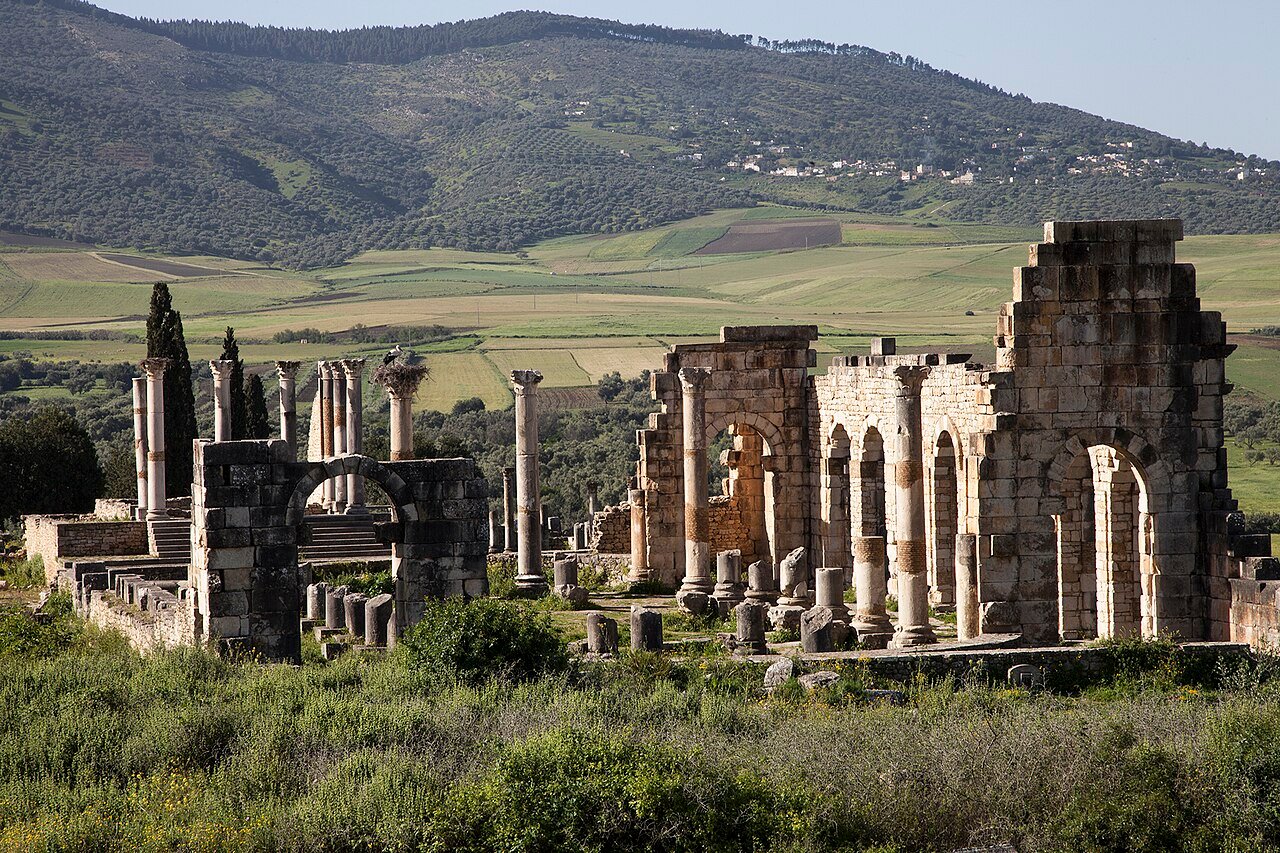
Volubilis, inscribed on the UNESCO World Heritage List in 1997, is the best-preserved Roman provincial city in the Maghreb — a 42-hectare archaeological site on the Zerhoun plain in northern Morocco, 33 kilometres from Meknès and 88 kilometres from Fès. From a Berber-Carthaginian settlement it grew to become the capital of the Roman client kingdom of Mauretania, then a provincial city of 20,000 inhabitants, before eventually serving as the first seat of the Idrisid dynasty that founded the Kingdom of Morocco. Its 40 in-situ floor mosaics, the largest collection in the Maghreb, document Roman provincial life with a specificity available nowhere else in northwest Africa.
From Berber Kingdom to Roman Province Zerhoun plain, between Meknès (33 km) and Fès (88 km), Morocco
Human occupation of the Zerhoun plain dates to at least the 3rd century BCE, when a Berber-Carthaginian settlement existed at the site now called Volubilis. The town grew in significance during the early Roman period as the capital of the client kingdom of Mauretania under Juba II, one of the most extraordinary figures of the late Republican and Augustan world. Juba II had been brought to Rome as a child after his father was defeated by Julius Caesar in 46 BCE and paraded through the city in a triumph. Raised and educated in Rome, he became a close associate of the future emperor Augustus, who installed him as king of Mauretania in 25 BCE. Juba married Cleopatra Selene II — the daughter of Mark Antony and Cleopatra VII, also brought to Rome as a child and paraded in a triumph — uniting in a single household two of the most consequential royal bloodlines of the Mediterranean world. Together Juba II and Cleopatra Selene governed from Volubilis (and from the coastal capital Caesarea, modern Cherchell in Algeria) as enthusiastic promoters of Hellenistic culture, producing or commissioning scholarly works on natural history, geography, art history and music.
The kingdom of Mauretania was annexed by Emperor Claudius in 40 CE, following the assassination of Juba II’s son Ptolemy by Caligula, and reorganised as the Roman province of Mauretania Tingitana with Volubilis as one of its principal administrative centres. The city expanded rapidly under Roman administration. At its peak under the Severan dynasty in the late 2nd and early 3rd centuries CE, Volubilis covered approximately 42 hectares and housed an estimated 20,000 inhabitants — a substantial city by the standards of the western provinces. The street grid of the Roman city is still clearly legible: a wide decumanus maximus (main east-west thoroughfare) runs the length of the site, flanked by the remains of shops and colonnades, with the principal public buildings concentrated in the civic centre where the decumanus crosses the cardo (main north-south street).
The civic centre of Roman Volubilis preserves three of the city’s most important monuments. The Capitoline Temple, dedicated to the Capitoline Triad of Jupiter, Juno and Minerva and standing on a high podium with a broad staircase, was the religious and symbolic heart of any Roman provincial city and remains one of the most imposing structures on the site. The Basilica — a 40-by-20-metre, five-nave civil hall in which justice was administered and commerce conducted — retains most of its walls and several of its interior arcades. The Triumphal Arch of Caracalla, erected in 217 CE to honour the emperor who had extended Roman citizenship to all free inhabitants of the empire in 212 CE, faces east and has been partially reconstructed; its inscription survives, dedicating the arch to “the most sacred emperor” and noting the gratitude of the citizens of Volubilis.
Volubilis was one of the most productive centres of olive oil in the western Roman Empire. More than 300 olive-oil presses have been excavated across the site — industrial installations consisting of stone pressing platforms, counterweighted wooden beams and ceramic collection vats — that document a commercial operation of considerable scale. The oil was shipped north to Rome and to the military garrisons of the Rhine and Danube frontiers, making Volubilis an important node in the supply chains that maintained the western Roman state. The ruins of these presses, distributed through the domestic and commercial quarters of the city, give Volubilis a character distinct from purely administrative or military Roman sites.
Mosaics, Storks and the Post-Roman City 42 km from Meknès; accessible by day trip
The floor mosaics of Volubilis constitute the site’s most visually immediate attraction and the most detailed surviving record of the tastes and aspirations of its Roman inhabitants. More than 40 mosaics survive in situ — protected by modern shelter structures where they have been left in place, rather than removed to a museum — making Volubilis the site of the largest collection of in-situ Roman mosaics in the Maghreb. The subjects range from mythological narrative to decorative geometric patterns and reflect the standard repertoire of Roman provincial patronage, drawn from pattern books circulated across the empire, but executed with sufficient quality to indicate trained craftsmen. The Orpheus Mosaic, in the House of Orpheus, shows the musician surrounded by animals charmed by his playing: a lion, a bear, an elephant, a horse, a bird and a snake are arranged in concentric circles around the central figure, a composition that also carried symbolic meaning in early Christian interpretation. The Labours of Hercules Mosaic documents eight of the canonical twelve labours in individual medallions. The Bacchus in a Chariot Mosaic shows the god of wine riding in triumph, drawn by panthers, a scene that combined religious associations with the pleasures of the symposium. The Four Seasons Mosaic, one of the largest on the site, represents the annual cycle through allegorical female figures.
After the Roman military withdrawal from Mauretania Tingitana in 285 CE, Volubilis did not immediately decline. The city continued under a romanised Berber population and, following the Arab-Muslim conquest of the Maghreb in the late 7th century, became the seat of Idris I, the great-great-great-grandson of the Prophet Muhammad who fled to the Maghreb in 788 CE after a political defeat in Arabia. Idris I gathered a substantial following among the Berber population, converted them to Islam and established the Idrisid dynasty — the first Islamic dynasty of Morocco and the founding line of the Moroccan royal house. He held court at Volubilis for several years before founding a new capital at nearby Fès in 789 CE. The Arab name for Volubilis, Walili (a corruption of the Latin name), persisted through this period, and the site remained inhabited until the catastrophic Lisbon earthquake of 1755, whose shockwaves were felt across northwest Africa and caused widespread structural collapse in Volubilis, prompting the final abandonment of the already partially ruined city.
Volubilis was discovered and first excavated by French colonial archaeologists in the 1890s, and systematic excavation continued through much of the 20th century. The site’s most visible unofficial inhabitants are the white storks that nest on the tops of collapsed columns, arch keystones and every convenient elevated platform across the ruins. Stork nests have been present at Volubilis for generations and have become an unofficial emblem of the site, adding an animated and unpredictable element to the experience of walking through the ruins, particularly in spring when the breeding pairs are active and audible at close range.
Practical information
Volubilis is most conveniently visited as a day trip from Meknès (33 km) or as a stop between Meknès and Fès (88 km). Grand taxis from Meknès run to Moulay Idriss, the pilgrimage town immediately adjacent to the site, from which it is a short walk or taxi ride to the entrance. Private tours from Fès are widely available and typically combine Volubilis with Moulay Idriss, a town built on a steep hillside above the ruins and centred on the tomb of Idris I, considered the most sacred pilgrimage site in Morocco. The site is open daily from approximately 08:00 to 18:00 (summer) and 08:00 to 17:00 (winter); confirm with the official tourism office as hours vary. Entry is charged at the Moroccan historic site rate, which is modest by international standards. The site is exposed and largely without shade; sun protection and water are essential from April through September. The best light for photography of the mosaics is mid-morning, before direct overhead sun washes out the colours. Meknès, 33 km away, is itself a UNESCO World Heritage Site (the historic city inscribed in 1996) and provides comfortable bases for a visit; the Bab Mansour gate and the royal granaries of Heri es-Souani are the principal monuments there.
Frequently Asked Questions
What makes the Volubilis mosaics exceptional compared to other Roman mosaic sites?
The key distinction of Volubilis is that more than 40 of its mosaics survive in situ — meaning they have been left in the floors of the houses and public buildings where they were originally laid, protected by modern shelter canopies, rather than lifted and transferred to a museum. This makes Volubilis one of the few places in the Roman world where mosaics can be seen in their architectural and domestic context: in the triclinium (dining room) of a wealthy household, at the entrance to a bath suite, or in the atrium of a civic building. The combination of spatial context with narrative and decorative content gives a sense of how these images functioned in daily life — how they shaped the experience of a dinner guest entering the room, for instance, or what they communicated about the owner’s education and cultural aspirations — that a museum display cannot fully convey. The quality of the Volubilis mosaics ranges from competent workshop production to genuinely accomplished work, particularly in the Orpheus and Bacchus compositions, which demonstrate a command of perspective, foreshortening and anatomical rendering that reflects training in the established conventions of Hellenistic painting. By North African standards, Volubilis is the richest single site for Roman mosaic art; the only comparable collection in the Maghreb is in the Bardo National Museum in Tunis, but those works have been removed from their original context.
Who was Juba II, and why is his connection to Volubilis historically significant?
Juba II (c. 48 BCE – 23 CE) was one of the most remarkable rulers of the Roman client system, and his presence at Volubilis connects the city to two of the most dramatic stories of the late Republican Mediterranean. His father, Juba I of Numidia, was defeated by Julius Caesar at the Battle of Thapsus in 46 BCE and died in the aftermath, leaving the young Juba II to be taken to Rome as a captive. He was raised in the household of the future emperor Augustus and received an excellent Hellenistic education, becoming a prolific writer on natural history, geography and art history — most of his works survive only in fragments quoted by later authors. Augustus installed him as king of Mauretania in 25 BCE, providing him with Cleopatra Selene II as his queen — the daughter of Mark Antony and Cleopatra VII of Egypt, herself a survivor of Roman captivity following the defeat of her parents in 30 BCE. Together they ruled Mauretania for fifty years, promoting Hellenistic culture and maintaining the loyalty to Rome that kept their kingdom stable. Juba II’s court at Volubilis was a centre of scholarly production at the western edge of the classical world, and several of his geographical observations about the Canary Islands and the sources of the Nile were transmitted through later ancient authors and remained in circulation through the medieval period.
How long was Volubilis inhabited, and why was it finally abandoned?
Volubilis was continuously inhabited for approximately two thousand years, from at least the 3rd century BCE to the aftermath of the Lisbon earthquake of 1755. The Roman military withdrew from Mauretania Tingitana in 285 CE as part of a wider consolidation of the imperial frontiers, but the city did not become immediately uninhabited; it continued under a romanised Berber population that maintained many elements of the Roman urban way of life for generations. The Arab-Muslim conquest of the Maghreb in the late 7th century brought new population and eventually Islam to the city, which was known by the arabicised name Walili and continued to function as a significant settlement through the early Islamic period. The Idrisid dynasty, which ruled Morocco from 788 CE onwards, made Volubilis its first seat before founding Fès. The city contracted gradually over the following centuries as Fès and Meknès grew to absorb political and commercial functions, but occupation continued in diminishing form until 1755, when the earthquake that destroyed Lisbon also sent shockwaves across the Maghreb, collapsing many of the already weakened standing structures at Volubilis and prompting the final evacuation of the remaining population. The ruins were quarried for building material by the rulers of Meknès through the late 18th century, which accounts for the absence of most of the original marble and dressed stone. Systematic archaeological excavation began in the 1890s under French colonial auspices and revealed the extraordinary state of preservation of the mosaic floors beneath the accumulated debris.