The Buddhist Monuments at Sanchi, inscribed on the UNESCO World Heritage List in 1989, occupy a sandstone hill in Madhya Pradesh, 46 kilometres from Bhopal, that has been one of the most important sacred sites in South Asia for more than 2,200 years. The Great Stupa — originally built by Emperor Ashoka in the 3rd century BCE over a casket of relics connected to the Buddha — stands as the oldest stone structure in India and the most complete and best-preserved ensemble of early Buddhist art anywhere on earth. The four elaborately carved gateways that surround it are among the greatest achievements of ancient Indian sculpture.
The Great Stupa and the Ashokan Foundation Madhya Pradesh, 46 km from Bhopal, 10 km from Vidisha
The sandstone hill at Sanchi was chosen as a sacred site by Emperor Ashoka — the Mauryan ruler who, following the devastating Kalinga War of c. 261 BCE, converted to Buddhism and became its most consequential royal patron — because of its proximity to Vidisha, the city where his first wife Devi was born and where he had lived as a young prince. Devi was a Buddhist laywoman, the daughter of a merchant from Vidisha, and her influence on Ashoka’s early engagement with the dharma is documented in Buddhist tradition. The original stupa at Sanchi was a relatively simple brick hemispherical dome, approximately half the diameter of the structure visible today, enclosing a stone relic casket. Ashoka is said to have built 84,000 stupas across his empire to enshrine relics of the Buddha and his disciples; Sanchi is the most completely preserved of these foundations.
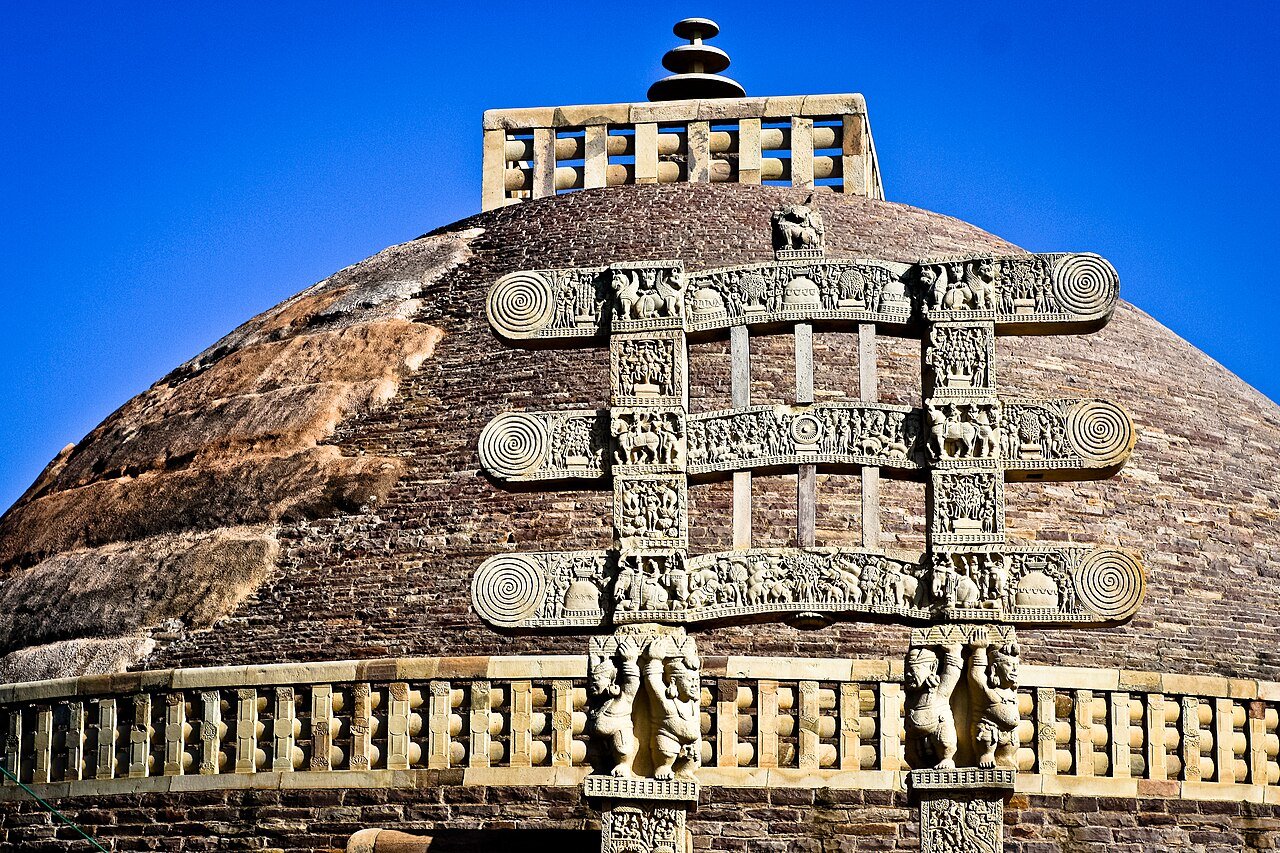
In the 1st century BCE, under the Shunga dynasty that had succeeded the Mauryas, the Great Stupa was extensively enlarged and transformed. The original brick dome was encased in dressed sandstone, increasing its diameter to approximately 36 metres. A raised processional terrace was added at mid-height, with a railing of sandstone posts and crossbars forming a pradakshina path — a path for circumambulation, the ritual of walking clockwise around a sacred object as an act of devotion. At the summit, a harmika, a square stone railing symbolising the celestial realm of the gods, enclosed a triple stone umbrella (chattra) rising 5 metres above the dome — a symbol of royal protection and the three jewels of Buddhism (the Buddha, the Dharma and the Sangha). The outer circumambulation path at ground level was enclosed in a massive stone railing of great visual weight, with four elaborate gateways (toranas) at the cardinal points.
These four gateways, the toranas, are the glory of Sanchi. Each stands approximately 10 metres high and consists of two square posts topped by three curved horizontal crossbars, the whole covered on every surface with carved narrative reliefs of exceptional quality and density. They were carved in the 1st century BCE and 1st century CE by craftsmen whose primary material was ivory — the Sanchi toranas are so finely worked that ancient sources describe them as the work of ivory-carvers who transposed their skills to stone. The South Gateway is the most dramatic entrance — it faces the main path up the hill from Sanchi village — and its carvings include scenes of the Great Departure (when Siddhartha Gautama left his father’s palace) and the Miracle at Kapilavastu. The East Gateway, the oldest, includes the famous scene of Queen Maya’s Dream and the earliest known narrative depiction of the Bodhi Tree beneath which the Buddha attained enlightenment. The North and West Gateways complete the programme with scenes from the Jataka tales and the early history of the Buddhist community.
One of the most significant features of the Sanchi toranas is what they do not show. The Buddha never appears in human form in any of the 1st-century-BCE carvings. Where the Buddha is present in a narrative scene, he is indicated by a symbol: footprints, the Bodhi Tree, the Dharma Wheel, a parasol held by attendants over an empty space, or a riderless horse. This “aniconic” convention — representing the Buddha’s presence through signs rather than images — characterises early Buddhist art across the subcontinent and represents a deliberate theological choice: the transcendent being who had passed beyond human existence and achieved nirvana could not be contained in a human likeness. The human representation of the Buddha only begins to appear in the 1st and 2nd centuries CE, at Mathura and Gandhara, under different theological and artistic influences. Sanchi thus preserves a visual record of the earlier, aniconic phase of Buddhist art that has no equal elsewhere.
Fifty Monasteries, Rediscovery and the Jataka Narratives Open site; nearest accommodation in Bhopal or Vidisha
The Great Stupa is the largest and most prominent of approximately 50 structures that once occupied the Sanchi hill, including smaller stupas (notably Stupa 2 and Stupa 3), temples, and the remains of monastic buildings that housed the community of monks who maintained the site. Sanchi was an active centre of Buddhist monastic life from the 3rd century BCE until the 12th century CE — a span of approximately 1,400 years — and the site documents, in its accumulated layers of construction and renovation, the full arc of Buddhist art and architecture in northern India from its origins through its eventual decline following the Muslim invasions of the 12th century CE. The sheer variety of structural styles visible on a single hill — Ashokan original construction, Shunga enlargement, Satavahana torana carving, Gupta-period temples, and later Pallava-influenced additions — makes Sanchi an unintended museum of Indian architectural history across more than a millennium.
Stupa 3, immediately north of the Great Stupa, is notable because its relic caskets were found intact during excavation in 1851 by British archaeologist F. C. Maisey. Two of the caskets contained cremated remains identified by inscriptions as those of Sariputra and Mahamoggallana — the two principal disciples of the Buddha himself, whose relics were considered among the most precious in the Buddhist world. The caskets are now in the British Museum (which retains them despite long-standing requests for their return) and in the Archaeological Museum at Sanchi. The relics themselves were transferred to a newly built temple at Sanchi in 1952, following Indian independence.
The Jataka tales depicted across the Sanchi toranas — stories of the 547 previous lives of the being who would eventually become the Buddha — are among the richest sources for understanding the popular Buddhism of the 1st century BCE. They draw on folk tales, fables and didactic narratives that circulated orally long before the Buddhist canon was written down, and their incorporation into monumental stone sculpture at Sanchi represents the institutionalisation of a popular storytelling tradition. Scenes from the most beloved Jatakas — the Chhadanta Jataka (a six-tusked elephant), the Syama Jataka (a devoted son) and the Mahajanaka Jataka (a king who renounces his throne) — appear on multiple gateways in versions adapted to the available stone surface, reflecting a narrative tradition so well known to contemporary viewers that it could be indicated in compressed, allusive form.
Sanchi was effectively abandoned after the 12th century CE and gradually covered by vegetation and accumulating soil. It was rediscovered in 1818 by Henry Taylor, a British officer, who found the outer railing and portions of the Great Stupa projecting above the ground surface. Subsequent years saw damaging amateur excavations that caused significant harm to the toranas; the site came under proper archaeological protection only in the 1880s under Sir John Marshall, Director-General of the Archaeological Survey of India, whose meticulous excavation and conservation work between 1912 and 1919 established the site’s current condition. The Archaeological Museum at Sanchi, opened in 1919, houses key finds from the excavations including the lion capital from an Ashokan pillar on the hill, a significant number of inscribed votive tablets, and sculptures removed from the site for conservation.
Practical information
Sanchi is 46 kilometres from Bhopal, the capital of Madhya Pradesh, which is served by regular flights from Delhi, Mumbai and other Indian cities and by express trains on the Delhi-Mumbai and Delhi-Chennai routes. From Bhopal, Sanchi is reached by train (the Bhopal-Sanchi-Vidisha local, approximately one hour) or by road taxi (45 minutes to one hour). The site is open daily from sunrise to sunset and entry is charged at Archaeological Survey of India rates, with a separate, higher fee for foreign visitors. The on-site Archaeological Museum is included in the entry charge and should not be skipped; allow at least one to two hours there. The optimal time to visit is October to March, when temperatures are moderate; April to June are very hot (40°C+) and July to September is monsoon season, when the site can be slippery but the surrounding landscape is dramatically green. Bhopal provides the nearest range of accommodation; Vidisha, 10 kilometres from Sanchi, is the local town but has fewer tourist facilities. Plan a minimum of three to four hours for the hill itself.
Frequently Asked Questions
Why is the aniconic representation of the Buddha at Sanchi historically important?
The toranas of Sanchi were carved in the 1st century BCE, during a period when Buddhist art across the subcontinent consistently avoided representing the Buddha in human form. Instead, wherever the Buddha appears in a narrative scene — the Great Departure from his father’s palace, the moment of Enlightenment beneath the Bodhi Tree, the First Sermon at Sarnath, the Parinirvana — his presence is indicated by a symbol: footprints in the earth, the Bodhi Tree beneath an empty canopy, a Dharma Wheel, a riderless horse or a parasol held over a vacant space. This convention is called aniconism, and its theological basis appears to have been that a being who had transcended human existence and achieved nirvana — liberation from the cycle of rebirth — could not appropriately be represented in the form of a human body, which would inevitably limit and anthropomorphise what the texts described as a state beyond all limiting conditions. The human image of the Buddha only begins to appear in the 1st and 2nd centuries CE, at the art schools of Mathura (in the Gangetic plain) and Gandhara (in present-day Pakistan and Afghanistan), under circumstances still debated by art historians. Sanchi’s aniconism thus preserves, in stone, a theological position on the nature of Buddhahood that was later superseded but remained a significant strand of early Buddhist thought, and gives the site an art-historical importance independent of its importance as an architectural monument.
What is inside the Great Stupa at Sanchi, and can visitors enter it?
The Great Stupa is a solid structure — it cannot be entered. Like all stupas, it is not a building in the functional sense but a reliquary monument: a dome of solid masonry enclosing, at its heart, a relic chamber. The original 3rd-century-BCE brick stupa built by Ashoka enclosed a stone relic casket whose contents — whether cremated remains of the Buddha, relics of his disciples, or symbolic objects — were not examined during the 20th-century excavations, which found the outer stone casing largely intact and chose not to disturb the interior. The stone drum and dome are therefore sealed monuments; worship and veneration take place on the outside, through circumambulation of the pradakshina path on the raised terrace and at ground level, and through the ritual of passing through the four toranas in the appropriate sequence. The solid form of the stupa is itself the architectural embodiment of a core Buddhist concept: the mountain, the cosmic axis, the axis mundi connecting earth and heaven, or in Buddhist cosmology, the world of human experience and the realm of nirvana. Walking around the stupa in a clockwise direction — the direction of the sun’s apparent movement through the sky — is a kinetic enactment of the journey toward enlightenment that the carved narratives on the toranas illustrate.
How does Sanchi compare to other early Buddhist sites in Asia?
Sanchi occupies a unique position in the landscape of Buddhist heritage worldwide because of the completeness and the antiquity of its surviving fabric. Bodh Gaya in Bihar, where the Buddha attained enlightenment beneath the Bodhi Tree, is the most sacred site in Buddhism, but the monuments there have been almost entirely rebuilt in the medieval period and later, so that relatively little physically original fabric from the Ashokan period survives. Sarnath, near Varanasi, where the Buddha delivered his First Sermon, has the Dhamekh Stupa (6th century CE) and important sculptural finds in its museum, but the site is largely in ruins and its early Buddhist monuments are fragmentary. Lumbini in Nepal, the birthplace of the Buddha, has been the subject of ongoing excavation that has revealed Ashokan foundations, but the complex is still partially under study. Sanchi’s advantage is that its principal monuments — the Great Stupa, the toranas and the surrounding structures — survive at near-full height with their carved surfaces largely intact, allowing a direct encounter with original 3rd-century-BCE through 1st-century-CE Buddhist art that is not mediated by medieval reconstruction or later overlay. The toranas in particular — four in place, their carvings readable and detailed even without magnification — have no equivalent elsewhere as examples of early Buddhist narrative relief sculpture in their original architectural setting.
Sources
- S1 — Shaw, Julia. Buddhist Landscapes in Central India: Sanchi Hill and Archaeologies of Religious and Social Change. Left Coast Press, 2007. ISBN 978-1-59874-012-7.
- S2 — Craven, Roy C. Indian Art: A Concise History. Thames & Hudson, 1997. ISBN 978-0-500-20302-6.
Spotted an error? Write to editorial@culturalheritageonline.com and we correct it the same day.