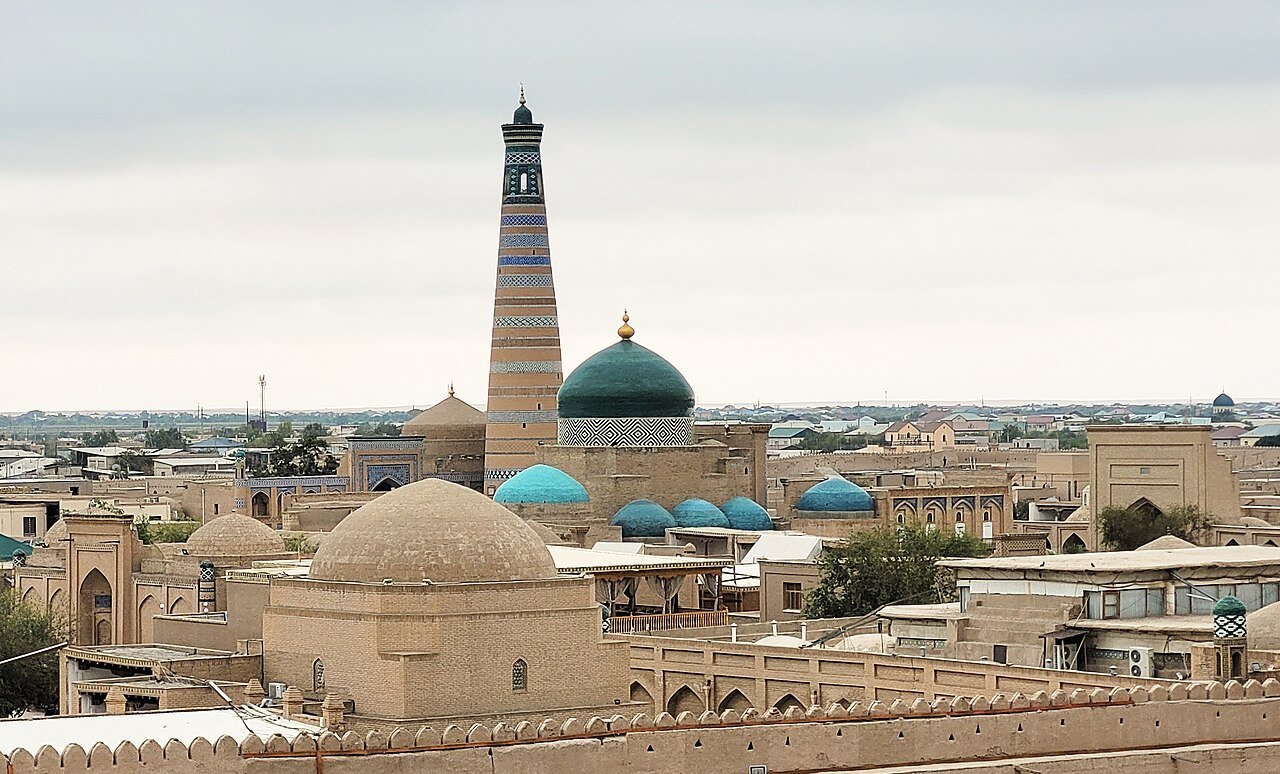
Itchan Kala, the walled inner city of Khiva in western Uzbekistan, was inscribed on the UNESCO World Heritage List in 1990 as the most completely preserved medieval Central Asian city in existence. Within 10 hectares enclosed by 10-metre-high mud-brick walls, more than 50 historic monuments survive in a state of authentic urban continuity that Samarkand and Bukhara — larger and more celebrated — cannot match, because Khiva was never substantially rebuilt or modernised. Silk Road caravansaries, elaborately tiled minarets, carved wooden mosques and a palace of 163 rooms together document a thousand years of Khwarazmian civilisation at the edge of the Karakum Desert.
The Walled City and Its Monuments Khorezm Region, western Uzbekistan
Itchan Kala — “inner fortress” in the Uzbek language — is the historic core of Khiva, enclosed by walls that date in their current form to the 17th century and earlier, pierced by four monumental gates: Ota Darvoza (Father Gate, to the north), Polvon Darvoza (Hero Gate, to the east), Bagcha Darvoza (Garden Gate, to the south) and Tosh Darvoza (Stone Gate, to the west). The walls stand between 8 and 10 metres high and are built entirely of rammed and fired mud brick — a technique refined over millennia in the arid climate of the Khorezm oasis, where the Amu Darya river provided both irrigation and the alluvial clay from which the brick was made.
The Islam Khodja Minaret, completed in 1910, is the tallest structure in Khiva at 45 metres, and with its 104 interior steps provides the best panoramic view of the walled city. It was built by Islam Khodja, the reformist grand vizier of the last Khan of Khiva, who also founded the first secular school in the emirate. The minaret’s slender, elegantly proportioned shaft is faced with alternating bands of light and dark terracotta tile; the adjoining Islam Khodja Madrasa, constructed at the same time, is now a museum of applied arts. The Islam Khodja complex represents the last architectural flourishing of the Khivan khanate before Russian dominance ended the independent political order of Central Asia.
The Kalta Minor — the “Short Minaret” — is perhaps the most immediately recognisable structure in Khiva, and one of the most distinctive in all of Central Asian architecture. Its fat, truncated form (29 metres tall, with a base diameter of 14.2 metres) and its cladding of turquoise, green and white glazed tile give it the appearance of a minaret that has been compressed or foreshortened. This is because it was never finished. Muhammad Amin Khan, who began its construction in 1851, intended it to become the tallest minaret in the Islamic world at 70 metres — a statement of the Khivan khanate’s ambition at a moment when Russian pressure on its borders was intensifying. Muhammad Amin Khan was killed in battle against the Persians at Merv in 1855, and construction halted immediately. The Kalta Minor has stood at its current height ever since, an involuntary monument to interrupted ambition.
The Juma Mosque is one of the oldest continuously used religious buildings in Central Asia, with its origins in the 10th century, though the current structure dates from an 18th-century reconstruction. Its most extraordinary feature is its hypostyle interior: a forest of 213 wooden columns, no two quite alike, supporting a flat mud-brick ceiling punctuated by 113 small domed skylights that filter natural light across the carved surfaces below. Twenty-one of the columns are from the original 10th-century mosque and are among the finest examples of early Islamic woodcarving in existence. The total silence of the interior — the thick walls and earthen floor absorb all ambient sound — combined with the dim, shifting light through the skylights makes the Juma Mosque one of the most atmospheric interiors in Central Asia.
The Tosh-Hovli Palace and the Slave Trade 450 km from Tashkent, near Turkmenistan border
The Tosh-Hovli Palace, built between 1832 and 1841 under Khan Allakuli, is the most ornate secular building in Khiva. Its 163 rooms, arranged around six interconnected courtyards, were intended to demonstrate that the Khivan khanate could rival the most sophisticated courts of the Islamic world, while using exclusively local artisans and materials. The harem courtyard is the most celebrated space: its walls are clad floor to ceiling in polychrome majolica tile in geometric and floral patterns of extraordinary intricacy, with carved wooden columns supporting carved and painted wooden porticoes. The blue, white, turquoise and ochre tilework of the Tosh-Hovli harem represents the apex of the Khivan decorative tradition, which drew on Persian and Timurid precedents but developed a distinctly local vocabulary of angular geometric forms combined with dense floral arabesque.
Khiva’s historical importance in the Silk Road economy cannot be disentangled from one of its darkest distinctions: it was the last active slave market of the Silk Road, a trade that continued until the Russian military conquest of 1873. Slaves — primarily Iranians, Russians and Circassians captured in raids across the steppe and desert — were traded in the main bazaar of Itchan Kala and formed a significant portion of the Khivan khanate’s economic activity. The Khan’s palace complex maintained a large enslaved population for construction, agricultural and domestic labour. The abolition of the slave trade was one of the conditions imposed by the Russian Empire following the military campaign that placed Khiva under Russian protectorate status in 1873, ending four centuries of independent khanate rule. The relationship between Khiva’s magnificent architectural heritage and the enslaved labour that built much of it is one that the site’s interpretation has begun, slowly, to address.
The surrounding Khorezm region preserves an extraordinary concentration of older fortresses — kala — scattered across the desert and agricultural land around Khiva. Toprak Kala (3rd–4th century CE), Ayaz Kala (1st–8th century CE) and Kyzylkala are among the most accessible, reached by guided jeep tours from the city. These mudbrick citadels, some preserved to near-full height by the desiccating desert air, document the Khwarazmian kingdom of antiquity — a state first mentioned in Achaemenid Persian records of the 6th century BCE and later described by Arab geographers as one of the wealthiest and most densely populated regions of the medieval Islamic world, before the Mongol invasion of 1221 CE devastated its irrigation infrastructure and drastically reduced its population.
Khiva today is home to approximately 50,000 people, of whom a significant number live within or immediately adjacent to the walled city. Itchan Kala functions simultaneously as a living neighbourhood and a UNESCO monument, a duality that produces occasional tensions between the conservation imperative and the needs of a resident community. The outer city, Dishon Kala, preserves the 19th-century bazaar streets and a number of important mosques and madrasas that fall outside the UNESCO boundary.
Practical information
Khiva is served by Urgench Airport (40 km), which has direct flights from Tashkent (approximately one hour), and connections to Moscow and other regional cities. From Urgench, shared taxis and minibuses run to Khiva. The train from Tashkent to Urgench takes approximately 14 hours; overnight trains are available. Itchan Kala is open to visitors at all hours, though the individual monuments have their own opening times (generally 09:00 to 17:00); a combined ticket covering the main museums and monuments is available at the city gates. The most rewarding season is April to June and September to October; July and August can exceed 40°C and the city is very crowded with domestic tourists. Hotels inside the walled city, including several boutique properties converted from historic buildings, offer the most atmospheric accommodation. The neighbouring Silk Road cities of Bukhara and Samarkand are accessible by road or rail and together with Khiva form the standard Uzbekistan heritage itinerary.
Frequently Asked Questions
What makes Itchan Kala different from Samarkand and Bukhara?
All three cities were major nodes on the Silk Road and are UNESCO World Heritage Sites, but Itchan Kala occupies a distinct position among them. Samarkand and Bukhara — much larger, richer and more politically prominent — were repeatedly rebuilt and expanded by successive rulers, most dramatically by Timur (Tamerlane) and the Timurid dynasty in the 14th and 15th centuries, who imported architects and craftsmen from across the Islamic world and constructed monuments of staggering ambition. Both cities continued to grow and change in the 18th, 19th and 20th centuries, incorporating significant amounts of Soviet-era construction. The result is that the historic monuments of Samarkand and Bukhara are extraordinary in their individual brilliance but exist within a heterogeneous urban fabric that spans multiple eras. Itchan Kala, by contrast, is smaller, less politically central and consequently less rebuilt. The medieval urban structure — the street pattern, the scale of the buildings, the relationship between the residential quarters and the monumental core — survives largely intact, providing an experience of a complete medieval Central Asian city that neither Samarkand nor Bukhara can offer. This is precisely the quality that UNESCO recognised in the 1990 inscription, which specifically noted Itchan Kala’s “exceptional integrity” as a criterion for its outstanding universal value.
Why was the Kalta Minor never finished, and why is it so famous in its incomplete state?
The Kalta Minor was begun in 1851 by Muhammad Amin Khan, the most powerful ruler of the Khivan khanate in the 19th century, with the stated intention of making it the tallest minaret in the Islamic world — the plan called for a height of approximately 70 metres. The project was a statement of political ambition at a moment of increasing Russian pressure on the khanate’s northern and eastern borders: a monument of superlative scale would project the authority and permanence of Khivan civilisation against an existential external threat. Muhammad Amin Khan was killed in battle against the Persians at Merv (in present-day Turkmenistan) in 1855, before the minaret could be more than partially completed. Construction stopped immediately upon news of his death, and the Kalta Minor has stood at its current height of 29 metres ever since. Its truncated form is the accident of history, but it has become one of the most admired silhouettes in Central Asian architecture: the fat, compressed proportions and the dense polychrome tile cladding in turquoise, green, white and blue — which would have been progressively revealed as the shaft rose to its intended height — give the finished portion a visual completeness and monumentality far exceeding what a conventionally proportioned minaret of the same height would have. The Kalta Minor demonstrates, inadvertently, the aesthetic power of the Khivan decorative tradition in isolation.
What is the significance of the 213 wooden columns in the Juma Mosque?
The Juma Mosque’s hypostyle interior — a flat-roofed hall supported by a grid of free-standing wooden columns — is one of the most distinctive architectural spaces in Central Asia, and its 213 columns are its defining feature. Unlike the colonnaded mosques of the Arab world, which were typically built in stone or brick, the hypostyle tradition in Central Asia developed in wood, drawing on ancient Zoroastrian and pre-Islamic architectural precedents in which the column was a sacred and symbolic element as much as a structural one. The Juma Mosque columns vary considerably in their carving and age: 21 of them date from the original 10th-century mosque and are among the oldest surviving examples of Islamic woodcarving in Uzbekistan, displaying geometric interlace patterns that predate the more elaborate arabesque traditions that developed under Timurid influence. The remaining columns were added, replaced and carved over successive centuries, creating an involuntary record of evolving taste. The forest of columns — with no two quite identical, rising to a ceiling punctuated by 113 small domed skylights — creates an interior effect of mystery and depth that is entirely unlike the wide-span domed interiors of the great Timurid mosques. It is a space best experienced in the morning, when the angle of the sun through the skylights casts moving shafts of light across the carved surfaces and earthen floor.
Sources
- S1 — Knobloch, Edgar. Monuments of Central Asia: A Guide to the Archaeology, Art and Architecture of Turkestan. I.B. Tauris, 2001. ISBN 978-1-86064-590-7.
- S2 — MacLeod, Calum, and Bradley Mayhew. Uzbekistan: The Golden Road to Samarkand. Odyssey, 2008. ISBN 978-962-217-795-6.
Spotted an error? Write to editorial@culturalheritageonline.com and we correct it the same day.