Harar Jugol, the Fortified Historic Town, inscribed in 2006, is the most important Islamic city in sub-Saharan Africa — the fourth holy city of Islam (after Mecca, Medina, and Jerusalem in the traditional Harar reckoning), a walled city of 82 mosques, 102 shrines, and over 3,000 traditional Harari houses (the densest concentration of mosques per square kilometre in the world) that has been continuously inhabited since its founding in the seventh century CE.
Harar Jugol: The Islamic City of Eastern Ethiopia Harari Region, eastern Ethiopia
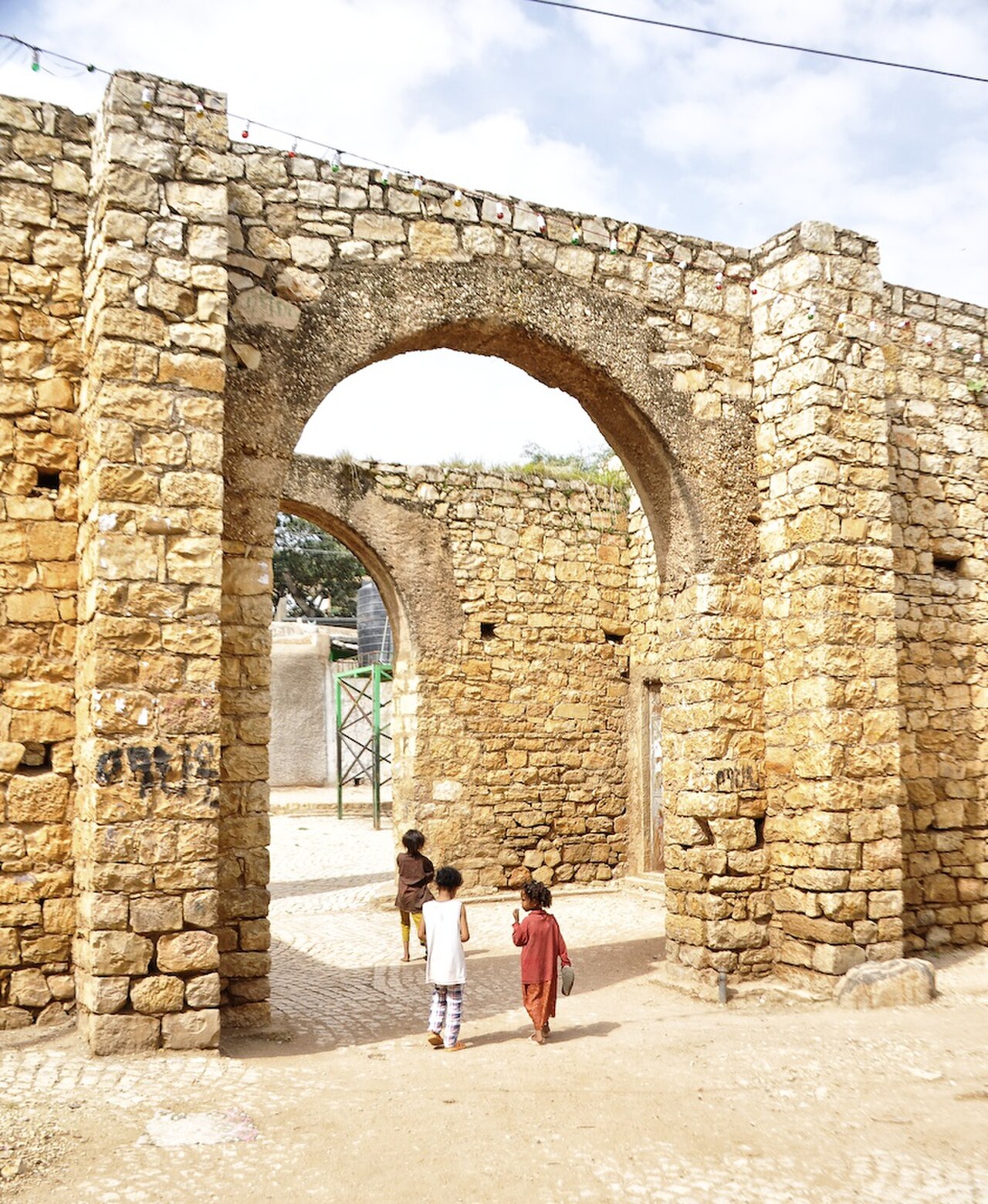
Harar Jugol (Jugol meaning “the wall” in the Harari language), inscribed in 2006 under criteria (ii), (iii), (iv), and (v), is the historic core of the city of Harar — a fortified Islamic city on the eastern Ethiopian plateau at 1,885 metres elevation, 520 km east of Addis Ababa, that has been one of the most important centres of Islamic scholarship, trade, and culture in sub-Saharan Africa since the tenth century CE. The Jugol (the city wall, built by Emir Nur in 1551 CE in response to the Oromo migrations, with five gates corresponding to the five founding communities of the city) encloses an area of approximately 48 hectares — a dense urban fabric of narrow alleys (some less than 1 metre wide), 82 active mosques (the largest is the Jami Mosque, the central Friday mosque, founded sixteenth century but repeatedly rebuilt), 102 shrines of local saints (the awliya, “friends of God”), and approximately 3,000 traditional Harari houses (gegar — rectangular two-storey structures of local stone and mud with elaborately decorated interior walls hung with woven baskets and covered with traditional Harari textiles). The Harari people (approximately 25,000 within the Jugol, 100,000 in the broader region) are a distinct Semitic-speaking ethnic group whose language (Ge’ez-derived Harari, or ‘Adare) is spoken only in Harar and is UNESCO-listed as an endangered language. Harar is also famous for its coffee trade (Harar longberry coffee, one of the oldest and most distinctive Ethiopian coffee varieties) and for the nightly ritual of the hyena men (individuals who feed wild spotted hyenas that come to the city gates after dark — a tradition that has continued for approximately 500 years).
The 82 Mosques and Arthur Rimbaud’s House Harar Jugol historic walled city
The concentration of 82 mosques within 48 hectares (one mosque per 0.6 hectares) makes Harar’s mosque density the highest of any city in the world per unit area. The mosques range from the large Jami Mosque (central, Friday congregational mosque, accessible to non-Muslims by request outside prayer times) to tiny neighborhood mosques (masjid) accommodating 10–20 worshippers, reflecting the neighborhood-scale organization of Islamic city life. The Harari domestic architecture is equally distinctive: the gegar (traditional Harari house) has a narrow street facade (3–5 metres wide) and an interior organized around a central room (the naggad bet) whose walls are covered floor to ceiling with traditional Harari wicker baskets (the most decorated domestic interior in East Africa); the beds and furniture fold against the walls, and the room is used as a reception room for guests and ceremonies. Arthur Rimbaud, the French poet (1854–1891), lived in Harar from 1880 to 1891 as a coffee and arms trader (having completely abandoned poetry after his early work); his house (Maison Rimbaud, now a museum) is one of the best-preserved nineteenth-century European merchant houses in the city and documents the French commercial presence in the Ethiopia-Somalia coffee trade.
Dire Dawa and the Afar Rift Valley 🚌 ~1 hr west or ✈ domestic
Dire Dawa, 50 km west of Harar (1 hour by road) and served by Dire Dawa International Airport, is the principal transport hub for the Harar region — the second-largest city in Ethiopia (after Addis Ababa), a French colonial railway city built in 1902 as the terminus of the Addis Ababa–Djibouti railway (Chemin de Fer Ethiopien, the first railway in Ethiopia). The city’s Kafira quarter (the old town) and the French-built Kezira quarter (the colonial residential area) preserve the most complete French Indochina-influenced colonial architecture in East Africa. The Awash National Park (200 km northwest, in the Afar Rift Valley) is adjacent to the Lower Valley of the Awash (UNESCO World Heritage, inscribed 1980 under criteria (ii) and (iii)), which contains the site where Donald Johanson discovered the Australopithecus afarensis specimen “Lucy” in 1974 — the most complete and oldest known hominid skeleton at the time of its discovery (3.2 million years old). The Danakil Depression (150 km northeast) — one of the most extreme environments on Earth (temperatures reaching 55°C at the Dallol hydrothermal fields, 116 metres below sea level) — is accessible from Harar or Dire Dawa for adventure tourism.
Practical information
Harar is accessible by direct road from Addis Ababa (520 km, 7 hours by bus or 1.5 hours by domestic flight to Dire Dawa, then 1 hour by taxi to Harar). Ethiopian Airlines serves Dire Dawa from Addis Ababa several times daily. The Jugol is best explored on foot with a guide (the alleys are complex and a Harari guide provides context for the mosques, shrines, and domestic architecture); licensed guides are available at the main gate (the Erer/Shoa Gate). The hyena feeding ritual takes place nightly just outside the Fallana Gate at approximately 6–8 p.m.; the “hyena men” charge a fee for the experience. The best season is October–February (dry and cool). Note: Harar is in a region that has experienced periodic security concerns; current travel advisories should be consulted before visiting eastern Ethiopia.
Frequently Asked Questions
Is Harar a UNESCO World Heritage Site?
Yes. Harar Jugol, the Fortified Historic Town, was inscribed in 2006 under criteria (ii), (iii), (iv), and (v). The inscription covers the walled city of Harar — the Jugol enclosure of 48 hectares with its five gates, 82 mosques, 102 shrines, and approximately 3,000 traditional Harari houses. Ethiopia has 11 UNESCO World Heritage Sites (as of 2024), including the Rock-Hewn Churches of Lalibela (1978), the Simien National Park (1978), the Fasil Ghebbi of Gondar (1979), the Lower Valley of the Awash (1980), the Lower Valley of the Omo (1980), the Aksum inscriptions and stelae (1980), the Tiya standing stones (1980), the Harar Jugol (2006), the Konso Cultural Landscape (2011), the Gedeo Cultural Landscape (2023), and the Bale Mountains National Park (2024).
Why is Harar called the fourth holy city of Islam?
Harar’s claim to be the fourth holy city of Islam (after Mecca, Medina, and Jerusalem) derives from a local Islamic scholarly tradition (not universally recognized in the wider Muslim world) that emphasizes the city’s exceptional concentration of mosques, shrines, and Islamic learning, and the presence within the Jugol of the tombs of 87 awliya (Islamic saints). The city was the seat of an independent Islamic emirate from approximately the tenth century CE to 1887, when it was conquered by Emperor Menelik II of Ethiopia. During this independent period, it was the most important centre of Islamic scholarship in sub-Saharan Africa — a role comparable to Timbuktu in West Africa. The city was closed to non-Muslims until Richard Burton disguised himself as an Arab and entered it in January 1855, becoming the first documented European to enter and leave Harar alive (a feat he described in his 1856 “First Footsteps in East Africa”).
Who was Arthur Rimbaud and why did he go to Harar?
Arthur Rimbaud (1854–1891) is considered one of the most significant poets of the French Symbolist movement and the direct precursor of Surrealism and the Dada avant-garde — his major work was written between the ages of 15 and 20 (Une Saison en Enfer, Les Illuminations), after which he completely abandoned literature and spent the last 11 years of his life as a trader in East Africa and Yemen. He arrived in Harar in 1880 as a coffee broker, then arms dealer (trading weapons to King Menelik of Shewa), settling in the Jugol as one of a small European merchant community. He wrote letters home to his family throughout this period that are now considered among the most important documents of nineteenth-century European life in East Africa; in none of them does he mention his literary past. He returned to France in 1891 with bone cancer in his right knee, had his leg amputated, and died in Marseille at the age of 37.