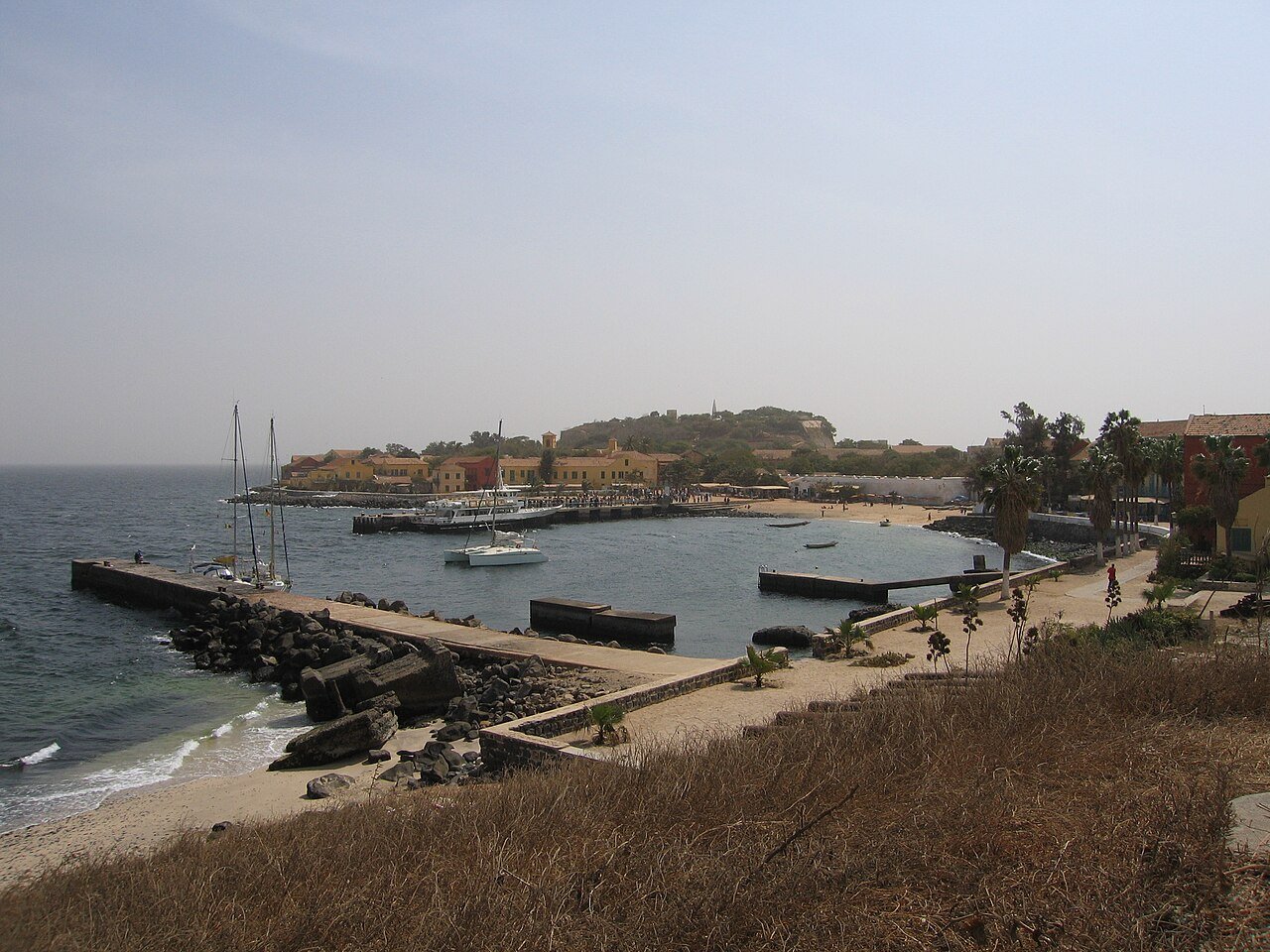
Île de Gorée is a 28-hectare island two kilometres off the Dakar peninsula, reachable in twenty minutes by ferry, and it holds in concentrated form nearly five centuries of Atlantic history — Portuguese anchorage, Dutch fortification, French colonial town, major node in the transatlantic slave trade — compressed into a car-free community of painted colonial houses, bougainvillea and the constant presence of the sea. It has been visited by four heads of state specifically to stand at the Doorway of No Return in the Maison des Esclaves (House of Slaves), and it is one of the sites in the world where the physical space still corresponds closely to the historical act that defined it.
Five centuries of Atlantic power and the trade in human beings History & Memory
Portuguese navigators were the first Europeans to use Gorée as an anchorage, establishing a presence on the island in the 15th century as part of their systematic exploration of the West African coast. The Dutch seized the island in 1617 and gave it its current name — from the Dutch Goede Reede, meaning “good harbour” — and began building the fortifications that would make it a contested colonial possession through the 17th and 18th centuries. Gorée changed hands between the Dutch, English and French eight times between 1617 and 1677, when France established permanent control and began the systematic development of the island as a trade and administrative centre for the growing French presence in West Africa.
The island’s most significant historical function was as a holding point in the transatlantic slave trade. Between the 15th and 19th centuries, an estimated 20 million Africans were transported across the Atlantic in the slave trade, and Gorée was one of the major embarkation points on the West African coast, serving the trade that fed the plantation economies of the Caribbean, Brazil and North America. Enslaved Africans were held in slave houses (maisons d’esclaves) in conditions calculated for maximum throughput: small cells designed to hold multiple people with minimal space, a central courtyard for processing and inspection, and a ground-floor exit facing the sea where the enslaved were loaded directly onto longboats for transfer to the slave ships anchored in the harbour.
The Maison des Esclaves (House of Slaves) on Gorée was built in 1776 and is the best-preserved of these structures. Its curator for many decades, Joseph Ndiaye, transformed it from a historical artifact into a site of active memory — his guided tours, conducted until his death in 2009, made the building one of the most emotionally powerful heritage sites in Africa, and his testimony shaped the experience of every prominent visitor from Nelson Mandela (1991) to Pope John Paul II (1992) to Bill Clinton (1998) to Barack Obama (2013). The pink-and-ochre colonial façade facing the courtyard, the narrow doorway opening directly onto the sea, and the cramped holding cells have become one of the defining images of the Middle Passage and of African diaspora memory.
Historical scholarship has debated the actual number of enslaved people who passed through Gorée specifically — some researchers argue that the island’s contribution to the overall trade has been overstated relative to the mainland ports of Dakar and Saint-Louis — but the broader significance of the site as a place of memory and testimony is not diminished by these quantitative debates. Gorée is not solely a statistical record; it is a place where the physical space of captivity survives with exceptional clarity, and where the emotional and political significance of that survival is actively maintained by its community and government.
UNESCO inscribed Île de Gorée in 1978, making it one of the earliest African sites on the World Heritage List and the first Senegalese UNESCO inscription. Beyond the Maison des Esclaves, the island preserves a complete stock of 18th and 19th-century French colonial architecture: the governor’s palace, the military hospital (now the Historical Museum), artillery batteries, a Creole-style church, and the graceful two-storey residential buildings with ground-floor commercial spaces and first-floor balconied residences that characterise the signare house type — a building form developed by the signares, the mixed-race women of Franco-African descent who were the commercial elite of colonial Gorée and whose economic influence shaped the island’s social structure.
Living island, diaspora memory and the weight of historical tourism Culture & Present
Gorée today has approximately 1,000 permanent residents — fishermen, artists, school teachers, ferry workers — living alongside the heritage infrastructure that draws several hundred thousand visitors annually. The absence of motor vehicles (the island is car-free; the only motorised transport is the island’s ambulance) gives it an immediate sensory distinction from mainland Dakar: the dominant sounds are the sea, human voices and roosters. The pace adjusts correspondingly. The baobab trees in the courtyards, the cats sleeping on the harbour walls, the fishing pirogues drawn up on the beach below the Castel fortification — none of this is performed for tourists; it is simply how the island functions.
The relationship between the living community and the heritage economy is not without tension. The concentration of tourist infrastructure around the Maison des Esclaves creates pressure on the rest of the island’s architectural stock, and the commercialisation of memory — souvenir stalls outside the slave house, guided tour circuits that move visitors through the emotional high points efficiently — is a dynamic that the island’s residents and managers continue to negotiate. Several artists’ studios and independent galleries operate in the island’s residential quarters, representing a counter-current to the official heritage circuit.
The ferry to Gorée runs from Dakar’s Embarcadère du Port de Pêche approximately every hour, with more frequent departures in the morning. The crossing takes 20–25 minutes. The ferry is cheap — one of the most affordable UNESCO site access journeys in the world — and runs throughout the year. Weekends bring the highest visitor numbers; weekday mornings in the dry season (November to May) offer the quietest access.
The nearest UNESCO site is the Island of Saint-Louis (UNESCO 2000), 270 kilometres north of Dakar by road — roughly 3 hours — also a French colonial island settlement with significant slave-trade history, though oriented more toward its role as first capital of Senegal and French West Africa. A two-city Senegalese UNESCO circuit is entirely practical for visitors with three to four days.
Practical information
Getting there: Ferries depart Dakar’s fishing port (Embarcadère du Port de Pêche, near the Plateau district) approximately every hour from 06:30. Journey time: 20–25 minutes. Return ferries run until approximately 19:00. Tickets are purchased at the embarkation point. Blaise Diagne International Airport (DSS) is 47 km from Dakar; Léopold Sédar Senghor Airport (DKR, now used for domestic/regional flights) is closer to the city centre.
Entry: The island itself is freely accessible. The Maison des Esclaves charges a modest entry fee; guided tours (in French and English) are included. The Historical Museum (in the former military hospital) charges separately. Most of the rest of the island is walkable without fee.
When to go: November to May (dry season). June to October brings the West African monsoon, with high humidity and occasional heavy rain. The island is pleasant year-round but most comfortable in the dry season.
Practical notes: No ATMs on the island; bring cash from Dakar. Restaurants and simple cafés are available near the ferry landing. The island is small enough to walk completely in two hours; plan at least four hours to do it properly, including the Maison des Esclaves and the Historical Museum.
Frequently Asked Questions
Is the Maison des Esclaves the only building of its kind on Gorée?
No — the Maison des Esclaves (House of Slaves, built 1776) is the best preserved and most visited of several slave houses that once operated on the island, but Gorée had a significant number of such buildings at the peak of the slave trade in the 18th century. Historical records and archaeological survey have identified at least fifteen structures on the island that functioned wholly or partly as slave-holding facilities, though most have been converted, demolished or absorbed into later construction. What makes the Maison des Esclaves exceptional is not uniqueness of function but completeness of physical survival: the courtyard, the ground-floor cells, the first-floor residential quarters (where the slave dealer lived in relative comfort above the holding cells), and the famous doorway to the sea all survive in a condition that allows the spatial logic of the original building to be read clearly. The building was restored and opened as a memorial and museum in the 1960s, and Joseph Ndiaye’s decades as its curator transformed it from an architectural survival into an active site of testimony and international memory. The Historical Museum in the former French military hospital (built 1864) holds artefacts and documentation related to the island’s full five-century history, including pre-colonial, slave-trade and colonial-era material, and provides useful context for the Maison des Esclaves visit.
Which world leaders have visited Île de Gorée and why does it matter politically?
The list of prominent visitors to Gorée, and specifically to the Doorway of No Return in the Maison des Esclaves, reads as a register of post-colonial diplomatic acknowledgment: Pope John Paul II visited in 1992 and offered prayers for the victims of the slave trade; Nelson Mandela visited in 1992 shortly before his release from prison became the catalyst for South Africa’s transition; Bill Clinton visited in 1998 and offered a carefully worded statement acknowledging American complicity in the slave trade without a formal apology (a distinction that generated political debate); Barack Obama visited with his family in 2013, making the visit an explicit personal statement about African-American historical identity. These visits are not merely symbolic — they are political acts that constitute the site as a place of international reckoning, and they have significantly raised its global profile and the number of visitors from the African diaspora who make deliberate pilgrimage-style journeys to Gorée. The pattern also reflects a broader phenomenon in the politics of slave-trade memory: the physical site provides a specific location for rituals of acknowledgment that would otherwise have no spatial anchor. Gorée functions as a surrogate for the dispersed, mostly invisible geography of the Middle Passage — a geography that has no surviving monuments on the water itself, and whose West African origins are distributed across thousands of kilometres of coastline.
How historically accurate is Gorée’s reputation as the major slave-trade embarkation point?
This is a genuinely contested question in academic history, and visitors to the site should be aware of the debate without allowing it to diminish the significance of what they are seeing. Gorée was certainly a significant slave-trade node, but some historians — notably Ephraim Isaac and Philip Curtin in the 1990s and 2000s — argued that the island’s reputation as the point through which millions of enslaved Africans passed was significantly overstated relative to the historical documentation. Their research suggested that the larger mainland ports of Dakar, Saint-Louis and the trading posts further up the Senegalese coast accounted for far more of the actual trade volume than Gorée, and that the number of people held in the Maison des Esclaves at any one time was in the dozens rather than the hundreds suggested by some popular accounts. These arguments were contested by other scholars and by Gorée’s own historians, and the debate remains unresolved in the quantitative details. What is not contested is that the slave trade happened, that Gorée was part of it, that the physical infrastructure of that trade survives on the island, and that the site’s symbolic power as a place of memory is real and significant regardless of where the quantitative debates eventually settle. The UNESCO inscription recognised both the historical significance and the memorial function of the site, and that dual recognition remains appropriate.
Sources
- S1 — Barry, Boubacar. Senegambia and the Atlantic Slave Trade. Cambridge University Press, 1998. ISBN 978-0-521-59760-9.
- S2 — Diène, Doudou, ed. From Chains to Bonds: The Slave Route Projects. UNESCO Publishing, 2001. ISBN 978-92-3-103779-5.
Spotted an error? Write to editorial@culturalheritageonline.com and we correct it the same day.