
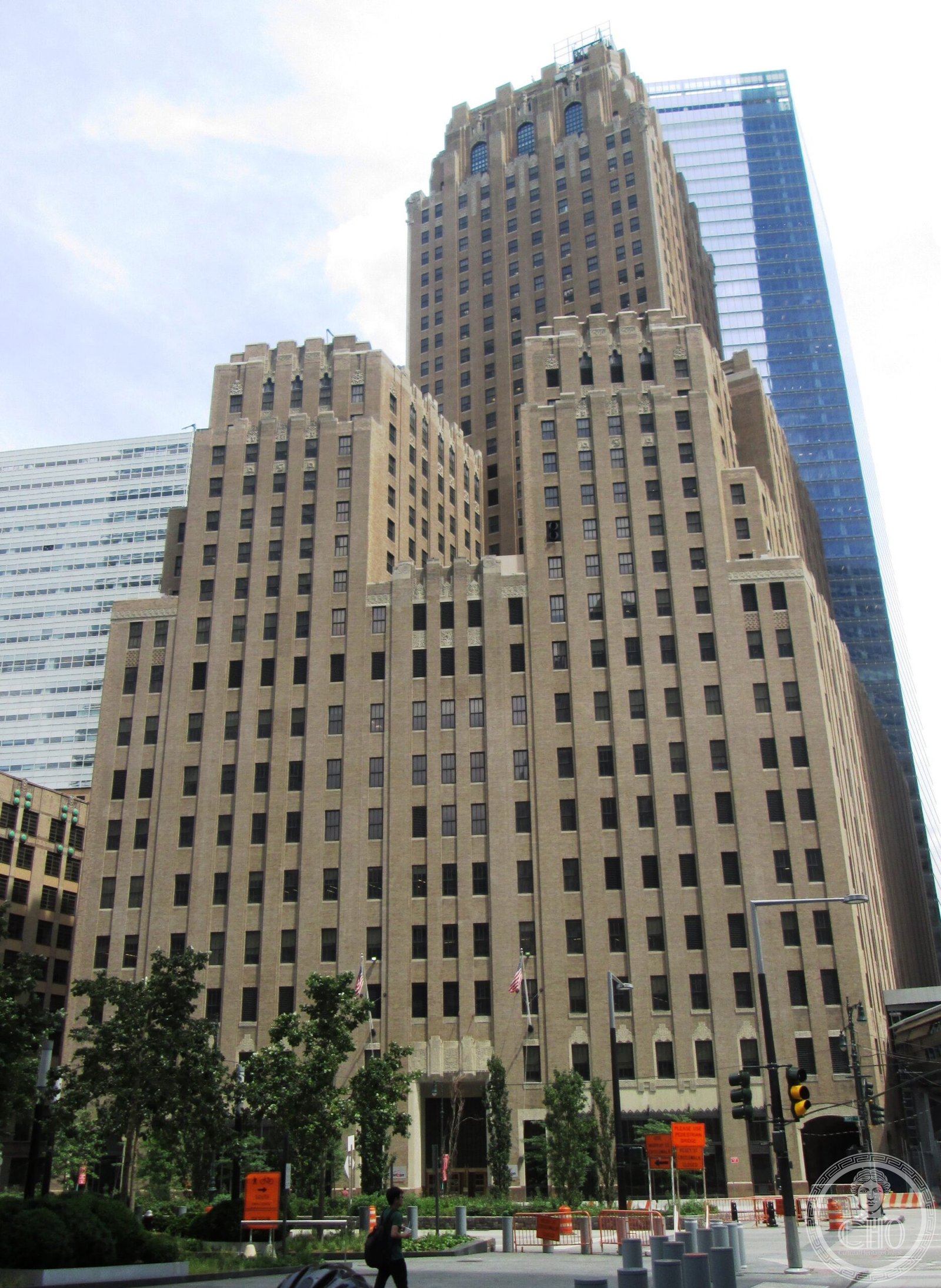
Barclay-Vesey Building
Ralph Walker’s 1927 telephone exchange tower at 140 West Street was the first major New York building to transform the zoning setback into a design principle, producing an organic, tapering silhouette that influenced a generation of American skyscraper design.
At a glance
The Barclay-Vesey Building at 140 West Street in Lower Manhattan was completed in 1927 as the headquarters of the New York Telephone Company and remains a landmark of the transition between Beaux-Arts commercial architecture and the fully realised Art Deco skyscraper. Ralph Walker used the 1916 Zoning Resolution’s setback requirements not as a constraint but as an expressive tool, producing a tower that tapers toward its crown through a series of carefully proportioned steps rather than mechanical “wedding cake” recessions. The terracotta ornament, incorporating stylised flowers and abstract Art Deco motifs, increases in density toward the upper floors. The building was named after the Barclay and Vesey telephone exchange prefixes that originated in this part of Lower Manhattan.
Key facts
- Location: 140 West Street, between Barclay Street and Vesey Street, Lower Manhattan
- Architect: Ralph Walker
- Completed: 1927
- Floors: 32 stories
- Style: Art Deco with terracotta ornament; pioneering use of setback design
- Status: New York City Individual Landmark; National Register of Historic Places
- Original use: New York Telephone Company headquarters and central exchange
History
The New York Telephone Company needed a building that could house both a corporate headquarters and the switching equipment that routed calls across the growing metropolitan telephone network. The site at 140 West Street, in the industrial-transitional zone between the Financial District and the Hudson waterfront, was chosen for its large footprint, which allowed the massive switching floors required by early telephone technology.
Ralph Walker’s design solution was to treat the setback tower not as a diminished version of a traditional office building but as a new building type with its own logic. The successive setbacks — themselves required by the 1916 Zoning Resolution to allow light to reach the streets below — were used to model the exterior as an organic form, with the ornamental terracotta concentrated at the transitions between setback levels and intensifying toward the crown. Walker’s work on this building established him as one of the most innovative architects of the 1920s and led to commissions for several other major telephone company buildings across the United States.
The building was severely damaged on September 11, 2001, when the collapse of the nearby World Trade Center towers caused significant structural damage. It was subsequently restored and converted to residential use, retaining its original exterior character while adapting the interior for a different function.
What you see
The tower is best understood by stepping back on West Street to take in the full setback profile, which reads as a sequence of diminishing volumes rather than a stepped pyramid. The ornamental terracotta surfaces are visible at close range on the lower floors, where stylised flowers, geometric Art Deco panels, and the concentrated ornament of the entrance portal can be examined in detail. Walker’s use of terracotta in a warm brick-brown tone gives the exterior a warmth unusual in the stone-and-limestone vocabulary of most Manhattan skyscrapers of the period.
The original lobby retains elements of its Art Deco interior; the telephone exchange floors, which once contained equipment critical to the city’s communications infrastructure, have been adapted for residential conversion while the architectural shell is preserved.
Practical information
- Access: Now a residential building; exterior viewing only.
- Best viewing: From the Hudson River Greenway pedestrian path on the west side of West Street, which gives a clear view of the full setback profile.
- Time needed: 15–20 minutes for exterior; the adjacent World Trade Center site and St. Paul’s Chapel are a ten-minute walk east.
- Transit: Chambers Street station (2/3) is two blocks northeast; Cortlandt Street (E/W/R) is nearby.
Getting there
The Barclay-Vesey Building is at 140 West Street in Lower Manhattan, between Barclay and Vesey Streets. The nearest subway station is Chambers Street (2/3) two blocks north, and Fulton Center (A/C/J/Z/2/3/4/5) is approximately four blocks east. The World Trade Center PATH station is two blocks south. The building faces the Hudson River Greenway, making it accessible from Battery Park City to the south and from Chambers Street to the north.
Nearby
- Western Union Building / 60 Hudson Street (1930) — Another Ralph Walker telephone-infrastructure tower, four blocks north, showing the evolution of his setback idiom in a building of different program and scale.
- Woolworth Building (1913) — Cass Gilbert’s Gothic skyscraper, four blocks east, the most celebrated pre-Deco skyscraper in New York.
- St. Paul’s Chapel (1766) — Manhattan’s oldest public building still in continuous use, five blocks east, which survived September 11 intact and served as a relief centre.
- One World Trade Center (2014) — The contemporary supertall tower replacing the Twin Towers, three blocks south, whose antenna and spire reach 1,776 feet.
Sources
- New York City Landmarks Preservation Commission, Individual Landmark Designation Report: 140 West Street (Barclay-Vesey Building).
- National Register of Historic Places nomination, Barclay-Vesey Building.
- Stern, Robert A. M., Gregory Gilmartin, and Thomas Mellins. New York 1930. Rizzoli, 1987.
- Krinsky, Carol Herselle. Rockefeller Center. Oxford University Press, 1978.
- Wikipedia, “Barclay–Vesey Building,” https://en.wikipedia.org/wiki/Barclay–Vesey_Building.
Find it on the map
See this place and what’s around it →📷 Diventa un fotografo di Cultural Heritage Online
Condividi le tue foto dei luoghi: restano pubblicate con la tua firma come autore. Più vengono viste, più ti fai conoscere — e presto un concorso premierà le foto più apprezzate.
Accedi o registrati gratis per aggiungere una fotoDo you manage this place?
This page is read by travellers and heritage enthusiasts who find it on Google. Keep it accurate — and make it work for you. Free for non-profit heritage institutions.