
Milwaukee’s most characterful Art Deco tower is crowned by an illuminated rooftop flame that has served as both a weather indicator and a civic landmark since the building opened in 1930.
At a glance
The Wisconsin Gas Building at 626 East Wisconsin Avenue in Milwaukee was completed in 1930 for the Wisconsin Gas Light Company, designed by the local firm Eschweiler & Eschweiler. The 20-story tower is faced in light brick and cast stone, with Art Deco ornament concentrated at the entrance portal and crown, where a large illuminated gas flame has been maintained as a landmark. The flame changes colour to serve as a weather indicator visible across downtown Milwaukee, a practical function that gave the building an identity beyond its architectural character alone. The building has been known since the 1980s by the name of its later owner, We Energies, but retains its original exterior and its distinctive rooftop installation.
Key facts
- Location: 626 East Wisconsin Avenue, Milwaukee, Wisconsin
- Architect: Eschweiler & Eschweiler
- Completed: 1930
- Floors: 20 stories
- Style: Art Deco with brick and cast-stone facing
- Feature: Rooftop illuminated flame, used as a weather indicator
- Current name: We Energies Building
History
The Wisconsin Gas Light Company commissioned the building at the peak of Milwaukee’s commercial construction boom, which ran from the mid-1920s through the early years of the Depression. Eschweiler & Eschweiler, a Milwaukee firm with an established practice in institutional and commercial buildings, designed the tower in the Art Deco idiom then dominant for commercial construction. The company’s choice of a visible flame at the crown was both practical and promotional: the flame indicator was a literal advertisement for the gas utility and a daily public service, as Milwaukeeans could read the weather from the building’s crown before leaving for work.
The building changed hands over the decades as the Wisconsin gas industry consolidated and was eventually acquired by We Energies. The rooftop flame has been maintained and remains one of the most distinctive corporate landmarks in the American Midwest. The building’s location on Wisconsin Avenue, Milwaukee’s main commercial corridor, means that the flame is visible along the length of the street and from much of the lakefront area.
What you see
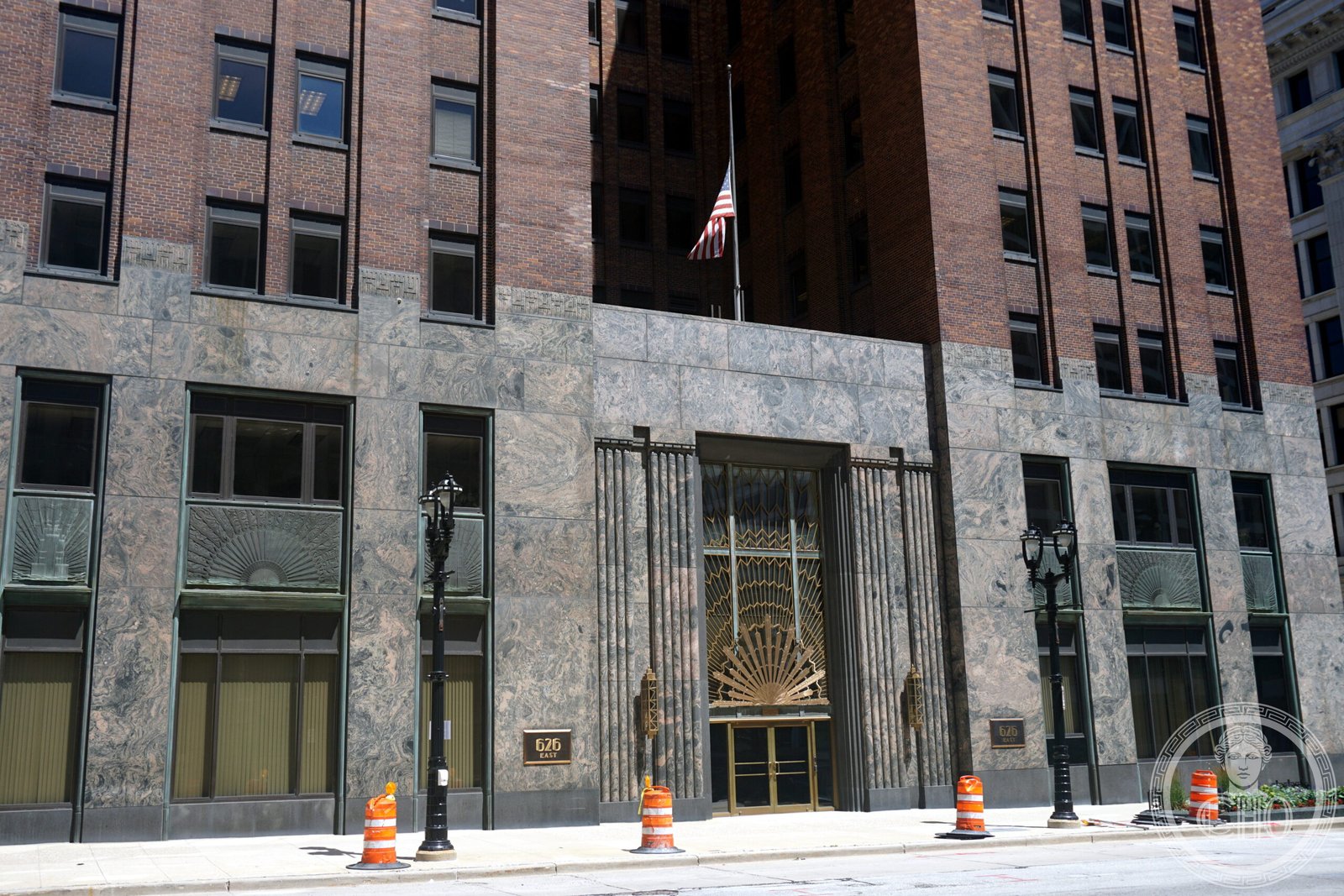
The tower presents a symmetrical facade on Wisconsin Avenue with a base of polished stone and a body of brick punctuated by regular windows. The ornamental programme is restrained: cast-stone details at the entrance and at the setback transitions mark the vertical divisions without the profusion of ornament found in the more theatrical Deco towers of New York or Chicago. The crown is the building’s most vivid element: the flame installation rises above the roofline and at night glows across downtown Milwaukee, a warm orange against the lake-effect sky.
The entrance lobby retains original Art Deco metalwork and the proportions typical of 1920s Milwaukee commercial interiors: generous ceiling height, polished stone floors, and bronze elevator doors. The street-level arcade along Wisconsin Avenue gives the building a civic presence that extends beyond its own footprint.
Practical information
- Access: Working office building; lobby accessible during business hours.
- Best viewing: The flame is best seen at dusk or after dark from Wisconsin Avenue or from the lakefront.
- Time needed: 15 minutes for exterior and lobby; combine with the Riverside Theater and the Milwaukee Art Museum for a broader architectural walk.
- Transit: Multiple bus lines on Wisconsin Avenue; Milwaukee Intermodal Station (Amtrak) about three blocks east.
Getting there
The Wisconsin Gas Building is in downtown Milwaukee at 626 East Wisconsin Avenue, within easy walking distance of the Milwaukee Intermodal Station (Amtrak and Greyhound) three blocks east. Milwaukee Mitchell International Airport (MKE) is approximately seven miles south, accessible by Milwaukee County Transit System buses. By car, the building is one block west of the Milwaukee River on Wisconsin Avenue, with public parking in garages on adjacent streets.
Nearby
- Riverside Theater (1928) — Milwaukee’s Art Deco performing arts venue two blocks east, an atmospheric interior with Spanish Baroque ornament.
- Milwaukee Art Museum (Calatrava wing, 2001) — The lakefront museum complex with the iconic movable brise-soleil wing, approximately seven blocks east on the Lake Michigan shore.
- Pabst Mansion (1892) — The Flemish Renaissance residence of Milwaukee’s brewing dynasty, three blocks west on Wisconsin Avenue.
- Milwaukee Public Library (1898) — A Beaux-Arts civic building two blocks west, housing an extensive local history collection relevant to Milwaukee’s architectural development.
Sources
- City of Milwaukee Historic Preservation Commission, Wisconsin Avenue Corridor documentation.
- Zimmermann, H. Russell, and Sadja Zimmermann. Magnificent Milwaukee: Architectural Treasures, 1850–1920. Milwaukee Art Museum, 1987.
- We Energies corporate history archives.
- Wisconsin Historical Society, Wisconsin Gas Company building permit records.
- Wikipedia, “Wisconsin Gas Building,” https://en.wikipedia.org/wiki/Wisconsin_Gas_Building.
Find it on the map
See this place and what’s around it →📷 Become a Cultural Heritage Online photographer
Share your photos of places: they stay published under your name as the author. The more they're seen, the more you get noticed — and soon a contest will reward the most appreciated photos.
Log in or sign up free to add a photoIs this page about you?
This page is read by travellers and heritage enthusiasts who find it on Google. Tell us how you are connected to this place and we will take it from there.