On the edge of the Lublin Upland in southeastern Poland, Zamość rises from the flat agricultural plain like a printed plan come to life. Conceived in 1580 by Grand Chancellor Jan Zamoyski and designed in its entirety by the Italian architect Bernardo Morando of Padua, the city is one of the most complete examples of a Renaissance ideal city anywhere in Europe — a place where geometry, humanism and political ambition fused into streets you can still walk today. The UNESCO inscription of 1992 recognised what travellers have long understood: that Zamość is unlike almost anywhere else on the continent.
A Chancellor’s Dream: The Renaissance Ideal City Old City of Zamość, UNESCO 1992 · southeastern Poland
Jan Zamoyski was the most powerful man in Poland after the king. As Grand Chancellor and Grand Hetman of the Crown, he commanded armies, controlled policy and accumulated wealth on a scale few Polish nobles matched. What he wanted, in 1580, was a city — not merely a market town that had grown organically over centuries, but a rationally planned urban settlement built from scratch on his private estate, a place that would serve as the administrative, commercial and cultural capital of his dominions.
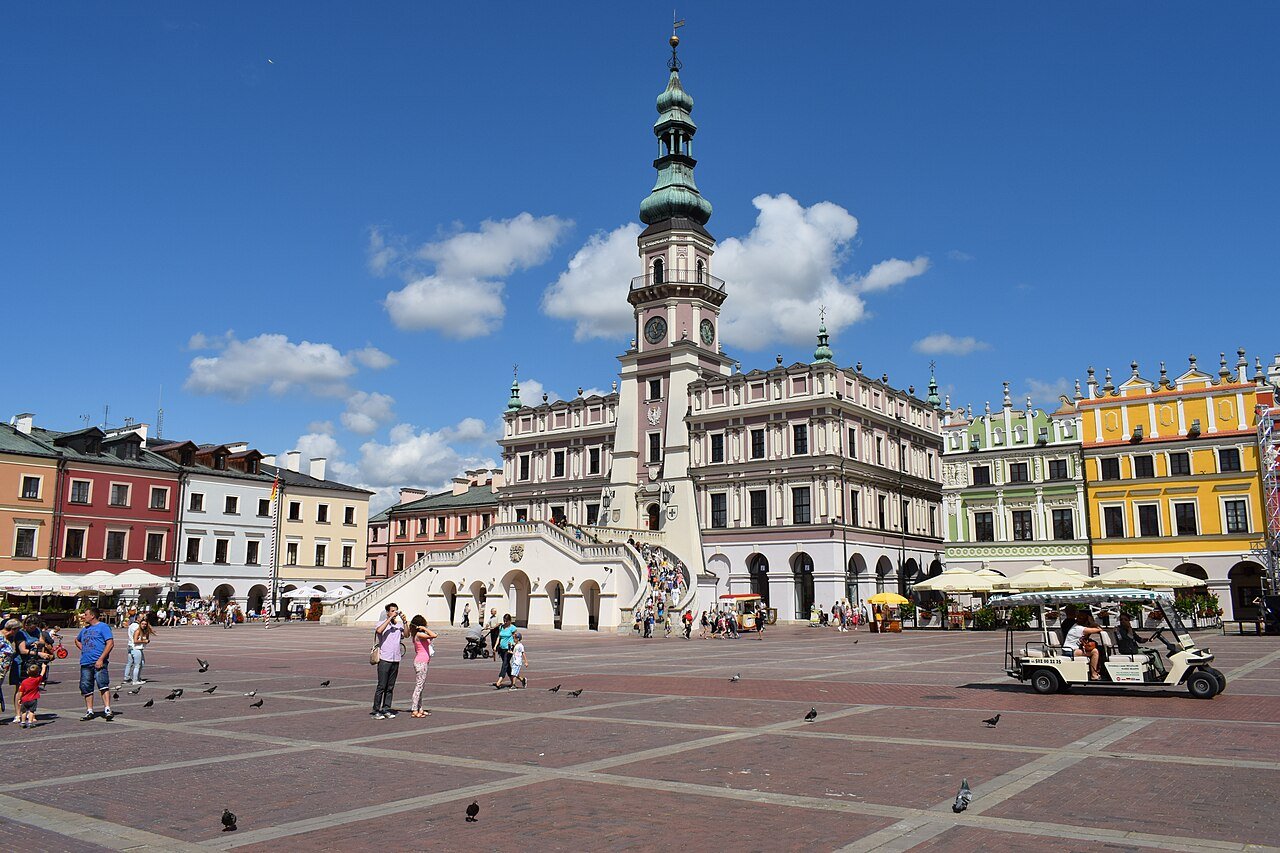
He turned to Bernardo Morando, a Paduan architect working in the tradition of Italian Renaissance urbanism. Morando had absorbed the theoretical frameworks of Alberti and Vitruvius, and he translated them here into brick and stone with exceptional rigour. The result is a compact walled city built on a near-perfect orthogonal grid, with Rynek Wielki — the Great Market Square — at its centre. At 100 metres by 100 metres, this square is one of the largest Renaissance market squares in Central Europe, flanked on every side by arcaded townhouses whose ground-floor loggias shelter pedestrians from sun and rain in the manner of Bologna or Padua.
Zamoyski wanted his city to attract the best merchants of the age, and he succeeded. Armenians, Sephardic Jews, Greeks and Scots all settled here, each community receiving its own quarter and its own place of worship. The Armenian merchants — who arrived from Lwów and the eastern trade routes — built the Armenian Church of the Annunciation (1617), a compact Mannerist structure whose tower still stands near the city’s northeastern edge. The diversity of the population made Zamość into a genuine cosmopolitan trading hub connecting Poland with the Ottoman Empire to the south and the Baltic ports to the north.
The nickname “Padua of the North” followed naturally. Zamoyski founded an Academy here in 1594 — one of the earliest institutions of higher learning in Poland — and invited scholars, poets and jurists to his court. For a period in the late sixteenth and early seventeenth centuries, the city was an intellectual centre of genuine European importance, a place where humanist ideals were not merely discussed but embodied in the very structure of the streets.
Walk Rynek Wielki today and you encounter the Town Hall at its northern end: a building that has been rebuilt and expanded several times but retains the spirit of Morando’s original design, with its elegant arcaded ground floor, its clock tower and the ceremonial external staircase added in the eighteenth century. The facades surrounding the square — in shades of mustard yellow, terracotta and white — are decorated with attic parapets and Renaissance ornamental friezes. Many of the arcaded houses still function as cafés, restaurants and shops, making the square not a museum but a living urban space.
Zamość survived the Second World War with its fabric largely intact, partly because its symbolic importance as a “German” Renaissance city was recognised — paradoxically — by the Nazi occupiers who renamed it Himmlerstadt and planned it as a settlement for ethnic Germans. The expulsion of the Polish population between 1942 and 1943 was one of the most violent episodes of the occupation. But the buildings survived, and after 1945 decades of careful restoration returned them to their pre-war appearance.
Beyond the Market Square: Fortifications, Faith and the Armenian Quarter Zamość city centre · 5 min walk from Rynek Wielki
Morando’s design extended beyond the central square to encompass a complete ring of Renaissance fortifications — bastions, moats and earthworks — that made Zamość one of the best-defended cities in Poland. The fortifications were tested in 1648 during the great Cossack uprising led by Bohdan Khmelnytsky: Zamość resisted a three-month siege and was never taken, a feat that earned it lasting fame in Polish military history. The Swedish armies of the Great Northern War also failed to breach the walls in 1656. The bastions have survived in good condition and can be walked as a circuit around the old city perimeter.
The Cathedral of the Resurrection and St Thomas the Apostle (1587–1598), designed by Morando himself, stands just off the main square on Kolegiacka Street. Its Mannerist facade, with pilasters and a triangular pediment, is one of the most assured pieces of Renaissance ecclesiastical architecture in Poland. Inside, the nave is flanked by richly decorated chapels, and the treasury holds vestments and silverwork from the seventeenth century. The Zamoyski family mausoleum occupies a dedicated chapel, where Jan Zamoyski and several of his successors are buried beneath elaborate epitaphs.
The Armenian quarter, centred on the street that still bears the community’s name (Ulica Ormiańska), preserves several houses that belonged to the merchant families who made Zamość’s fortune. The Armenian church, though no longer used for worship, has been restored and can be visited. Nearby, the Old Arsenal — a long, arcaded building from the early seventeenth century — now houses the Zamość Museum, whose collections cover the city’s history from foundation to the present, with particular attention to the Second World War period and the enforced deportations.
Practical access from Warsaw: the journey by PKP intercity train takes approximately 3 hours 30 minutes, with Lublin as a midway stop. From Lublin, regional buses make the 100-kilometre run to Zamość in about 1 hour 45 minutes. The old city is entirely walkable and accommodation is available within the historic perimeter. The summer months bring a busy festival calendar; the Zamość Jazz Festival in July and the Zamość Hetman’s Tournament — a historical re-enactment of medieval combat — draw visitors from across Poland and beyond.
Practical information
Getting there: Zamość lies 245 km southeast of Warsaw. The fastest option is PKP intercity to Lublin (approximately 2 hours), followed by a FlixBus or PKS regional bus to Zamość (1 hour 45 minutes). Direct buses from Warsaw’s central bus station also cover the route in around 4 hours. Driving from Lublin takes 90 minutes via the S17/S12 expressway. There is no direct rail link to Zamość from Warsaw; the nearest large station is Zamość-Starówka, served by regional trains from Lublin.
When to visit: May to September is optimal; July and August are the peak festival months. Spring (April–May) and early autumn (September–October) offer cooler temperatures and fewer crowds. Winters are cold and the market square can be icy, but the Renaissance facades under snow have their own appeal.
What to see beyond the inscribed zone: The Roztocze National Park, 30 km south of Zamość, protects one of the most biodiverse lowland forest systems in Central Europe. The village of Szczebrzeszyn, 20 km west, is famous in Poland as the setting of a classic children’s tongue-twister poem and has a well-preserved medieval market square. The Bełżec Memorial and Museum (60 km southeast) is an essential stop for anyone engaging with the history of the region during the Second World War.
Frequently Asked Questions
Why is Zamość called the “Pearl of the Renaissance”?
The epithet reflects the exceptional completeness and stylistic purity of Zamość’s historic centre. Most Renaissance cities in Europe evolved organically over many centuries, accumulating Gothic, Baroque and later additions that dilute the original character. Zamość, by contrast, was designed as a single coherent project by one architect — Bernardo Morando — working to a unified brief from its founder Jan Zamoyski. The result is a remarkably homogeneous urban ensemble: the street grid, the fortifications, the cathedral, the main square and the surrounding townhouses all belong to the same conceptual moment and the same architectural language, even though construction extended over several decades. The arcaded houses of Rynek Wielki, the Mannerist cathedral and the Renaissance bastions form a system that reads as a single statement rather than a palimpsest. UNESCO’s 1992 inscription cited precisely this integrity as the Outstanding Universal Value of the site. In Central and Eastern Europe, only a handful of cities — Telč in the Czech Republic, Chełmno in northern Poland — approach this level of Renaissance urban coherence, and none on quite the same scale.
Who was Jan Zamoyski and why did he build an ideal city?
Jan Zamoyski (1542–1605) was the dominant political figure of late sixteenth-century Poland. Educated in Padua, Paris and Strasbourg, he returned to Poland as one of the most accomplished humanists of his generation, rose rapidly at court under King Stefan Batory and eventually held the twin offices of Grand Chancellor and Grand Hetman of the Crown simultaneously — a concentration of power unprecedented in the Polish-Lithuanian Commonwealth. His private estate in southeastern Poland was vast, and he decided to transform it by founding a new city that would serve as the administrative and commercial hub of his domains while simultaneously projecting his power and learning to the world. The model was the Italian ideal city — the Renaissance concept, derived from Alberti and realised partially in Ferrara and Pienza, of a city planned rationally from the ground up according to humanist principles. Zamoyski hired Morando, brought in merchants from across Europe, founded an Academy and endowed it generously. The city was, in a sense, his autobiography in stone: it announced who he was and what he believed about the proper organisation of human society.
What happened to the Jewish and Armenian communities of Zamość?
Zamość had a substantial Jewish population from its earliest decades. By the nineteenth century, Jews constituted roughly half the city’s inhabitants and were central to its commercial life. The community was entirely destroyed during the German occupation of 1939–1945: Zamość’s Jews were murdered at the Bełżec extermination camp between 1942 and 1943. The Armenian community, which had arrived in the late sixteenth century as part of Zamoyski’s deliberate strategy to attract skilled merchants, declined gradually after the city was absorbed into the Russian Empire in the late eighteenth century. The partition of Poland disrupted the trade routes on which the Armenian merchants depended, and the community dispersed over the following generations. The Armenian church was eventually converted to other uses and then restored. Today, both communities are commemorated in the city’s museums and in a series of memorial plaques installed across the historic centre in the years since 1989.