Wikimedia Commons,
CC BY-SA 3.0.
Zacatecas sits at 2,440 metres in a narrow ravine in the central Mexican highlands, its rose-pink stone colonial buildings climbing the steep canyon walls above the Arroyo de la Plata. Founded in 1546 after the discovery of what proved to be the world’s largest silver deposits, the city spent two centuries pumping wealth into the Spanish empire and expending it on a concentrated burst of Baroque architecture that culminates in what most architectural historians consider Mexico’s finest Churrigueresque cathedral facade. UNESCO inscribed the Historic Centre of Zacatecas in 1993.
The silver city that built the Baroque and funded the Spanish empire North-central Mexico · 700 m above Mexico City (2,440 m elevation) · 8 hr bus or 1 hr flight from Mexico City
The silver vein discovered on the Cerro de la Bufa in September 1546 by a mixed expedition of Spanish soldiers and Tlaxcalan allies was not merely another colonial mining claim. It was the beginning of what became the most productive silver district in human history. Over the three centuries of Spanish colonial rule, the mines of Zacatecas and its satellite districts — Fresnillo, Sombrerete, Jerez — produced an estimated 40,000 tonnes of silver, approximately one-fifth of all silver mined worldwide during that period. The economic consequences were global: the Zacatecas silver funded the Spanish Habsburgs’ wars in Europe, contributed to the “price revolution” that destabilised European economies in the 16th century, and flowed via the Manila Galleon trade to China, where it lubricated an economy moving from commodity to monetary exchange.
The city that grew around the mines was built in layers of compulsive construction, each wave funded by new silver discoveries. The first mining camp of 1546 became a formal town in 1548; by 1585 Zacatecas was the second-largest city in New Spain after Mexico City. The builders worked in the pink-red cantera stone quarried from the canyon walls, a material that carves with exceptional ease when freshly extracted but hardens to great durability on exposure to air. This material property explains the extraordinary richness of Zacatecas Baroque decoration: the stone permitted carvers to achieve levels of detail in facade ornament — undercutting, layering, three-dimensional foliage — that were impossible in harder materials.
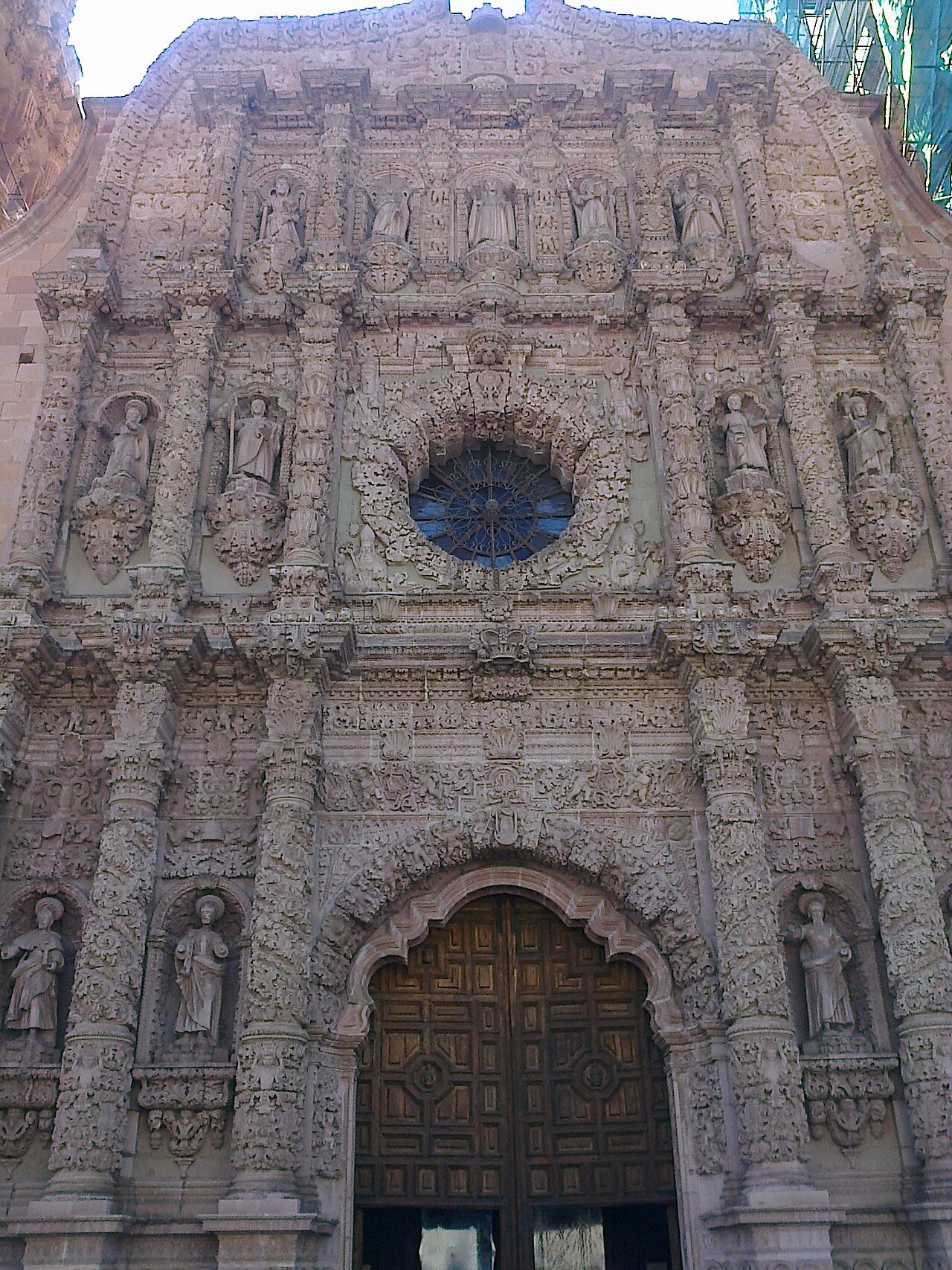
The Cathedral of Zacatecas, begun in 1612 and substantially completed by 1752, is the city’s defining monument and one of the most discussed works of architecture in the Americas. Its western facade — the only one of the three that was fully completed in the intended style — is the fullest realisation of the Churrigueresque Baroque manner anywhere in Mexico. The term Churrigueresque (from José Benito Churriguera, the Spanish architect whose followers developed the style) refers to a deliberately overwhelming accumulation of carved ornament — estípite pilasters, layered niches, foliate capitals, medallions, and herms — that covers every surface of the facade without leaving any area plain. The effect is not chaotic but rhythmically organised: tiers of figures and ornament ascend from base to crown in a sequence that an art historian once compared to a symphony in stone. The facade’s rose-pink colour, which shifts from salmon to deep red as the angle of sunlight changes through the day, intensifies the sculptural drama.
The Mina El Edén, the most productive of the Zacatecas silver mines, operated from the colonial period until 1960 and extracted an estimated 2,500 tonnes of silver from over 2,000 metres of tunnels driven through the Cerro del Grillo on the western side of the canyon. Today the mine operates as a museum whose visitors ride a cable car across the canyon — the Teleférico de Zacatecas, strung between the Cerro del Grillo and the Cerro de la Bufa at 2,900 metres — and descend into the mine on foot. The interior of the mine after the museum tour becomes, at night, a remarkable nightclub (La Mina nightclub) whose dance floor occupies a 400-year-old excavation chamber 60 metres underground — possibly the most unusual nightlife venue in Mexico.
The Cerro de la Bufa, the rocky outcrop above the city at 2,900 metres where silver was first discovered, is accessible by foot or cable car and is one of the best viewpoints in Mexico: the canyon city spreads below, the dome of the cathedral visible among the pink and terracotta rooftops, the semi-arid highland landscape extending to the horizon in every direction. The Bufa also bears a museum and a chapel (La Capilla de los Remedios, 1728) commemorating the site’s dual history as a place of mineral wealth and religious devotion.
The Battle of Zacatecas, fought on 23 June 1914 between the forces of Pancho Villa and the Federal Army of Victoriano Huerta, was one of the decisive engagements of the Mexican Revolution. Villa’s División del Norte swept into the canyon from three directions simultaneously; the Federal garrison, though holding a terrain advantage, was overwhelmed in a single day of fighting. The victory opened the road to Mexico City and effectively ended the Huerta regime. The battle is commemorated at the Cerro de la Bufa, where a dramatic bronze monument to Villa and his officers overlooks the city.
Beyond the city: Guadalupe and the colonial art circuit of Zacatecas state 5-80 km · local buses and organised tours
The town of Guadalupe, just 5 km south-east of Zacatecas city centre, contains one of the most important repositories of colonial Baroque art in Mexico: the Templo y Ex-Convento de Guadalupe, a Franciscan foundation of the early 18th century whose sacristy, choir, and Capilla de Nápoles are decorated with major works of New Spain painting from the 17th and 18th centuries. The Museo de Guadalupe, installed in the former convent, holds over 1,400 paintings, including works by Cristóbal de Villalpando, the greatest Mexican Baroque painter — his large-scale canvases at Guadalupe are considered among the finest in New Spain. The collection is largely unknown to international visitors and is one of the most underrated art destinations in Mexico.
Jerez de García Salinas, 55 km south-west of Zacatecas, is a colonial silver-era town with an intact 19th-century historic centre, a remarkable Teatro Hinojosa (1886) with original painted interior, and a weekly Sunday market that draws villagers from across the surrounding sierra. The town is the birthplace of the poet Ramón López Velarde (1888-1921), whose Suave Patria is one of the most celebrated poems in the Spanish language; his birthplace is a museum.
Practical information
Getting there: General Leobardo C. Ruiz International Airport (ZCL) serves Zacatecas with domestic flights from Mexico City (1 hr), Guadalajara (1 hr), and several US cities. ADO and Omnibus de Mexico operate direct coach services from Mexico City’s Terminal del Norte (approximately 8 hours); the bus station is 4 km from the historic centre. Driving from Mexico City takes 6-7 hours via the Querétaro-San Luis Potosí highway.
Getting around: The historic centre is compact and walkable; the Cathedral, Plaza de Armas, and the entrance to Mina El Edén are within a 15-minute walk of each other. The terrain is hilly — some streets are essentially staircases (callejones) — and the altitude of 2,440 m requires acclimatisation if arriving from sea level. The Teleférico cable car connects the Cerro del Grillo (near the Mina El Edén) to the Cerro de la Bufa; the trip takes about 8 minutes and offers exceptional views over the city.
Best time to visit: April-May and September-October offer the most comfortable temperatures; June-August is the rainy season (afternoon thunderstorms are common but usually brief). The Feria Nacional de Zacatecas (September) is the city’s main popular festival, with bullfights, cockfights, concerts, and regional food. Semana Santa is celebrated with considerable ceremony. December is popular with Mexican domestic tourists and is pleasant at this altitude.
Practical tips: The altitude affects visitors coming from sea level; plan for a day of gentle acclimatisation on arrival. The cathedral’s western facade is best photographed in the morning (when it faces east) or under diffuse cloud light; direct afternoon sun creates harsh shadows in the deeply carved ornament. The Museo Rafael Coronel, in the former Franciscan convent of San Francisco, holds the largest collection of Mexican pre-Columbian and folk masks in the country and is worth a full afternoon.
Frequently Asked Questions
What is Churrigueresque Baroque and why is Zacatecas its finest example?
Churrigueresque is a style of ultra-ornate Baroque architecture that developed in Spain in the late 17th century and reached its fullest expression in New Spain (Mexico) in the 18th century. Named after José Benito de Churriguera (1665-1725) and his brothers, the style is characterised by the estípite — an inverted obelisk or tapering pilaster form — used as a structural and decorative element in layered, three-dimensional compositions that cover facade surfaces with near-total density of ornament. In New Spain, access to malleable cantera stone and a highly skilled indigenous and mestizo workforce of stone carvers produced a variant of the style that exceeded anything built in Spain itself in terms of decorative complexity. The Zacatecas Cathedral’s western facade is considered its finest realisation because the three tiers of figural sculpture — apostles, evangelists, and saints in deep-cut niches, framed by estípite columns and foliate borders — are executed with an exactness of detail and a sculptural understanding of light and shadow that is unmatched in the tradition. The rose-pink cantera stone also ages more gracefully than the grey stone of comparable Spanish facades, retaining colour and surface detail.
How much silver did Zacatecas actually produce?
Precise figures are difficult to establish because colonial records are incomplete and much silver moved outside official channels (via tax evasion, contraband, and unregistered indigenous extraction). Historians’ estimates range between 30,000 and 45,000 tonnes of pure silver produced in the Zacatecas district between 1546 and the end of colonial rule in 1821. This would represent approximately 20-25% of total global silver production during that period. The Spanish royal fifth (quinto real) — a 20% tax on all silver produced — generated revenue on this scale for nearly three centuries, making Zacatecas one of the single largest contributors to Spanish state finance in the early modern period. The economic and monetary consequences were global: the influx of American silver into European and Asian monetary systems is considered one of the primary drivers of the inflationary “Price Revolution” of the 16th-17th centuries, which destabilised economies from Spain to China.
Is Mina El Edén safe to visit and what does the tour involve?
Yes, Mina El Edén is a well-maintained tourist site with established safety protocols. The tour involves entering the former mine on a narrow-gauge electric train that takes visitors approximately 60 metres into the hillside, followed by a walking section through illuminated tunnels where interpretive displays explain the extraction process, the working conditions of the colonial-era miners, and the geology of the silver veins. The temperature inside the mine is constant at approximately 14-16°C regardless of the outside temperature — a useful consideration on hot summer afternoons. The tour takes about 45 minutes. After the mine visit, the cable car (Teleférico) can be taken from the exit point on the Cerro del Grillo to the Cerro de la Bufa; the two attractions are often combined into a half-day circuit. The underground nightclub occupies a section of the mine not accessible on the standard museum tour and operates on Thursday-Saturday evenings.
Sources
- S1 — Bakewell, Peter J. Silver Mining and Society in Colonial Mexico: Zacatecas 1546-1700. Cambridge University Press, 1971. ISBN 978-0-521-08031-6.
- S2 — Baird, Joseph Armstrong. The Churches of Mexico: 1530-1810. University of California Press, 1962. ISBN 978-0-520-00057-5.
Spotted an error? Write to editorial@culturalheritageonline.com and we correct it the same day.