Tucked into the forested Carpathian foothills of northeastern Slovakia, Bardejov is one of Europe’s quieter UNESCO prizes — a medieval town whose market square, Gothic church and Renaissance town hall have survived seven centuries of history with a completeness that astonishes visitors arriving without prior knowledge. Inscribed in 2000, the Historic Town of Bardejov was recognised for the exceptional integrity of its Gothic and early Renaissance urban fabric and for the remarkable collection of altar panels preserved in its parish church. Small enough to cross on foot in twenty minutes, rich enough to reward a full day’s attention.
Gothic in the Carpathians: Bardejov’s Medieval Market Square Historic Town of Bardejov, UNESCO 2000 · northeastern Slovakia
Bardejov received its royal charter in 1376 from King Louis I of Hungary and rapidly developed into a significant trading town on the route connecting Hungary with Poland and the Baltic. Its position on the Topl’a River valley made it a natural waypoint for merchants moving cloth, spices and metalwork between Cracow and Budapest, and the town grew wealthy on the proceeds. By the fifteenth century it was sufficiently prosperous to undertake ambitious architectural projects: the Gothic parish church, the town walls and, eventually, the town hall that stands at the centre of the main square.
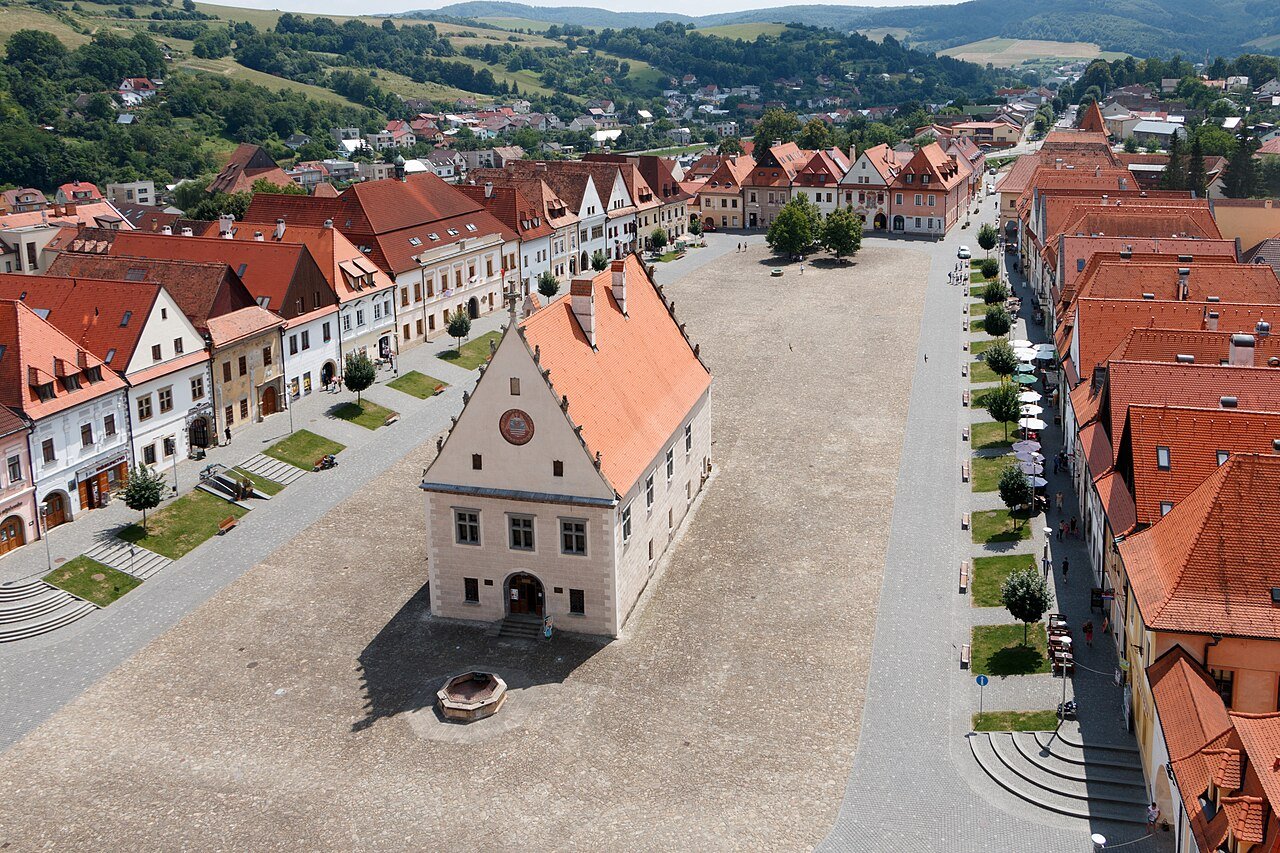
Radničné námestie — the Town Square — is the heart of everything. Unlike many Central European market squares that were heavily remodelled in the Baroque era, Bardejov’s retained its Gothic and early Renaissance character with remarkable fidelity. The burgher houses surrounding the square preserve their original proportions and, in many cases, their original Gothic or Renaissance facades, with gabled rooflines and ground-floor arcades recalling the commercial character of a medieval trading town.
The Town Hall (1505–1511) is the architectural crown of the ensemble. Built in a transitional Gothic-Renaissance style at the moment when Italian humanist ideas were beginning to penetrate Central European building culture, it has an elegant loggia on the ground floor, a steeply pitched roof and a stepped gable that manages to look both Gothic and modern simultaneously. It now houses the Šariš Museum, whose collections cover local history, religious art and the ethnography of the Carpathian region. The building itself — its proportions, its stone detailing, its position at the centre of the square — is the primary exhibit.
The Church of St Egidius (St Giles) at the northern end of the square is one of the most remarkable late Gothic churches in Slovakia. Construction began in the fourteenth century and continued through the fifteenth, resulting in a hall church of considerable scale whose interior is dominated by the most extraordinary feature of Bardejov: eleven Gothic winged altar panels, created between approximately 1460 and 1520 and preserved in the church in near-original condition. These polyptychs — painted wooden altarpieces with hinged wings that open to reveal gilded sculptural compositions — represent the full range of late Gothic devotional art in the region, from the severe linearism of the earliest panels to the softer, more emotional style of the latest ones influenced by German and Flemish painting. Nowhere else in Slovakia, and few places in Central Europe, can you see a collection of this quality and completeness in its original ecclesiastical setting.
The town walls, built in the fourteenth and fifteenth centuries, survive as an almost complete circuit, with towers and barbicans at regular intervals. Walking the perimeter — a circuit of roughly a kilometre — gives a clear sense of the medieval town’s extent and of the engineering effort required to defend it. One of the towers has been converted into a small museum of military history; others can be viewed from the exterior or accessed via the rampart walk.
Beyond the Walls: Jewish Heritage and the Bardejov Spa Bardejov surroundings · 6 km north to Bardejovské Kúpele
Bardejov had a significant Jewish community from the sixteenth century onwards, and the town preserves exceptional evidence of this history. The Jewish quarter, located outside the medieval walls near the western gate, contains a complex of buildings centred on the synagogue built in 1829 — a neoclassical structure that survived the Second World War intact and has been carefully restored. The adjacent Jewish community house and the Jewish school building (1881) have also been preserved. Together they form one of the most complete surviving Jewish community complexes in Slovakia, now managed as a museum and memorial site. The synagogue’s interior, with its women’s gallery, its decorated ark and its painted ceiling, is particularly moving.
The Jewish cemetery, located a short walk from the town centre, contains tombstones spanning several centuries. The oldest stones, with their carved Hebrew inscriptions and symbolic imagery — hands raised in priestly blessing, animals, crowns — are remarkable documents of Central European Jewish funerary art. The community was almost entirely murdered at Auschwitz-Birkenau in 1942; the cemetery and synagogue complex serve as the principal memorial to their presence.
Six kilometres north of the town centre lies Bardejovské Kúpele, a spa resort that has been operating since the eighteenth century and reached its peak of fashionable popularity in the nineteenth, when it attracted a clientele that included the Empress Elisabeth of Austria (Sisi) and the Tsarina Maria Alexandrovna of Russia. The mineral springs here are rich in carbon dioxide and iron, and the elegant spa buildings — Empire, neoclassical and early Art Nouveau in style — have been largely preserved. The open-air museum of folk architecture (skanzen) adjacent to the spa preserves traditional wooden buildings from across the Carpathian region, including Greek Catholic and Orthodox churches of the kind found throughout the mountain villages of northeastern Slovakia.
Access from Košice — Slovakia’s second city and the nearest major transport hub — takes approximately 1 hour 30 minutes by regional train or bus. From Bratislava, the journey by train takes around 5 hours, with a change at Prešov. The nearest international airport is Košice (KSC), with connections to Prague, Vienna and Warsaw.
Practical information
Getting there: Bardejov is 40 km north of Prešov and 85 km north of Košice. Direct buses from Prešov run frequently and take about 1 hour. From Košice, take a train or bus to Prešov and connect. Regional trains also serve Bardejov from Prešov, though the journey involves a change. Driving from Košice takes approximately 1 hour 10 minutes via the E50 motorway and Route 77.
When to visit: May to September offers the most comfortable conditions for walking the town and the spa area. The Bardejov Culture Summer festival brings concerts and folk events in July and August. The Christmas market on Radničné námestie in December is one of the most atmospheric in Slovakia.
What else is nearby: The wooden churches of the Carpathian region — a separate UNESCO World Heritage inscription covering remarkable Orthodox and Greek Catholic churches built entirely of wood — lie within 30–60 km of Bardejov. The churches at Bodružal, Ladomirová and Jedlinka are the closest and most accessible. The Poloniny National Park, bordering Poland and Ukraine, is approximately 80 km east.
Frequently Asked Questions
What makes the Gothic altarpieces of St Egidius so significant?
The eleven winged altarpieces in the Church of St Egidius are significant for three overlapping reasons. First, their number and completeness: most Gothic churches in Central Europe lost the majority of their original furnishings during the Reformation, the Counter-Reformation, fires, wars or simply changing taste. Bardejov, as a royal free town that converted to Lutheranism in the sixteenth century and subsequently returned to Catholicism, navigated these upheavals without the wholesale destruction of its medieval art. Second, the quality and variety of the panels themselves: produced between approximately 1460 and 1520 by workshops active in Cracow, Levoča and possibly Nuremberg, they represent a cross-section of late Gothic devotional painting at its height. The earliest panels are tightly drawn and hieratic; the latest show the influence of Flemish naturalism and German expressionism that was filtering into Central European workshops in the early sixteenth century. Third, the setting: seeing these panels in the church for which they were made, rather than in a museum gallery, is a fundamentally different — and more powerful — experience.
Is Bardejov difficult to reach without a car?
Bardejov is accessible by public transport but requires patience. The most convenient approach is the direct bus service from Prešov (approximately 1 hour, multiple departures daily), which connects to the national rail network at Prešov station. From Bratislava, the combined rail and bus journey takes approximately 5–6 hours. Košice Airport (KSC) is the nearest international airport, served by Ryanair and Wizz Air from several European cities; from the airport to Bardejov by bus via Prešov takes about 2 hours. Within the town itself, everything is easily walkable — the historic centre is compact, the walls can be circled on foot in 20 minutes, and a taxi to the Bardejovské Kúpele spa is inexpensive. Renting a car at Košice Airport significantly expands access to the wooden churches in the surrounding mountains.
What is the connection between Bardejov and the Empress Elisabeth of Austria?
The Empress Elisabeth of Austria — known popularly as Sisi — visited Bardejovské Kúpele, the spa resort 6 km north of the town, for cure treatments in the 1890s. Elisabeth was one of the great travellers of the nineteenth-century European aristocracy, perpetually in motion between the spa towns and seaside resorts of the continent, and her visit to Bardejov — then part of the Kingdom of Hungary within the Austro-Hungarian Empire — was part of this restless itinerary. A modest pavilion in the spa park commemorates her stay, and the visit is recalled in the local museum. The connection matters beyond mere celebrity: it illustrates Bardejov’s position, in the late nineteenth century, as a resort of genuine European standing, attracting a clientele from Vienna, Budapest and St Petersburg who came for the mineral waters and stayed for the mountain air. The spa buildings from this period are among the most elegant survivors of the Austro-Hungarian resort architecture in Slovakia.
Sources
- S1 — Dvořáková, Vlasta. Bardejov: Urban Conservation Reserve. Tatran, 1984. ISBN 978-80-222-0012-7.
- S2 — Homza, Martin. History of Slovakia. Veda, 2006. ISBN 978-80-224-0912-4.
Spotted an error? Write to editorial@culturalheritageonline.com and we correct it the same day.