The Complex of Hue Monuments, inscribed in 1993, is the imperial capital of the Nguyen dynasty (1802–1945 CE) — the last royal dynasty of Vietnam — a walled citadel on the banks of the Perfume River with a system of royal palaces, temples, and imperial tombs that represent the high-water mark of Vietnamese imperial architecture and are also the site of the 1968 Tet Offensive’s most intense urban battle, which left the monuments severely damaged.
Hue Imperial Citadel: Vietnam’s Last Imperial Capital Thua Thien-Hue Province, central Vietnam, on the Perfume River (Sông Hương)
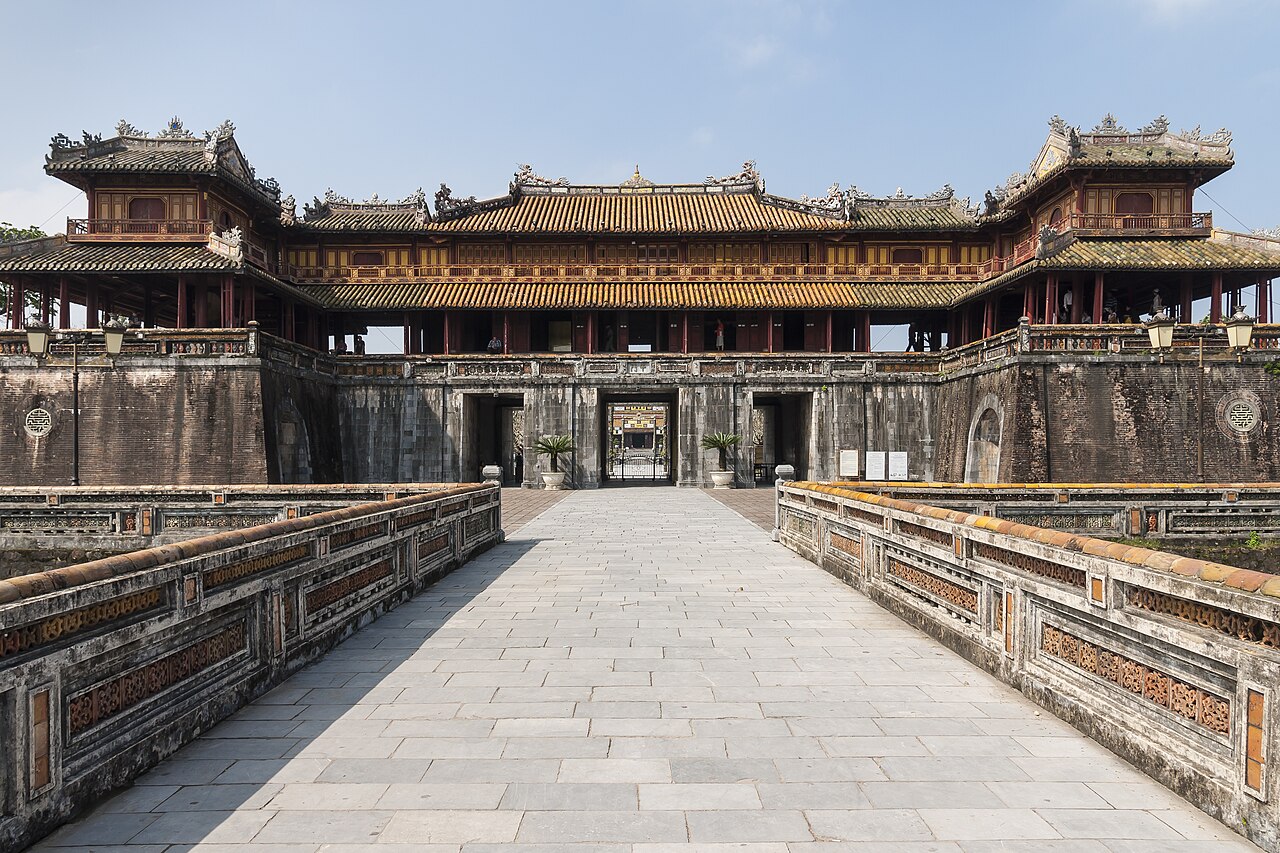
The Complex of Hue Monuments (inscribed in 1993 under criteria (iii), (iv)) encompasses the Imperial Citadel (Kinh Thành), the Purple Forbidden City (Tử Cấm Thành) within it, the imperial temples and shrines of the Nguyen dynasty, and the seven imperial tombs (lăng) distributed along the Perfume River south of the city. Hue was established as Vietnam’s capital by Emperor Gia Long (the first Nguyen emperor, r. 1802–1820 CE), who unified Vietnam for the first time in its history after centuries of division (the Trinh lords controlled the north; the Nguyen lords controlled the south); it remained the imperial capital for 143 years through 13 emperors until Emperor Bảo Đại’s abdication in August 1945. The Imperial Citadel (Kinh Thành, built 1805–1832 CE under Gia Long and Minh Mang) is a vast defensive enclosure of approximately 8 km² with 10 km of walls (6–7 metres high, 20–21 metres thick at the base), a moat, and 10 gates; within it is the Royal Citadel (Hoàng Thành, a walled enclosure within the Citadel) and at its centre the Purple Forbidden City (Tử Cấm Thành, directly modelled on the Beijing Forbidden City and exclusively used by the emperor and his immediate family, with a Noon Gate — Ngọ Môn — as its principal entrance). The entire complex was designed according to a combination of Chinese geomantic principles (the Perfume River flowing from west to east in front of the citadel, the Ngự Bình mountain to the south providing “backing” in the feng shui sense) and Vietnamese interpretations of the Chinese imperial spatial system.
The Tet Offensive Battle of Hue (1968) and Ongoing Restoration Hue city and the Imperial Citadel
The Battle of Hue (31 January–2 March 1968) was the most intense urban battle of the Vietnam War and the event that most severely damaged the Complex of Hue Monuments. During the Tet Offensive (the coordinated North Vietnamese Army and Viet Cong assault on major South Vietnamese cities during the Vietnamese New Year ceasefire of January–February 1968), communist forces captured and held the Imperial Citadel of Hue for 25 days (January 31–February 25), until US and South Vietnamese forces recaptured it in prolonged and intense close-quarter combat. The fighting destroyed approximately 40% of the Imperial Citadel (the Purple Forbidden City was particularly heavily damaged, with most of the palace buildings inside it destroyed by artillery and fire) and killed approximately 5,000 civilians in Hue (including approximately 2,800 civilians murdered by NVA/Viet Cong forces in what is known as the Massacre at Hue, the killing of individuals deemed politically undesirable during the communist occupation). The Complex of Hue Monuments has been under continuous restoration since 1993 (the year of UNESCO inscription), with restoration prioritizing the Noon Gate and the most visible elements of the Citadel; the Purple Forbidden City (Tử Cấm Thành) remains largely in ruins, with only the Thai Hoa Palace (the Throne Hall, where the emperor received formal audiences) substantially restored.
Practical information
Phu Bai International Airport (HUI) serves Hue with direct flights from Hanoi, Ho Chi Minh City, and Da Nang (30 minutes from Hue Airport to the city centre). Hue is also on the North-South Railway (Hà Nội–Ho Chi Minh City) with daily trains from Hanoi (approximately 13–15 hours by overnight train) and Ho Chi Minh City (approximately 16–18 hours). The Imperial Citadel is 3 km from the city centre; the admission ticket covers the Citadel, the Noon Gate, and the main palace area (approximately VND 200,000). A separate ticket is required for each royal tomb (Minh Mang, Tu Duc, Khai Dinh). The best season is February–April and August–October; November–January can be very rainy (Hue receives 3,000 mm of rain annually and is the wettest city in Vietnam). The Hue Festival (biennial, even years) is the most important cultural event.
Frequently Asked Questions
Is Hue a UNESCO World Heritage Site?
Yes. The Complex of Hue Monuments was inscribed in 1993 under criteria (iii) and (iv). Vietnam has 8 UNESCO World Heritage Sites (as of 2024): the Complex of Hue Monuments (1993), Ha Long Bay (1994, natural), Hoi An Ancient Town (1999), My Son Sanctuary (1999), Phong Nha-Ke Bang National Park (2003, natural), the Central Sector of the Imperial Citadel of Thang Long – Hanoi (2010), Citadel of the Ho Dynasty (2011), and Trang An Landscape Complex (2014).
What is the Noon Gate (Ngọ Môn) and why is it Hue’s most iconic monument?
The Noon Gate (Ngọ Môn, 1833 CE under Emperor Minh Mang) is the main southern gate of the Royal Citadel (Hoàng Thành) within the Imperial Citadel of Hue — a two-level gate complex of extraordinary scale and architectural elaboration that served as the formal public face of the Nguyen imperial court. The Noon Gate consists of a massive granite base with five arched entrances (the central entrance reserved for the emperor; the two flanking entrances for the imperial guard and the royal family; the two outer entrances for ministers) surmounted by the Belvedere of the Five Phoenixes (Lầu Ngũ Phụng) — a two-storey wooden pavilion of four interconnecting roof structures in the traditional Vietnamese palace style, roofed with yellow-glazed tiles (reserved for imperial use). The Noon Gate is named for the south-facing direction (the ceremonial direction of the emperor in Chinese cosmology; the emperor faces south to govern, as the sun is in the south at noon). It was the site of some of the most important imperial ceremonies of the Nguyen court: the announcement of the lunar new year calendar, the announcement of examination results, and the reception of tribute missions. On August 23, 1945, the last Nguyen emperor, Bảo Đại, abdicated from the balcony of the Noon Gate, handing the Imperial Seal to a delegation of the Democratic Republic of Vietnam — ending 143 years of Nguyen imperial rule and over two millennia of Vietnamese monarchy.
What are the Nguyen imperial tombs and which is the most important to visit?
The seven imperial tombs (Lăng) of the Nguyen emperors are located along the banks of the Perfume River south of Hue, each built by the emperor during his own lifetime as a combined mausoleum and pleasure palace where the emperor could retreat for meditation and the enjoyment of nature, and where his body would be interred after death. Each tomb is a self-contained walled complex with an honour court (lined with stone mandarins, horses, and elephants), a stele pavilion (where the emperor’s self-written funerary inscription is carved), a sacrificial temple, a lake or pond, and the burial tumulus. The three most architecturally significant are: (1) the Tomb of Minh Mang (Lăng Minh Mạng, 1841–1843 CE) — the most formally symmetrical and Chinese-influenced, with a long series of courts and gates on a central axis; (2) the Tomb of Tu Duc (Lăng Tự Đức, 1864–1867 CE) — the most romantically picturesque, with a large lake, a pavilion on an island, and informal gardens; and (3) the Tomb of Khai Dinh (Lăng Khải Định, 1920–1931 CE) — the most eclectic and individual, built in a fusion of Vietnamese, French, and Chinese styles with a remarkable interior of inlaid glass and porcelain mosaics. Of the three, Tu Duc is most visited for its landscape quality; Khai Dinh for its unusual architecture.
Sources
- S1 — Phan, Thuan An. The Imperial Citadel of Hue. Thuan Hoa Publishing House, 1999. ISBN 978-604-902-120-6.
- S2 — Woodside, Alexander. Vietnam and the Chinese Model: A Comparative Study. Harvard University Press, 1971. ISBN 978-0-674-93721-5.
Spotted an error? Write to editorial@culturalheritageonline.com and we correct it the same day.