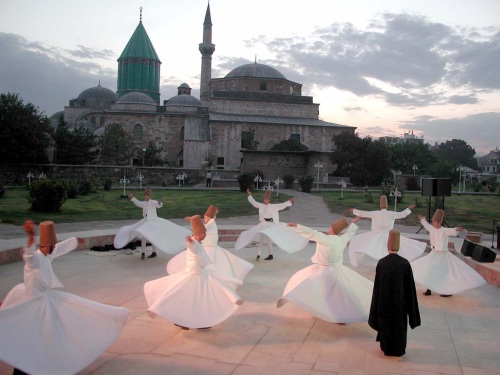
Konya, at the heart of the Anatolian plateau, is Turkey’s most sacred Muslim city — the home of the tomb of Jalal ad-Din Rumi (Mevlana, 1207–1273), the greatest Persian-language mystical poet and the founder of the Mevlevi Order of Whirling Dervishes, whose turquoise-domed mausoleum is the most visited pilgrimage site in Turkey. Çatalhöyük, one of the world’s oldest urban settlements (8,800 BCE), inscribed in 2012, is 50 km south.
Mevlana Museum and the Whirling Dervishes: Sufism’s Most Sacred Shrine City centre, Konya
Konya’s primary significance in Islamic heritage is the Mevlana Museum (formerly the Dergah of the Mevlevi Order) — the lodge, convent, and tomb of Jalal ad-Din Rumi (1207–1273), known in Turkish as Mevlana (“our master”), the greatest mystical poet of the Persian literary tradition and the founder of the Mevlevi Sufi order, whose adherents are internationally known as the Whirling Dervishes. Rumi was born in Balkh (present-day Afghanistan) and settled in Konya in 1228, where he spent the rest of his life composing the Masnavi (Masnavi-ye Manavi, “Spiritual Couplets”), a 25,000-verse poem considered the greatest work of Persian Sufi literature, and developing the Sema ceremony — the turning meditation practice that became the signature spiritual practice of the Mevlevi Order. The Mevlevi lodge was built around his tomb after his death in 1273; Rumi’s son Sultan Walad institutionalised the order and built the first proper dergah (lodge) in Konya; successive Seljuk and Ottoman sultans expanded the complex, which reached its current form in the early sixteenth century. The Mevlana Museum (converted from an active lodge to a state museum in 1925 when Atatürk suppressed the Sufi orders) contains Rumi’s green-tiled mausoleum and the sarcophagi of his family and disciples, the Sema ceremony hall (still used for performances), and a collection of Mevlevi musical instruments, calligraphy, and manuscripts. The Sema ceremony (UNESCO Intangible Cultural Heritage of Humanity, 2008) involves white-robed dervishes spinning in a meditative state representing the soul’s journey toward the divine; public performances are held in Konya every Saturday evening and during the Rumi Commemoration Week (December 10–17 annually, when up to 200,000 visitors attend).
Seljuk Heritage of Konya: The Alaeddin Mosque and Karatay Madrasa Alaeddin Hill, city centre
Konya was the capital of the Sultanate of Rum (the Anatolian Seljuk state) from 1077 to 1307 — the period in which the city’s most significant secular and religious monuments were built. The Alaeddin Mosque (Alaeddin Camii, 1220–1237, on the Alaeddin Hill in the centre of Konya) is the largest Seljuk mosque in Anatolia — a hypostyle hall of 42 columns (reused from Byzantine and Roman structures, including a Roman sarcophagus repurposed as an ablution basin) with a Seljuk portal of carved stone and the tombs of eight Seljuk sultans in its precinct. The Karatay Madrasa (1251, now the Karatay Museum of Tile) is the most beautiful Seljuk ceramic tile ensemble in Turkey: its single domed hall is lined with gold-lustre and blue faience tiles in a geometric and calligraphic programme that represents the peak of Seljuk decorative art. The Ince Minareli Madrasa (1265, the Slender Minaret Madrasa, now the Museum of Stone and Wood Carving) preserves the most elaborately carved Seljuk portal in Anatolia — a stone lacework composition of intertwined arabesques, calligraphic bands, and figural medallions of remarkable complexity. Konya also has two early thirteenth-century caravanserais (Konya is on the Silk Road) — the Zazadin Han and the Sultan Han — that document the Seljuk road system linking Konya to Kayseri, Sivas, and eastern Anatolia.
Çatalhöyük: The World’s First Urban Settlement 🚗 ~50 mins south
Çatalhöyük, inscribed in 2012 under criteria (iii) and (iv), is located 52 km south of Konya on the Konya plain — the Neolithic proto-city described in the Göreme/Cappadocia article (batch 44) as the oldest evidence of permanent human settlement at urban scale. For visitors to Konya, Çatalhöyük is the natural day trip: the site museum (opened 2013) presents the excavation history from James Mellaart’s 1961 discovery through the ongoing Ian Hodder excavations; the two excavation shelters covering active digs allow visitors to see the layered house floors in situ. The site’s significance lies not only in its age (c. 7500–5700 BCE) but in what the evidence suggests about the social organisation of the first large human communities: no public buildings, no temples, no administrative structures — only identical houses, entered from the roof, in which the dead were buried beneath the living floor and the walls were painted with hunting scenes and geometric patterns. Çatalhöyük challenges the conventional narrative that cities require hierarchy and specialisation from the outset.
Practical information
Konya is 250 km south of Ankara; high-speed trains (Konya HST) from Ankara take 1.5 hours and from Istanbul approximately 4 hours (via Eskişehir). The Mevlana Museum is open daily (9 a.m.–6:30 p.m., Friday from 10 a.m.); the entry fee is approximately 80 TL (2024). The Sema ceremony at the Mevlana Cultural Centre takes place every Saturday at 7 p.m. (free). The Rumi Commemoration Festival in December brings Sema performances at multiple venues; accommodation must be booked months in advance. Çatalhöyük is 52 km south by car (no direct public transport from Konya city centre; a taxi + wait is the practical option for day visitors). The best season for Konya is April–June and September–November; the December festival is the most culturally significant time to visit despite the cold. Konya is culturally conservative; modest dress (covered shoulders and knees) is appreciated in the religious sites.
Frequently Asked Questions
Who was Rumi (Mevlana) and why is Konya his city?
Jalal ad-Din Muhammad Rumi (1207–1273) was a Persian-language Sufi poet and theologian, born in Balkh (modern Afghanistan), who settled in Konya in 1228 after the Mongol invasions displaced his family westward. He spent the last 45 years of his life in Konya, composing the Masnavi (his major work, 25,000 couplets on the themes of divine love, spiritual longing, and the soul’s return to God) and the Divan-e Shams-e Tabrizi (lyric poetry dedicated to his spiritual companion Shams of Tabriz). He founded the Mevlevi Sufi order, whose meditative Sema practice (whirling in a specific posture and rhythm) his disciples developed and codified after his death. Rumi’s poetry is the most widely read Persian poetry in the world today; his Masnavi is sometimes called “the Persian Quran” by Persian literary critics. He is buried in Konya, where his tomb has been a pilgrimage site continuously since his death in 1273.
Is the Sema (Whirling Dervish) ceremony still practised?
Yes. The Sema ceremony was suppressed by the Turkish Republic in 1925 as part of Atatürk’s secularisation programme (all Sufi orders were banned and their lodges converted to museums or other uses). It was permitted as a “cultural performance” from the 1950s and has been openly practised as a living spiritual tradition since the 1990s, when the ban on Sufi orders was effectively relaxed. The Sema was inscribed in UNESCO’s Intangible Cultural Heritage of Humanity list in 2008. Public Sema performances take place every Saturday evening in Konya (at the Mevlana Cultural Centre, a modern venue adjacent to the museum); the most significant performances are during the Rumi Commemoration Festival in December. The Sema is not a tourist performance — the dervishes (members of an active Mevlevi lodge) practice it as a genuine spiritual discipline, though visitors are welcome to observe in silence.
What makes Çatalhöyük different from other ancient sites?
Çatalhöyük (c. 7500–5700 BCE) is unusual because it demonstrates that large permanent human communities (5,000–8,000 people) can exist without the social structures that archaeological theory traditionally predicts for urban settlements: no public buildings, no temples, no administrative quarter, no distinguishable elite households (burials across the site show no significant difference in grave goods between individuals), no streets (houses entered via roof hatches). This challenges the model in which cities are defined by centralised power, religious administration, and social stratification. Çatalhöyük’s people lived in nuclear family groups, maintained strong symbolic relationships with cattle (skulls plastered into house walls in bucrania installations), and appear to have organized collective life through ritual and kinship rather than through political hierarchy.
Sources
- S1 — Schimmel, Annemarie. The Triumphal Sun: A Study of the Works of Jalaloddin Rumi. SUNY Press, 1993. ISBN 978-0-7914-1636-5.
- S2 — Redford, Scott. Landscape and the State in Medieval Anatolia: Seljuk Gardens and Pavilions of Alanya. BAR Publishing, 2000. ISBN 978-1-84171-095-2.
Spotted an error? Write to editorial@culturalheritageonline.com and we correct it the same day.