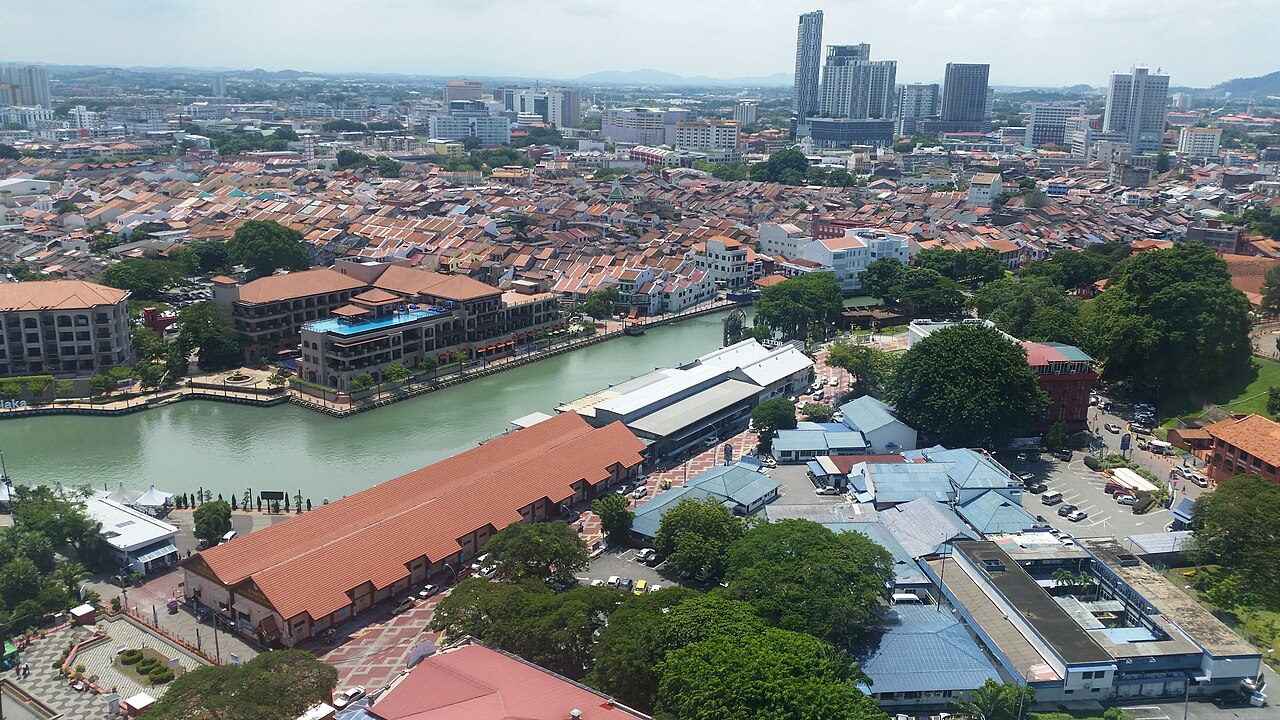
Melaka (Malacca), inscribed jointly with George Town (Penang) in 2008, is the best-preserved example of a multicultural Southeast Asian trading city — a port founded by the Malay Sultanate in 1400 CE that was successively a Portuguese fortress (1511–1641), a Dutch colonial capital (1641–1824), and a British Straits Settlement (1824–1957), its layers of architecture, cuisine, and cultural practice creating the unique Baba-Nyonya Peranakan tradition of Chinese-Malay synthesis.
Historic City of Melaka: Five Centuries of Layered Colonial Identity Melaka city centre, west coast of the Malay Peninsula
The Historic Cities of the Straits of Malacca: Melaka and George Town, inscribed in 2008 under criteria (ii), (iii), and (iv), documents the exceptional multicultural heritage of two surviving Straits Settlements port cities that preserve, in their urban fabric, the evidence of Southeast Asian, Chinese, Indian, Portuguese, Dutch, and British settlement and commerce over six centuries. Melaka was founded c. 1400 CE by Paramesvara, a Sumatran prince who created the most important port in Southeast Asia — the entrepôt where ships from China, India, Arabia, Java, and Siam exchanged goods, where the Malay language became the lingua franca of maritime Southeast Asian trade, and where Islam was adopted by the Malay Sultanate in the early fifteenth century, radiating outward to become the religion of maritime Southeast Asia. The Portuguese captured and destroyed the Sultanate in 1511, building the A Famosa fortress (its Porta de Santiago gate survives as the best-preserved Portuguese fortification in Asia) and constructing the St. Paul’s Church on the hill above the port (now a ruin whose bell tower was used as a lighthouse by the Dutch). The Dutch East India Company (VOC) conquered Melaka from the Portuguese in 1641 and built the Stadthuys (1660, the most complete Dutch colonial administrative building in Asia) and Christ Church (1753) in the distinctive Dutch red-brick Flemish style; the Stadthuis has been in continuous administrative use since its construction (it is now a museum). The British period added the English language, schools, and the street-grid of Chinatown and Little India that gives Melaka its characteristic urban texture today.
Baba-Nyonya Peranakan Heritage: Chinese-Malay Cultural Synthesis Jonker Street and Heeren Street, Chinatown
The most culturally distinctive element of Melaka’s heritage is the Peranakan (Baba-Nyonya) culture — the tradition of the descendants of Chinese immigrants who settled in Melaka in the fifteenth through seventeenth centuries, married locally, and developed a synthesis of Chinese and Malay culture: the Baba (male) and Nyonya (female) community spoke a creole Malay-Chinese language (Baba Malay), combined Chinese ancestor veneration with Malay dress and cuisine, and produced an extraordinarily rich decorative art tradition in their terrace houses (shophouses with elaborate ceramic tilework, carved timber screens, and gilt-painted interiors). The Baba-Nyonya Heritage Museum on Heeren Street (three connected shophouses c. 1896) preserves the complete domestic environment of a wealthy Peranakan family, including the bridal bed chamber (the site of elaborate eight-day wedding rituals), the ancestral altar, and the collection of Nyonya porcelain (a specifically Melaka variant of Chinese export ware produced to Peranakan taste in the late nineteenth century). Jonker Street (Jalan Hang Jebat) is the main commercial artery of Chinatown, lined with antique shops, Nyonya kuih pastry sellers, and the Cheng Hoon Teng temple (1646, the oldest functioning Chinese temple in Malaysia).
George Town (Penang): Street Art and Clan Jetties ✈ ~40 mins from Melaka or 🚌 ~3.5 hrs north
George Town, on Penang island (connected to the mainland by bridge), was inscribed jointly with Melaka in 2008; the two cities together document the full range of Straits Settlement multicultural heritage, with George Town representing the British-period entrepôt (founded 1786 by Francis Light of the East India Company) and Melaka the earlier Portuguese-Dutch-Malay layers. George Town’s heritage centre preserves the most complete surviving late-colonial Southeast Asian port city: the clan jetties (Chew, Tan, Lim, and others — waterfront settlements built by specific Chinese surname clans who had exclusive commercial and residential rights over their stretch of the waterfront from the late eighteenth century); the Khoo Kongsi clan house and courtyard (1906, the most elaborate clan association building in Malaysia, with a rooftop theatre for Hokkien opera); and the concentration of pre-war shophouses in the Georgetown area that, from 2012 onward, attracted a street art programme by the Lithuanian artist Ernest Zacharevic (whose 2012 mural “Little Children on a Bicycle” became one of the most photographed street art works in Southeast Asia). The Penang Heritage Trail maps 20 heritage buildings in the historic centre that are now accessible for guided visits.
Practical information
Melaka is 148 km south of Kuala Lumpur; buses from KL Bersepadu Selatan (Terminal Bersepadu Selatan, TBS) take 2–2.5 hours and run frequently. Melaka Sentral bus terminal is 5 km from the historic centre; Grab (ride-sharing) or local bus connects to the centre. The historic centre is compact and walkable; the Portuguese Hill (with the A Famosa gate and St. Paul’s ruins), the Dutch Square (Stadthuys and Christ Church), and Jonker Street (Chinatown) can be covered on foot in half a day. Trishaw (becak) rides are the traditional tourist transport through the streets. Baba-Nyonya Heritage Museum requires a guided entry (tours run daily). George Town (Penang) is 340 km north by road (3.5 hours) or 40 minutes by flight from Batu Berendam Airport. The best season for Melaka is the dry season (March–October); the Jonker Street Weekend Night Market (every Friday and Saturday evening) is the most vibrant street market in the historic centre. Note: Melaka can be very hot and humid year-round; early morning visits are recommended.
Frequently Asked Questions
Are Melaka and George Town UNESCO World Heritage Sites?
Yes. The Historic Cities of the Straits of Malacca: Melaka and George Town, Penang, were inscribed together as a single UNESCO World Heritage property in 2008 under criteria (ii), (iii), and (iv). The joint inscription reflects the historical and cultural relationship between the two cities as successive Straits Settlements that, together, document the full spectrum of multicultural Southeast Asian colonial port heritage from the fifteenth century to the present.
What is Peranakan (Baba-Nyonya) culture?
Peranakan (from the Malay for “locally born”) refers to the descendants of Chinese traders and immigrants who settled in the Malay Archipelago — principally in Melaka, Penang, and Singapore — from the fifteenth century onward, and who over generations adopted elements of local Malay culture while maintaining Chinese religious and ancestral traditions. The Baba (males) and Nyonya (females) spoke a creole language (Baba Malay), wore Malay-influenced dress, prepared a fusion cuisine (Nyonya cooking — the most complex regional cuisine of Malaysia, combining Chinese cooking techniques with Malay ingredients and spice profiles), and developed an elaborate decorative art tradition in ceramic, embroidery, and wood carving. The Peranakan community occupied a privileged position in British colonial society (as culturally and linguistically intermediate between the Chinese and British communities) and accumulated commercial wealth that is evident in the elaborate shophouses and clan association halls of Melaka and George Town.
What is the A Famosa and why does only a gate survive?
The A Famosa (Portuguese for “the Famous”) was the Portuguese fortress of Melaka, built beginning in 1511 after the Portuguese conquest of the Malay Sultanate and developed into one of the most extensive fortifications in Southeast Asia over the following 130 years. When the VOC (Dutch East India Company) conquered Melaka in 1641, they maintained and extended the fortress. When the British acquired Melaka from the Dutch in 1824, they ordered the demolition of the fortress (to prevent it falling into hostile hands); the demolition was nearly complete when Stamford Raffles (the founder of Singapore, who was visiting Melaka) ordered the work stopped to preserve one gate as a historical monument. The Porta de Santiago — the inner gate of the A Famosa, a sandstone arch with the Portuguese royal arms and the date 1511 — is the surviving fragment, now the only Portuguese colonial fortification in Malaysia.
Sources
- S1 — Sandhu, Kernial Singh, and Paul Wheatley, eds. Melaka: The Transformation of a Malay Capital. Oxford University Press, 1983. ISBN 978-0-19-582528-2.
- S2 — Tan, Chee-Beng. The Baba of Melaka: Culture and Identity of a Chinese Peranakan Community. Pelanduk Publications, 1988. ISBN 978-967-978-219-6.
Spotted an error? Write to editorial@culturalheritageonline.com and we correct it the same day.