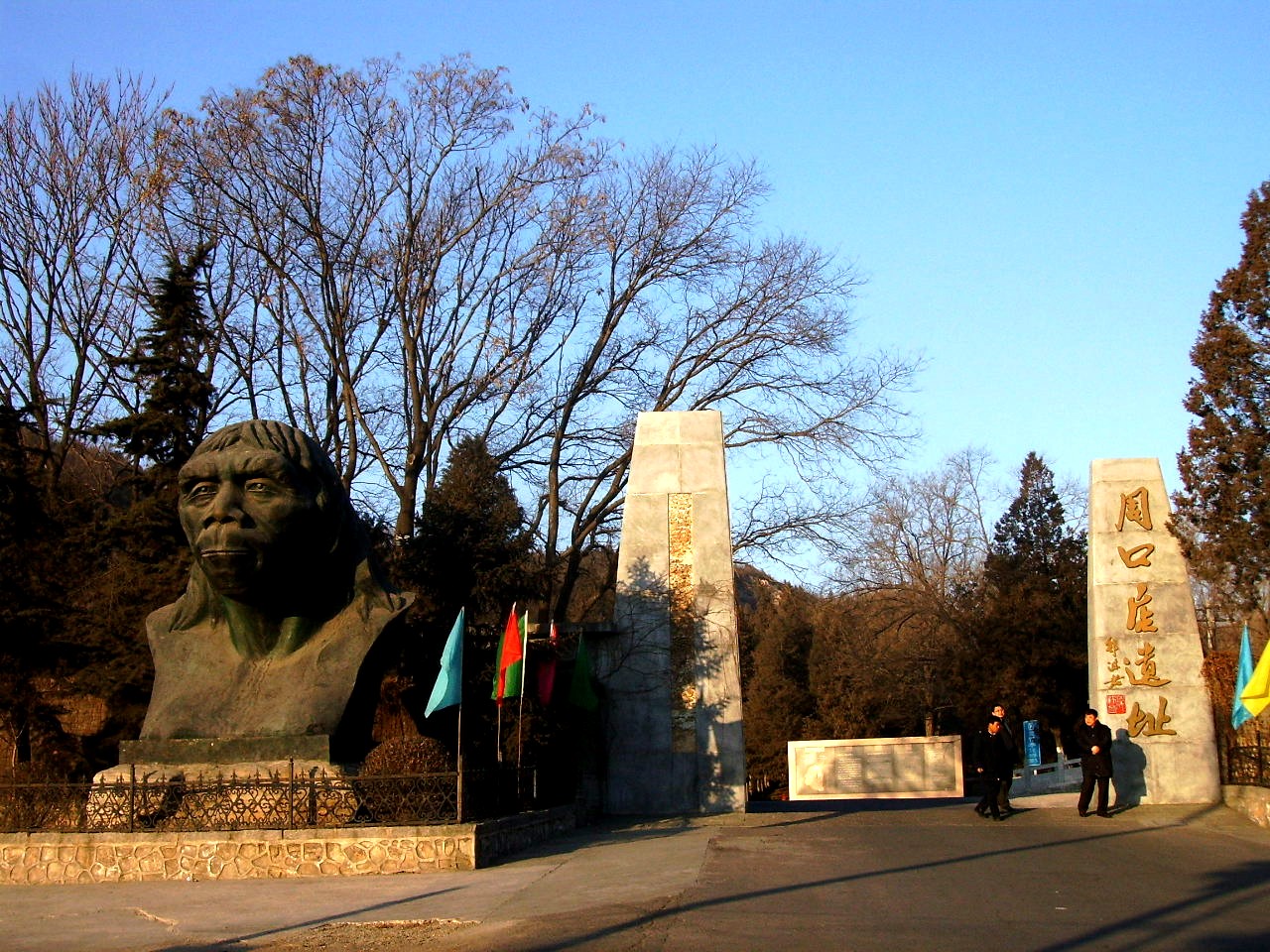
The Peking Man Site at Zhoukoudian, inscribed by UNESCO in 1987, is a complex of cave and fissure sites in the limestone hills 48 kilometres southwest of Beijing where fossilized remains of Homo erectus pekinensis — “Peking Man” — were excavated between 1921 and 1937. The Zhoukoudian Homo erectus fossils, dated to 700,000–200,000 years ago, were among the most important palaeontological discoveries of the 20th century: they provided the first robust evidence that Homo erectus had inhabited East Asia. Cave 1 (the “Lower Cave”) produced 200 fossilized remains representing at least 40 individuals; an Upper Cave yielded three anatomically modern Homo sapiens skulls (Upper Cave Man) dated to approximately 30,000 years ago.
Southwest of Beijing and the Fangshan corridor Forbidden City · Temple of Heaven · Great Wall — 15 to 60 km
Forty-eight kilometres northeast of Zhoukoudian by expressway and subway (approximately 90 minutes total), the Imperial Palaces of the Ming and Qing Dynasties — the Forbidden City (inscribed 1987) — is the 15th-century palace complex at the centre of the city whose deepest human occupation Zhoukoudian documents. The 700,000-year gap between the Zhoukoudian Homo erectus and the Ming Yongle Emperor’s Forbidden City (built 1406–1420 CE) is the full span of human biological and cultural evolution in East Asia: the same North China Plain geography, the same limestone hills of Fangshan, and the same river-valley topography channelled human movement from the Pleistocene to the present. The anatomically modern Homo sapiens who replaced or absorbed Homo erectus in northern China approximately 40,000 years ago were the ancestors of the agricultural communities that colonized the Yellow River plain, the states that competed in the Bronze Age Shang and Zhou kingdoms, and the imperial court that built the Forbidden City in the valley below Zhoukoudian’s hills.
Forty-five kilometres northeast of Zhoukoudian (approximately 50 minutes by expressway and Beijing subway), the Temple of Heaven (Tiantan), inscribed 1998, was built in 1420 CE — the same year as the Forbidden City — as the site of the emperor’s annual winter solstice sacrifice to Heaven. The ritual distance between the Temple of Heaven’s cosmological ceremony (the emperor as mediator between the human world and the cosmic order, 1420 CE) and the Zhoukoudian Homo erectus using fire in a limestone cave (500,000 BCE) is the full span of human cultural development that the two inscriptions bookend in the same metropolitan area. The Temple of Heaven’s Circular Mound Altar stands 45 km northeast of the cave where fire use was first documented in East Asia; the same population’s cultural relationship to fire — from a survival technology to a ritual medium — is the arc the two sites define.
Sixty kilometres north of Zhoukoudian by expressway (approximately 75 minutes by car), the Great Wall of China at Badaling (inscribed 1987) runs along the Yanshan granite ridge defining Beijing’s northern mountain boundary. The geological relationship between Zhoukoudian’s limestone hills (Taihang Mountain foothills) and Badaling’s granite ridge is a continuum of the same mountain arc: the limestone of Fangshan where Homo erectus sheltered and the granite of Yanqing where the Ming Wall runs are both outcrops of the same Taihang-Yanshan mountain system that defines Beijing’s western and northern boundary. The Wall and the cave are at opposite ends of this mountain arc, 60 kilometres apart — one documenting humanity’s oldest occupation of the terrain, the other its most ambitious attempt to define its territorial limits.
Forty kilometres northeast of Zhoukoudian (approximately 45 minutes by car via the Fifth Ring Road), the Summer Palace (Yiheyuan), inscribed 1998, is the 290-hectare imperial garden-park on Kunming Lake in Beijing’s northwest. Kunming Lake was created by Emperor Qianlong in 1750 by expanding a natural spring-lake fed by the same groundwater system that produces the springs at the base of Zhoukoudian’s limestone hills: groundwater moving through fractured limestone emerges at the Fangshan springs (the same springs that made Zhoukoudian an attractive camp for Homo erectus) and at Yuquan Hill springs northwest of Beijing (which fed the original natural lake that Qianlong expanded into Kunming Lake). The hydrological thread connecting Zhoukoudian’s Pleistocene cave camp and the Qing imperial garden park runs through the fractured limestone aquifer of the Taihang foothills.
Further from Beijing and the Pleistocene context Ming Tombs · Jinshanling · Mount Taishan — 70 to 500 km
Seventy kilometres north of Zhoukoudian by expressway (approximately 80 minutes), the Imperial Tombs of the Ming and Qing Dynasties at Changling (inscribed 2000) are built into the same Yanshan Mountain foothills at whose southern base Zhoukoudian’s caves are located. The Spirit Way of the Changling tombs — 7 kilometres of stone animal sculptures — leads into the limestone-and-granite mountain geography that provided Homo erectus with cave shelter 700,000 years earlier. The human relationship with the Fangshan-Yanshan limestone landscape is continuous from Homo erectus to the Ming court: caves, then quarries (the white marble used in the Forbidden City was quarried from the same Fangshan limestone), then imperial garden springs, then imperial burial chambers cut into the same rock formation. The Changling tomb complex (Changling: Yongle Emperor; Dingling: Wanli Emperor, the only excavated tomb) is accessible from Zhoukoudian by car via the expressway north of Beijing (approximately 80 minutes).
One hundred thirty kilometres northeast of Zhoukoudian (approximately 2 hours by car via Beijing), the Jinshanling section of the Great Wall in Hebei Province offers the most complete walking experience of the Ming construction. The 10-kilometre Jinshanling-to-Simatai hiking traverse (approximately 4–5 hours) crosses 67 watchtowers of the Wall in its most atmospheric state — a mix of restored and original Ming brick, with the Simatai section’s evening lighting for night walks. Zhoukoudian and Jinshanling are at the southern and northern extremes of the same mountain arc, 130 kilometres apart: the Homo erectus cave at the southern limestone foothills and the Ming military rampart at the northern granite ridge define the human occupation of this terrain across 700,000 years.
Five hundred kilometres southwest of Zhoukoudian by high-speed rail (approximately 4 hours from Beijing South via Xi’an to Luoyang Longmen), the Longmen Grottoes at Luoyang (inscribed 2000) document Tang-dynasty Buddhist sculpture 700,000 years after Homo erectus occupied the same Yellow River watershed. The geographic connection between Zhoukoudian (Fangshan District, Beijing, on the North China Plain’s western edge) and Luoyang (on the Yellow River in Henan Province) is the North China Plain itself: the same alluvial geography that Homo erectus moved across at Zhoukoudian was the landscape the Han and Tang dynasties organized into China’s most productive agricultural and administrative territory. The Longmen inscription and the Zhoukoudian inscription bracket the North China Plain’s human occupation from the Pleistocene to the Tang: 700,000 years of continuous hominid and human presence in the same drainage basin.
Five hundred kilometres southwest of Zhoukoudian by high-speed rail (approximately 2 hours from Beijing South to Tai’an), Mount Taishan in Shandong Province (inscribed 1987) documents the cultural landscape of the North China Plain’s most sacred summit. The First Emperor who conducted the first recorded Taishan sacrifice in 221 BCE was a direct institutional descendant of the polities that emerged from the agricultural communities that colonized the Yellow River plain — communities whose deepest human ancestry in East Asia traces back to the Homo erectus population documented at Zhoukoudian. The cultural-biological connection between Zhoukoudian Homo sapiens (Upper Cave Man, approximately 30,000 years ago, the anatomically modern population that entered the same cave system after Homo erectus) and the Shang-Zhou-Qin-Han populations that created the Taishan ritual is the question of modern palaeogenomics research into East Asian human origins.
Practical information
The Zhoukoudian Peking Man Site is in Fangshan District, Beijing Municipality, 48 km southwest of central Beijing. It is accessible by Beijing Subway Line 14 (from Dongdaqiao in the city centre to Zhangguozhuang Station, approximately 50 minutes) and then local bus or taxi (approximately 20 minutes from Zhangguozhuang to the site); alternatively, by bus 917 from Beijing South Railway Station to Zhoukoudian Town (approximately 90 minutes). The Museum of Peking Man (Zhōukōudiàn Yí Zhǐ Bówùguǎn) at the site entrance displays replica casts of the original fossils (lost in wartime transit in 1941), stone tools (flint scrapers, choppers, and points) and animal bone assemblages from Cave 1’s fill, the charred bone and ash evidence of fire use (dated approximately 500,000 years ago — the earliest documented fire use by Homo erectus in East Asia), and results of ongoing excavation at Cave 1 and surrounding sites. Cave 1 (the Lower Cave, the principal Homo erectus site) is accessible for self-guided viewing; the cave’s interior extends approximately 40 metres into the hillside, with the primary fossil-bearing sediment layer visible in section. The Upper Cave (where Homo sapiens remains were found in 1933) is separately viewable from an external path. The site opens Tuesday through Sunday (closed Mondays); hours vary by season. Nearby tourist sites in Fangshan District include the Yunjusheng pagoda complex (Tang dynasty, with 15,000 stone sutra tablets carved over 1,000 years in a nearby valley) and the Zhoukoudian Railway Station (served by the Beijing-Shijiazhuang suburban rail line from Beijing West Station, approximately 50 minutes) for visitors preferring rail access.
Frequently Asked Questions
What happened to the original Peking Man fossils?
The original Peking Man fossils — skull caps (calvaria), mandibles, teeth, and limb bones representing approximately 40 individuals excavated from Cave 1 between 1921 and 1937 by the Cenozoic Research Laboratory under Davidson Black and later Franz Weidenreich — were packed for safekeeping at the American Embassy in Beijing in late 1941 as Japanese forces prepared to occupy the city. They were shipped toward the United States aboard the SS President Harrison (departing Qinhuangdao for Manila and then San Francisco) on 8 December 1941 — the day Japan attacked Pearl Harbor. The ship was captured by Japanese forces off Shanghai on that same day. The fossil crates were either lost in the chaos of capture and trans-shipment, confiscated and then mislaid in the Japanese military logistics system, or destroyed. Despite extensive searches by Chinese, American, and Japanese authorities in the decades since (including a 2012 Chinese government investigation), the original fossils have never been recovered. The loss is one of the most significant in the history of palaeontology: the original specimens are irreplaceable primary evidence, and Weidenreich’s 1943 monograph with its detailed measurements and photographs (completed just before his death in 1948) remains the primary scientific record. The casts made by Weidenreich’s team (stored at the American Museum of Natural History in New York) are the physical objects that represent the Peking Man fossils in all subsequent morphological research. Ongoing excavations at Zhoukoudian since the 1970s have recovered additional Homo erectus teeth and bone fragments, but no skull material comparable to the lost specimens.
What is Homo erectus and how does it relate to modern humans?
Homo erectus is a species of archaic human that lived in Africa and Asia from approximately 1.9 million years ago to approximately 110,000 years ago — the longest-lived human species in the fossil record. The Zhoukoudian Homo erectus (700,000–200,000 years ago) is the East Asian regional population of a species whose earliest members are found in Africa and Georgia. Homo erectus at Zhoukoudian was fully bipedal, with a brain volume of 900–1,100 cc (approximately 65–80% of modern human brain volume of 1,350 cc), capable of producing the Acheulean tool tradition (hand axes, cleavers, scrapers) and, at Zhoukoudian, demonstrating control and sustained use of fire — the earliest fire use in East Asia documented in the archaeological record. The relationship between Homo erectus and modern Homo sapiens is the central question of human evolution research. The current consensus position, derived from genetic analysis of ancient and modern DNA, is that anatomically modern Homo sapiens emerged in Africa approximately 300,000 years ago from a population derived from African Homo heidelbergensis (a close relative of Homo erectus); modern humans spread out of Africa approximately 70,000–50,000 years ago and reached East Asia approximately 40,000–50,000 years ago, where they may have co-existed briefly with the last surviving Homo erectus populations before those populations went extinct. The extent to which modern East Asians carry Homo erectus DNA is unresolved: early gene-flow models suggested significant archaic admixture, but recent ancient DNA studies suggest that modern East Asians descend overwhelmingly from the African-origin Homo sapiens, with only trace archaic admixture from Denisovans (a separate archaic human population known from Siberia and Tibet) rather than from Homo erectus.
Why was Zhoukoudian important as a prehistoric site for early humans?
Zhoukoudian’s limestone hill complex provided Homo erectus with a combination of resources that made it one of the most productive foraging bases in the North China Plain: the cave’s elevated position gave a view over the surrounding plain for detecting game; the cave system provided shelter from winter temperatures and summer storms; the Fangshan springs at the hill base provided reliable water; and the surrounding mixed forest-grassland ecotone provided a diversity of prey (deer, rhinoceros, hyena, bear, saber-toothed cat) and plant foods. The 700,000-year occupation span documented at Cave 1 indicates that these advantages were consistently available — the site was not a one-time occupation but a repeatedly used base camp over 500,000 years of Homo erectus evolutionary history. The fire evidence at Zhoukoudian (charred bone, ash deposits, and burnt stone tools in the same stratum as Homo erectus remains) indicates that fire was used for cooking, warmth, and probably predator deterrence — making Zhoukoudian the site of the earliest documented fire use in East Asia and one of the earliest globally (African fire use evidence is documented at Wonderwerk Cave in South Africa from approximately 1 million years ago). The site’s significance for the UNESCO inscription is therefore multi-layered: it documents not just the physical presence of early humans in East Asia, but their behavioural complexity (tool use, fire control, repeated seasonal return to a productive base) at a time when these capabilities were not yet universal in the human lineage.
Sources
- S1 — UNESCO World Heritage Centre — Peking Man Site at Zhoukoudian (Ref. 449) — https://web.archive.org/web/20230601000000/https://whc.unesco.org/en/list/449/
- S2 — UNESCO World Heritage Centre — Statement of Outstanding Universal Value (Ref. 449) — https://whc.unesco.org/en/list/449/
Spotted an error? Write to editorial@culturalheritageonline.com and we correct it the same day.