
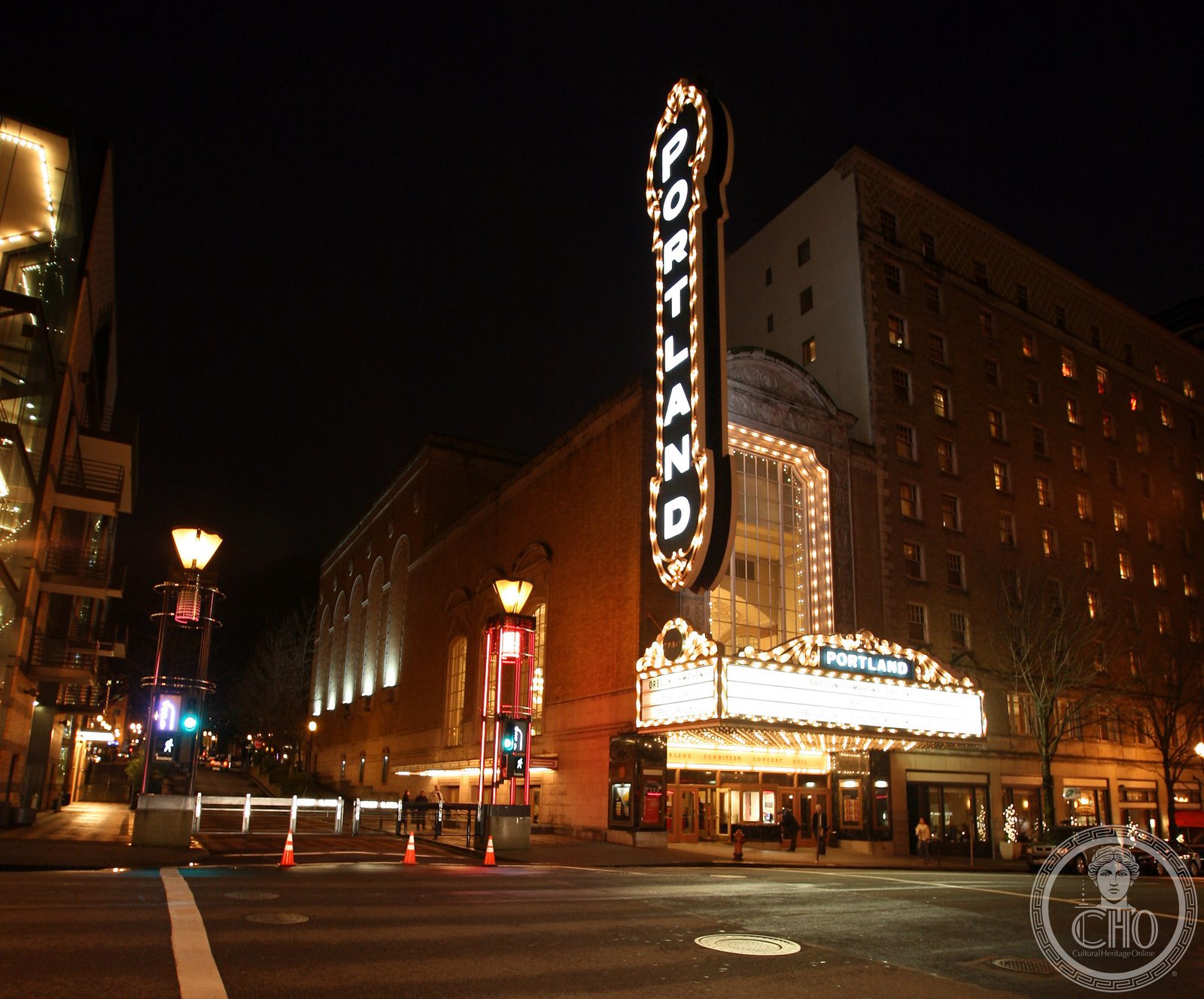
Rapp & Rapp brought the same Spanish Baroque opulence to Portland in 1928 that they had given Chicago’s Loop seven years earlier—a gilded movie palace on SW Broadway that traded reels for symphonies when it became Oregon’s premier concert hall in the 1980s.
At a glance
The building opened on October 28, 1928 as the Paramount Theatre, the flagship cinema of Portland’s downtown at a moment when the great American movie palace was reaching its peak of architectural ambition. Rapp & Rapp, the Chicago firm that had designed the Chicago Theatre (1921) and dozens of other major cinema palaces across the country, applied a Spanish Baroque vocabulary to the SW Broadway elevation: an ornate terra-cotta façade, a vertical marquee sign visible from blocks away, and an interior of gilded plasterwork, painted murals, and crystal chandeliers designed to make the experience of cinema equal in occasion to the opera. The building was renamed the Arlene Schnitzer Concert Hall in 1984 after philanthropist Arlene Schnitzer’s major gift funded its conversion to its current role as the home of the Oregon Symphony.
Key facts
- Address: 1037 SW Broadway, Portland, OR 97205
- Original name: Paramount Theatre
- Architects: Rapp & Rapp
- Opened: October 28, 1928
- Style: Spanish Baroque Revival
- Capacity: approximately 2,700 seats
- Landmark status: Portland Historic Landmark; National Register of Historic Places
- Current use: Home of the Oregon Symphony; managed by Portland’5 Centers for the Arts
History
Rapp & Rapp designed the Paramount as a prestige commission in what was, by 1928, a well-established national typology: the large-capacity downtown movie palace that competed with the legitimate theatre and opera house for civic prestige and nightly audiences. The Spanish Baroque style—arched niches, elaborate plasterwork, coats of arms, and wrought-iron lanterns—gave the interior an atmosphere of Mediterranean grandeur that contrasted deliberately with the pragmatic commercial architecture of the surrounding downtown blocks.
The theatre operated as a major entertainment venue through the 1950s, then entered the familiar trajectory of decline as suburban multiplex cinema displaced downtown first-run houses. By the 1970s the Paramount had closed as a full-time cinema. The city and the performing arts community recognized the building’s acoustic and spatial qualities as well as its architectural significance, and in the early 1980s a conversion was undertaken to adapt the stage and orchestra-level seating for symphony use. The renovation was made possible in part by a major gift from Arlene Schnitzer, after whom the hall was renamed at its reopening in 1984. The PORTLAND vertical marquee sign, one of Portland’s most recognisable downtown landmarks, was retained and refurbished.
What you see
The SW Broadway façade presents the characteristic Rapp & Rapp composition: a tall ground-floor arcade of arched openings in terra-cotta, surmounted by a vertical neon sign that identifies the building from a distance and anchors it within the street. The Spanish Baroque ornament—clustered columns, elaborate cartouches, and a broken pediment above the main entrance—is executed in cream-coloured terra-cotta that retains its legibility against the surrounding masonry at street level and at the scale of the streetscape.
The interior reads as a series of spatial escalations from foyer to auditorium. The side walls of the auditorium carry the Spanish Baroque ornament into the volume of the hall in tiered niches, painted panels, and gilded plaster reliefs. The stage opening is framed by a deep proscenium arch whose ornamental density rivals the Chicago Theatre’s. The acoustic renovation of 1984 preserved these surfaces while reconfiguring the orchestra floor and stage to serve a symphony orchestra rather than a film projection booth—a reuse model that has proven successful in preserving large-capacity downtown theatres across the United States.
Practical information
- Open for Oregon Symphony performances and touring concerts; check Portland’5 Centers for the Arts calendar
- Lobby open to the public approximately 90 minutes before performances; guided tours available by arrangement
- The façade and marquee are best viewed in the evening when the neon sign is illuminated
- Fully accessible; elevator access to all levels
- Pre-performance dining available in the lobby bar on concert evenings
Getting there
The Arlene Schnitzer Concert Hall stands at 1037 SW Broadway in downtown Portland. The MAX Light Rail stops at the nearby Pioneer Courthouse Square (Red, Blue, Green, Yellow, and Orange lines), approximately 3 blocks north. Portland International Airport (PDX) is approximately 10 miles northeast; the MAX Red Line runs directly from the airport to downtown. Street parking and a city parking garage are available within a block on SW Broadway and SW 10th Avenue.
Nearby
- Portland Art Museum — approximately 1 block east on SW Park Avenue; encyclopedic collection including Northwest Coast Native art, European masters, and a strong modern/contemporary collection
- Pioneer Courthouse Square — approximately 3 blocks north; Portland’s civic living room, a tree-lined public plaza with the historic Pioneer Courthouse (1875)
- Powell’s City of Books — approximately 0.5 miles northwest on W Burnside Street; the largest independent bookstore in the United States, occupying an entire city block
Sources
- National Register of Historic Places nomination: Paramount Theatre, Portland, OR
- Portland Bureau of Development Services: historic landmark designation documentation
- Portland’5 Centers for the Arts: institutional history of the Arlene Schnitzer Concert Hall
- Naylor, David. American Picture Palaces: The Architecture of Fantasy. New York: Van Nostrand Reinhold, 1981 (chapter on Rapp & Rapp)
Find it on the map
See this place and what’s around it →📷 Become a Cultural Heritage Online photographer
Share your photos of places: they stay published under your name as the author. The more they're seen, the more you get noticed — and soon a contest will reward the most appreciated photos.
Log in or sign up free to add a photoIs this page about you?
This page is read by travellers and heritage enthusiasts who find it on Google. Tell us how you are connected to this place and we will take it from there.