Florence is itself a UNESCO World Heritage Site — the historic centre inscribed in 1982 as the city that produced the Renaissance. Within two hours by road or train, three more inscribed cities — Siena, San Gimignano, and Pisa — and the Val d’Orcia landscape extend one of Europe’s densest heritage concentrations.
Historic Centre of Florence: The City That Made the Renaissance City centre
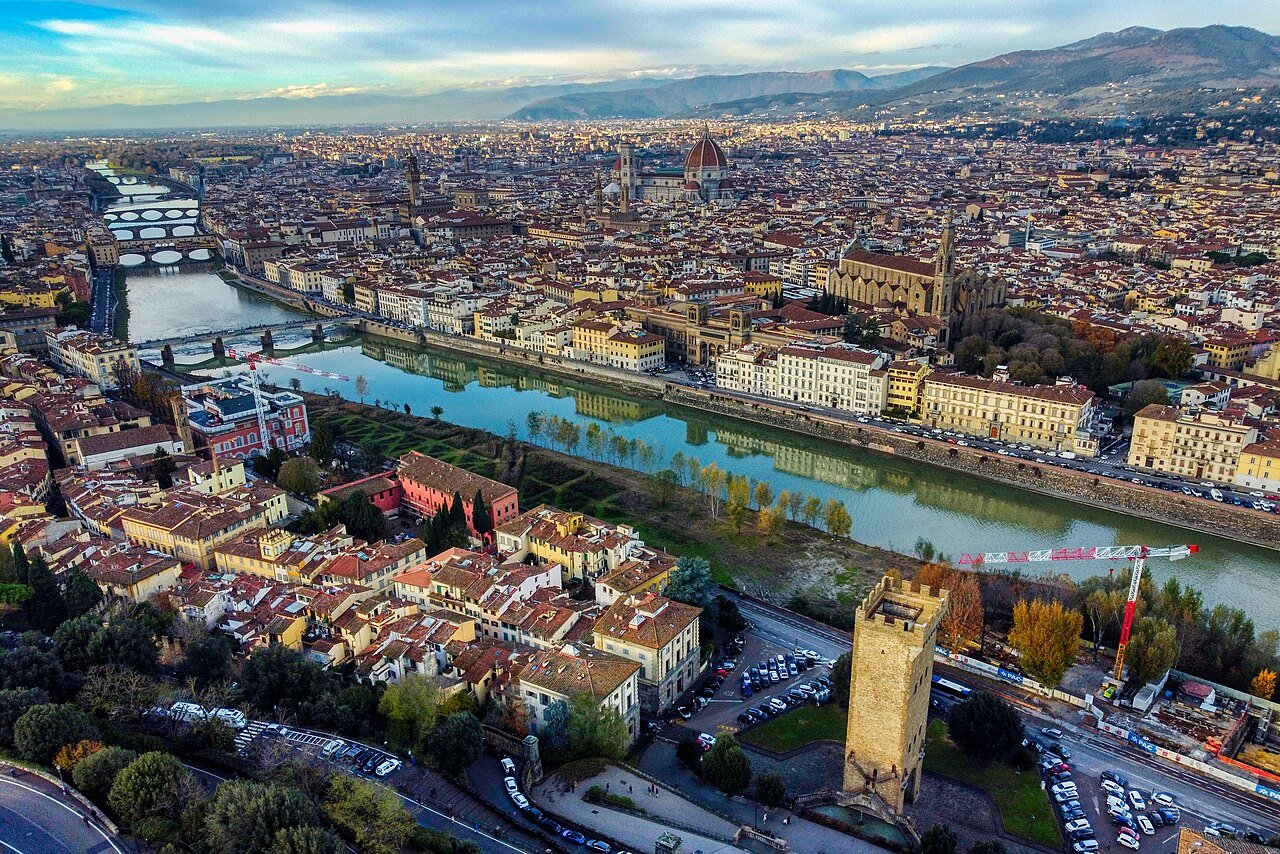
The Historic Centre of Florence, inscribed in 1982 under criteria (i), (ii), (iii), (iv), and (vi), holds an exceptional accumulation of art, architecture, and intellectual achievement from the thirteenth to the seventeenth century. The Brunelleschi dome of Santa Maria del Fiore (1436) — still the largest masonry dome ever built — stands at the centre of a city where Botticelli, Leonardo, Michelangelo, and Galileo all worked. The Uffizi Gallery, originally built as administrative offices for the Medici by Giorgio Vasari in 1560, holds the world’s greatest concentration of Renaissance painting. The Bargello, the Palazzo Vecchio, and the church of Santa Croce — where Michelangelo, Galileo, Machiavelli, and Dante are entombed — give a sense of how densely the city’s fabric is threaded with consequence. The Ponte Vecchio, lined with goldsmiths since the sixteenth century, and the Piazzale Michelangelo viewpoint above the Arno complete a landscape that has barely changed since the grand tour paintings of the eighteenth century.
Historic Centre of Siena: Gothic City Without a Renaissance 🚗 ~1.5 hrs south
Siena, inscribed in 1995 under criteria (i), (ii), and (iv), is the anti-Florence — a Gothic city that missed the Renaissance because it lost the plague of 1348 so catastrophically that its medieval form was preserved by depopulation. The Piazza del Campo, shaped like a tilted shell around the Palazzo Pubblico, hosts the Palio horse race twice a year on the bare earth. The Duomo di Siena, its black and white marble striped facade visible from the hills, contains Nicola Pisano’s pulpit (1268) and Pinturicchio’s Piccolomini Library. A day in Siena is best planned in the morning before the bus groups arrive: the fan-shaped campo is extraordinary at dawn when the travertine glows pink against the brick towers.
Historic Centre of San Gimignano: The Medieval Manhattan 🚗 ~1 hr southwest
San Gimignano, inscribed in 1990 under criteria (i) and (iii), has fourteen surviving medieval towers — out of an original seventy-two — that were built by competing aristocratic families as symbols of wealth and power between the twelfth and fourteenth centuries. The town is small enough to walk in an hour but dense enough in frescoed churches, civic palaces, and vernacular medieval architecture to hold several days of close looking. The Collegiata contains Bartolo di Fredi’s Old Testament cycle and Domenico Ghirlandaio’s Santa Fina chapel. Arrive early or stay late to see it without the midday crowds.
Val d’Orcia: A Painted Landscape 🚗 ~2 hrs south via Siena
The Val d’Orcia, inscribed in 2004 under criteria (iv) and (vi), protects a section of the Sienese landscape that has been managed for aesthetic effect since the fourteenth century, when the Sienese government improved roads for pilgrims on the Via Francigena and encouraged landowners to replace scrubby hills with wheat fields, cypress avenues, and fortified farmhouses. The result is the landscape that appears in the backgrounds of Sienese paintings — cypress-lined ridges, rounded clay hills (crete senesi), and fortified villages at Montalcino, Pienza (itself a Renaissance planned town), and Montepulciano. The spring light, late April to May, turns the wheat green and poppy-red: the photographs taken on this timing account for a significant percentage of Italy’s travel imagery.
Practical information
Florence is served by Santa Maria Novella station — Italy’s main rail spine passes through it, with fast trains from Rome (1.5 hrs), Milan (1.75 hrs), and Bologna (35 mins). Siena and San Gimignano are best reached by bus from Florence (Siena 1.5 hrs, San Gimignano 1.5 hrs with change at Poggibonsi). The Val d’Orcia requires a rental car. Florence’s historic centre has a Limited Traffic Zone (ZTL); don’t drive into it without checking your hotel’s permit status. The most crowded months are April, May, July, and August; September and October offer stable weather with smaller crowds in the smaller hill towns.
Frequently Asked Questions
Is Florence itself a UNESCO World Heritage Site?
Yes. The Historic Centre of Florence was inscribed in 1982 under five UNESCO criteria — (i), (ii), (iii), (iv), and (vi) — making it one of the world’s most comprehensively cited heritage cities for its role in the development of Renaissance art and culture.
How many UNESCO sites can you visit on a day trip from Florence?
Two comfortably: Siena (1.5 hrs by bus) and San Gimignano (1.5 hrs by bus via Poggibonsi) make a logical pair, though the distance means an early start and no lingering. Three in one day is rushed. The Val d’Orcia warrants an overnight in Pienza or Montalcino.
What is the best time to see the Val d’Orcia landscape?
Late April to mid-May, when wheat fields are green and poppies add red accents to the Crete Senesi hills. Autumn (September–October) offers golden light and harvested fields. Summer turns everything straw-coloured and is very hot.
Sources
- S1 — Goldthwaite, Richard A. The Building of Renaissance Florence. Johns Hopkins University Press, 1980. ISBN 978-0-8018-2975-8.
- S2 — Hibbert, Christopher. The Rise and Fall of the House of Medici. Penguin Books, 1979. ISBN 978-0-14-005090-5.
Spotted an error? Write to editorial@culturalheritageonline.com and we correct it the same day.