Seville’s UNESCO inscription covers three of the city’s own monuments — the Cathedral, the Alcázar, and the Archivo de Indias — but the city is also the gateway to the most concentrated UNESCO heritage region in Spain: Córdoba’s Mosque-Cathedral, Granada’s Alhambra, and the Doñana wetlands are all within three hours.
Seville Cathedral, Alcázar and Archivo de Indias: Three Worlds in One City City centre
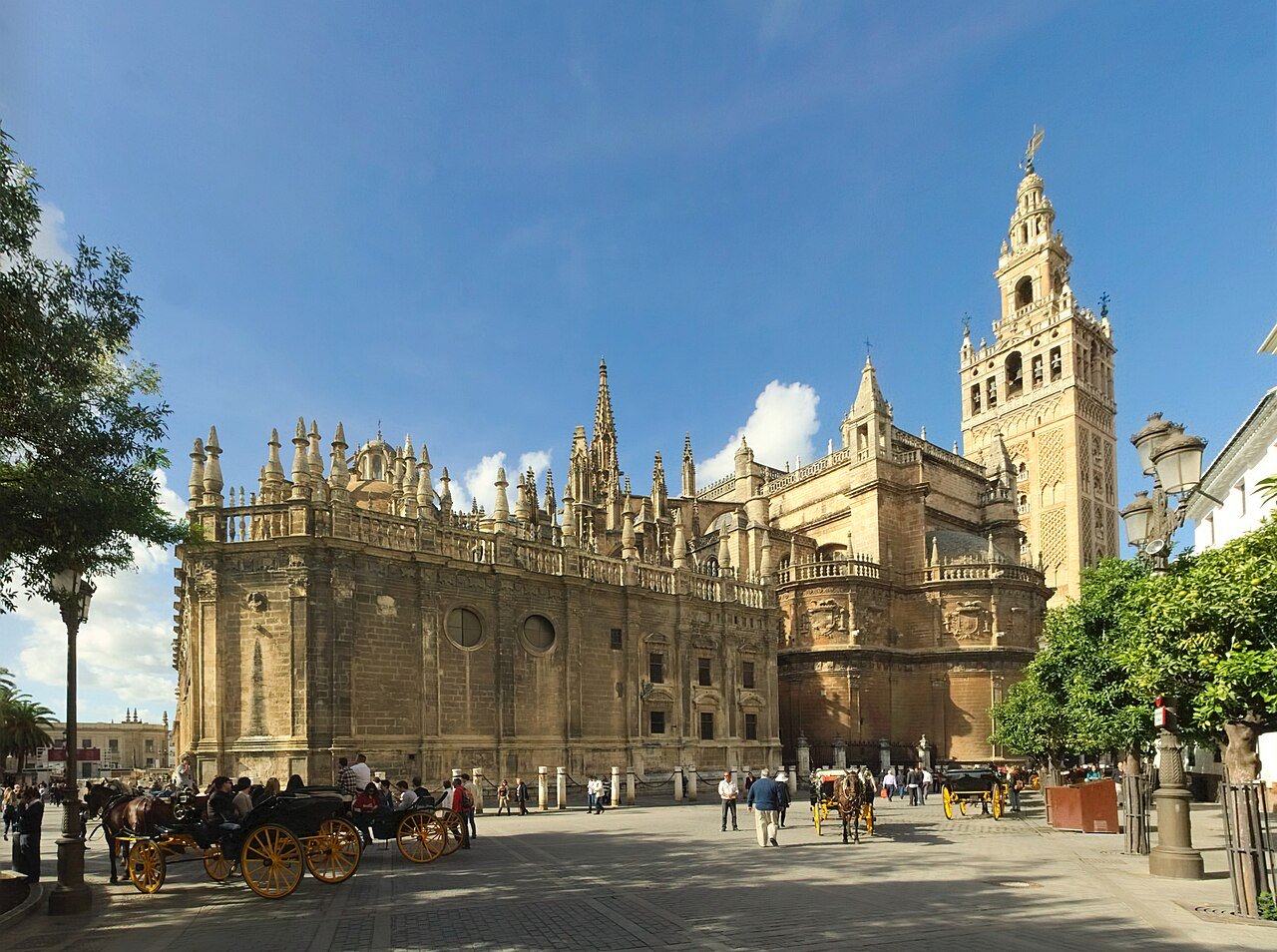
The three monuments forming Seville’s UNESCO inscription (1987, criteria (i), (ii), (iii), (iv), and (vi)) represent three distinct civilisations and purposes overlapping on the same ground. The Cathedral, built between 1401 and 1528 on the site of the former mosque, is the largest Gothic cathedral in the world by interior volume; it holds the tomb of Christopher Columbus. The Giralda tower — originally the minaret of the Almohad mosque, converted to a bell tower in 1568 — still stands at the cathedral’s corner, its Moorish brickwork a different texture from the Gothic buttresses beside it. The Real Alcázar, a royal palace continuously occupied since the tenth century, layers Moorish, Mudéjar, Renaissance, and Baroque work in its rooms and gardens. The Archivo de Indias, built by Juan de Herrera in 1598, holds 90 million pages of documents from the Spanish colonial administration — every letter Columbus sent back from America, every land grant, every death record.
Historic Centre of Córdoba: The Mosque-Cathedral 🚗 ~1.5 hrs northeast
The Historic Centre of Córdoba, inscribed in 1984 (extended 1994) under criteria (i), (ii), (iii), and (iv), is dominated by the Great Mosque-Cathedral — the Mezquita — begun in 785 by Abd al-Rahman I on the site of a Visigothic church, expanded three times over the next two centuries, and converted to a cathedral after the Christian reconquest by inserting a Renaissance nave directly through the middle of the hypostyle forest. The result is architecturally dissonant and historically eloquent: you pass from a forest of 856 red-and-white striped arches into a vaulted Baroque choir without transition. The Jewish quarter of the Judería, the synagogue (one of three surviving medieval synagogues in Spain), and the medieval bridge across the Guadalquivir complete the site.
Alhambra, Generalife and Albaicín: Granada’s Palace and Quarter 🚗 ~2.5 hrs east
The Alhambra, Generalife, and Albaicín, inscribed in 1984 (Albaicín added 1994) under criteria (i), (iii), and (iv), are the high-water mark of Nasrid palace architecture — a complex built over the thirteenth and fourteenth centuries on a red sandstone ridge above Granada, its name derived from the Arabic for “red fortress.” The Patio de los Leones and the Hall of the Abencerrages demonstrate the Nasrid court’s mastery of light, water, and carved stucco; the Generalife gardens, irrigated through channels cut into the hillside, demonstrate their mastery of planted landscape. Tickets must be booked months in advance for peak season. The Albaicín district across the valley retains its Moorish street pattern and gives the most coherent view of the Alhambra’s profile from the church terrace of San Nicolás.
Doñana National Park: Europe’s Most Important Wetland 🚗 ~1.5 hrs southwest
Doñana National Park, inscribed in 1994 (extended 2005) under criteria (vii), (ix), and (x), protects the largest roadless area in western Europe — a complex of marismas (seasonally flooded marshes), fixed and mobile dunes, and Mediterranean scrubland that serves as a critical wintering and migration stopover for millions of birds on the Atlantic flyway. The park harbours the last viable population of the Iberian lynx and one of the two surviving wild populations of the Spanish imperial eagle. Access is restricted to guided 4×4 tours to protect the ecosystem; advance booking is essential. The drive from Seville through El Rocío village, famous for its annual pilgrimage, approaches the park’s northern edge.
Practical information
Seville is served by Santa Justa high-speed rail station — AVE trains from Madrid take 2.5 hours. Córdoba is 45 minutes from Seville by AVE. Granada is most easily reached by bus (3 hrs) or a connecting train via Córdoba (3.5 hrs). Doñana requires a rental car. The Alhambra’s most popular time slots (morning, Nasrid Palaces) sell out months ahead during March–October; book well in advance via the official Alhambra website. Spring (March–May) and autumn (September–October) offer the best conditions for Seville, Córdoba, and Doñana; summer temperatures regularly exceed 40°C.
Frequently Asked Questions
What is included in Seville’s UNESCO World Heritage inscription?
Seville’s UNESCO inscription (1987) covers three monuments: the Cathedral (including the Giralda tower), the Real Alcázar palace complex, and the Archivo de Indias. The three buildings form a concentrated triangle in the city centre.
Do you need to book the Alhambra in advance from Seville?
Yes. The Nasrid Palaces section of the Alhambra has limited timed entry and sells out weeks to months in advance during spring and summer. Book through the official Alhambra website (entradas.alhambra-patronato.es) well before travel.
What is Doñana National Park known for?
Doñana is Europe’s most important wetland for migratory and wintering birds. It also protects Spain’s last Iberian lynx population. Access is strictly managed through guided tours; self-drive entry into the core park zone is not permitted.
Sources
- S1 — Harvey, L. P. Islamic Spain, 1250 to 1500. University of Chicago Press, 1990. ISBN 978-0-226-31962-9.
- S2 — Dodds, Jerrilynn D., ed. Al-Andalus: The Art of Islamic Spain. Metropolitan Museum of Art, 1992. ISBN 978-0-87099-636-8.
Spotted an error? Write to editorial@culturalheritageonline.com and we correct it the same day.