

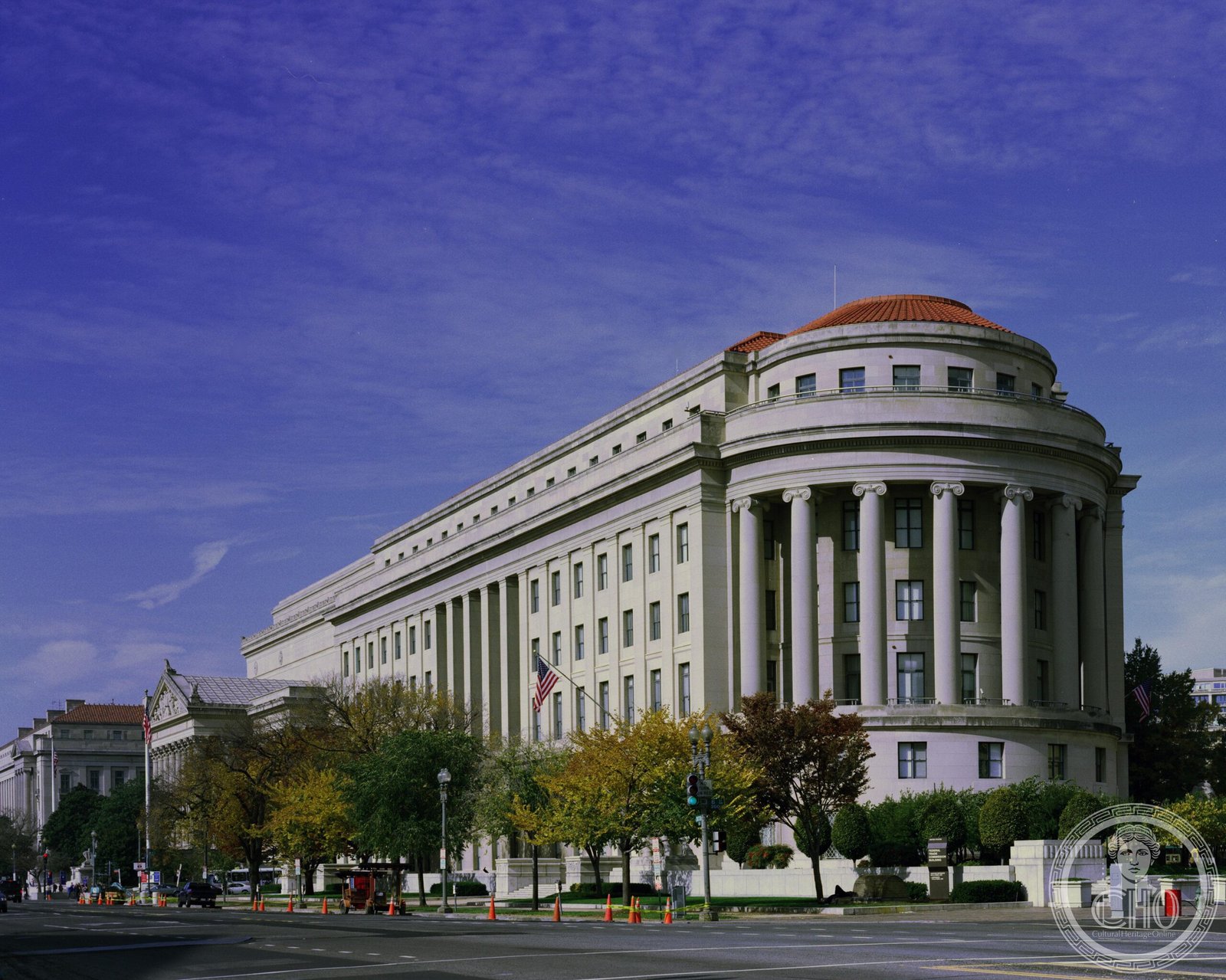

Completed in 1938 at the triangular intersection of Pennsylvania Avenue and Constitution Avenue NW, the Federal Trade Commission’s Apex Building is the architectural centrepiece of Washington’s Federal Triangle — occupying the acute angle where the two great avenues converge, its curved eastern facade and two colossal equestrian sculpture groups by Michael Lantz representing “Man Controlling Trade” creating one of the most powerful compositions of New Deal civic art in the capital.
At a glance
The Federal Trade Commission Building at 600 Pennsylvania Avenue NW is known as the Apex Building because it occupies the triangular apex formed by the intersection of Pennsylvania Avenue and Constitution Avenue — the geometric focus of the entire Federal Triangle development. Completed in 1938, it was among the last of the Federal Triangle buildings to be finished, and its position and curved eastern facade make it the building that closes and completes the Triangle visually. The two monumental sculpture groups flanking the Pennsylvania Avenue entrance — Michael Lantz’s “Man Controlling Trade” (1942), depicting a muscular human figure restraining a charging horse, representing the federal government’s power to regulate commerce — are among the most celebrated examples of public Art Deco sculpture in the United States. The building is part of the Pennsylvania Avenue National Historic Site.
Key facts
- Completed: 1938
- Style: Classical Moderne
- Address: 600 Pennsylvania Ave NW, Washington DC 20580
- NRHP: Part of Pennsylvania Avenue National Historic Site
- Sculptures: “Man Controlling Trade” × 2, Michael Lantz, 1942; limestone and granite; flanking Pennsylvania Avenue entrance
- Notable: Occupies the triangular apex of the Federal Triangle; curved eastern facade; Lantz sculptures among finest New Deal public art in Washington
History
The Federal Trade Commission was established in 1914 as the federal agency charged with enforcing antitrust law and protecting consumers from unfair or deceptive business practices. When the Federal Triangle development was planned, the FTC was assigned the triangular parcel at the apex of the development — the point where Pennsylvania Avenue, running on a diagonal from the Capitol to the White House, meets Constitution Avenue, running east-west along the north edge of the National Mall. This position was both the geometric and symbolic focus of the entire Triangle, and the building that occupied it would be the keystone of the development’s composition.
The architects designed a building whose plan followed the triangular site, with a curved eastern facade that addressed the apex of the two converging avenues, and two long facades running along Pennsylvania Avenue to the north-west and Constitution Avenue to the south. The result is a building whose relationship to the urban context is among the most sophisticated of any in the Federal Triangle: the curved apex turns the corner from one avenue to the other without a break in the facade, creating a sense of enclosure and formal completion that the straight-sided buildings of the Triangle’s flanks cannot achieve alone.
Michael Lantz was commissioned to create the two monumental sculpture groups flanking the Pennsylvania Avenue entrance in 1940, and they were installed in 1942. Each group depicts a male figure of heroic scale restraining a rearing horse — an image of human reason and law controlling the wild forces of commerce. The figures, in limestone and granite, are approximately 11 feet tall and are among the most powerful examples of New Deal public sculpture anywhere in the United States. They have become a symbol of the FTC and of the federal government’s regulatory mission.
What you see
The approach to the Apex Building from Pennsylvania Avenue is one of the great architectural promenades in Washington: as you walk south-east from the DOJ and IRS buildings along Pennsylvania Avenue, the curved facade of the Apex Building comes progressively into view, its seven stories of Indiana limestone rising above the triangular intersection that defines the Federal Triangle’s focus. The two Lantz sculpture groups, flanking the recessed entrance portal, are visible from the end of the block; at close range, the scale of the horses and the figures — each group taller than a standing adult — creates an impression of controlled power that is perfectly calibrated to the building’s regulatory mission.
The curved eastern facade, best seen from the triangular plaza at the apex of the two avenues, is the building’s most unusual element: the curve is subtle but unmistakable, and it gives the building a dynamic quality that the flat facades of the Triangle’s other buildings lack. Standing at the apex, with the Capitol visible up Pennsylvania Avenue to the east and the West Wing of the White House visible up the avenue to the north-west, the Federal Triangle’s civic ambition is most fully legible: a quarter-mile of limestone government buildings flanking the ceremonial axis of the American republic.
Practical information
- Exterior sculptures: Freely visible from Pennsylvania Avenue and the apex plaza at all hours
- Lobby access: Limited; security check required on weekdays
- Best view: Pennsylvania Avenue looking south-east toward the apex; or from the triangular plaza at the apex itself
- Time needed: 20 minutes exterior
- GPS: 38.8925° N, 77.0207° W
- Nearest transit: DC Metro Archives station (Green/Yellow Lines, 5 minutes walk); Federal Triangle station (Blue/Orange/Silver, 8 minutes walk)
Getting there
The FTC Apex Building is at 600 Pennsylvania Avenue NW at the apex of the Federal Triangle, between 6th and 7th Streets. DC Metro Archives station (Green and Yellow Lines) is 5 minutes west on Pennsylvania Avenue; Federal Triangle station (Blue, Orange, Silver Lines) is 8 minutes west. Ronald Reagan Washington National Airport (DCA) is approximately 4 miles (6 km) south; Metro Blue/Silver Lines from the airport to Archives take approximately 20 minutes.
Nearby
- National Archives Building (1935) — John Russell Pope; Declaration of Independence and Constitution on permanent display; 2 minutes west on Constitution Ave; already in the CHO collection
- National Gallery of Art — East Building (I. M. Pei, 1978) and West Building (Pope, 1941); world-class collection; National Mall; 5 minutes south
- United States Capitol Building — visible from Pennsylvania Avenue looking east; 12 minutes walk east along the avenue
Sources
- Pennsylvania Avenue National Historic Site, FTC Apex Building records — nps.gov
- Federal Trade Commission, building history — ftc.gov
- Commission on Fine Arts, Michael Lantz sculpture records — cfa.gov
- Kohler, Sue A. The Commission of Fine Arts: A Brief History 1910–1995. GPO, 1996.
- Wikidata, Federal Trade Commission Building Washington DC — wikidata.org
Find it on the map
See this place and what’s around it →📷 Become a Cultural Heritage Online photographer
Share your photos of places: they stay published under your name as the author. The more they're seen, the more you get noticed — and soon a contest will reward the most appreciated photos.
Log in or sign up free to add a photoIs this page about you?
This page is read by travellers and heritage enthusiasts who find it on Google. Tell us how you are connected to this place and we will take it from there.