

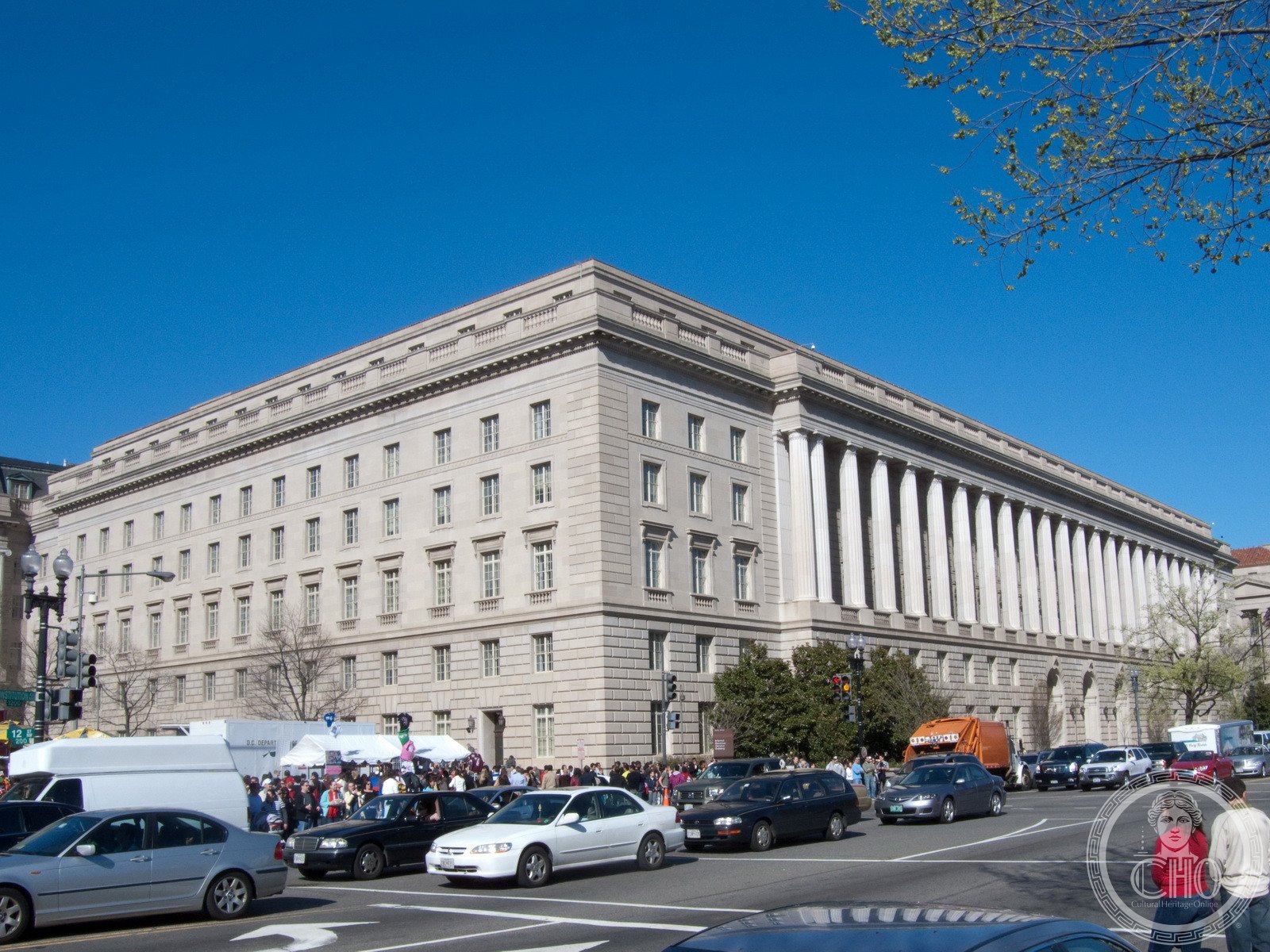

Completed in 1935 as the final major element of the Federal Triangle complex, the Internal Revenue Service Building at 1111 Constitution Avenue NW is the longest facade in the Federal Triangle sequence — a Classical Moderne composition in Indiana limestone whose Constitution Avenue elevation extends for three full city blocks, presenting one of the most monumental unbroken facades in Washington’s federal architecture.
At a glance
The Internal Revenue Service Building at 1111 Constitution Avenue NW was the last of the major Federal Triangle buildings to be completed. Designed under the supervision of Louis A. Simon, the Supervising Architect of the Treasury, and completed in 1935, the building occupies the entire block along Constitution Avenue between 10th and 12th Streets NW, presenting a continuous facade of Indiana limestone that extends for approximately 700 feet — one of the longest continuous government building facades in the United States. The building is part of the Pennsylvania Avenue National Historic Site and continues to serve as the principal office complex of the Internal Revenue Service.
Key facts
- Completed: 1935
- Architect: Louis A. Simon (Supervising Architect of the Treasury)
- Style: Classical Moderne
- Address: 1111 Constitution Ave NW, Washington DC 20224
- Facade length: Approximately 700 ft (213 m) along Constitution Avenue
- NRHP: Part of Pennsylvania Avenue National Historic Site
- Notable: One of the longest continuous government building facades in the USA; Federal Triangle anchor on Constitution Avenue side
History
The Federal Triangle development, which began in earnest under President Herbert Hoover and was continued and expanded under President Roosevelt, required the demolition of a large area known informally as “Murder Bay” — a dense zone of boarding houses, saloons, and commercial buildings that had accumulated between Pennsylvania Avenue and the Mall since the Civil War era. The replacement programme called for a sequence of monumental federal buildings that would transform this zone into a civic ensemble worthy of the capital’s ceremonial axis.
The Internal Revenue Service Building was, despite being chronologically one of the later buildings in the sequence, the element that closed the Federal Triangle along its Constitution Avenue side. Louis A. Simon, who served as Supervising Architect of the Treasury from 1934 to 1934, oversaw the design of the IRS Building as a Classical Moderne composition that conformed to the overall design framework established for the Triangle while allowing for the specific functional requirements of the tax collection agency, whose large bureaucratic workforce required extensive open floor plates and efficient vertical circulation.
The building’s facade treatment — the rusticated base, the central arcade zone with its arched windows, and the attic level with paired windows and restrained ornament — repeats the tripartite Classical Moderne vocabulary of the other Triangle buildings while managing the challenge of the building’s exceptional length along Constitution Avenue. The result is a facade that reads as coherent and monumental despite its scale, which is among the most ambitious dimensions of any single building facade in the New Deal federal programme.
What you see
The Constitution Avenue facade is the IRS Building’s principal architectural achievement: a 700-foot composition in Indiana limestone that manages its extraordinary length through the careful rhythm of arched bays, projecting end pavilions, and a central entrance pavilion that marks the axis of the building without breaking the continuity of the facade. The carved limestone ornament — abstracted foliate and figural panels at the spandrel zones, carved keystones above the arched windows — is deployed with controlled restraint, concentrated at the entrance and end pavilions and simplified across the central run of the facade.
The building is best understood as part of the Federal Triangle ensemble: standing at Constitution Avenue and 12th Street, looking east toward the FTC Apex Building, or west toward the National Archives and the DOJ, the sequence of limestone facades creates one of the most powerful civic streetscapes in the United States. The east end of the IRS Building meets the Apex Building of the Federal Trade Commission, and the two buildings together form the triangular apex of the Federal Triangle complex. The interior lobbies, accessible during business hours, preserve original New Deal-era ornament including bronze fixtures, terrazzo floors, and murals.
Practical information
- Lobby access: Limited public access; security check required on weekdays
- Best view: Constitution Avenue looking east at the full facade length; or the triangular meeting point with the FTC Apex Building
- Time needed: 15–20 minutes exterior
- GPS: 38.8938° N, 77.0255° W
- Nearest transit: DC Metro Federal Triangle station (Blue/Orange/Silver Lines, 3 minutes walk)
Getting there
The IRS Building is at 1111 Constitution Avenue NW in the Federal Triangle area of downtown Washington DC. DC Metro Federal Triangle station (Blue, Orange, and Silver Lines) is 3 minutes south on 12th Street; Archives station (Green/Yellow Lines) is 5 minutes east. Ronald Reagan Washington National Airport (DCA) is approximately 4 miles (6 km) south; Metro Blue/Silver Lines from the airport to Federal Triangle take approximately 18 minutes.
Nearby
- FTC Apex Building (1938) — the architectural apex of the Federal Triangle; Michael Lantz’s “Man Controlling Trade” sculptures; 5 minutes east; CHO place card
- National Archives Building (1935) — John Russell Pope; Declaration of Independence and Constitution; Constitution Ave and 9th St; already in the CHO collection
- Natural History Museum (Smithsonian) — National Mall; free; 5 minutes south across the Mall
Sources
- Pennsylvania Avenue National Historic Site, Federal Triangle records — nps.gov
- General Services Administration, IRS Building historical summary — gsa.gov
- Longstreth, Richard. The Mall in Washington, 1791–1991. National Gallery of Art, 1991.
- HABS documentation, IRS Headquarters Building DC-WASH-657 — loc.gov
- Wikidata, Internal Revenue Service Building Washington DC — wikidata.org
Find it on the map
See this place and what’s around it →📷 Become a Cultural Heritage Online photographer
Share your photos of places: they stay published under your name as the author. The more they're seen, the more you get noticed — and soon a contest will reward the most appreciated photos.
Log in or sign up free to add a photoIs this page about you?
This page is read by travellers and heritage enthusiasts who find it on Google. Tell us how you are connected to this place and we will take it from there.