

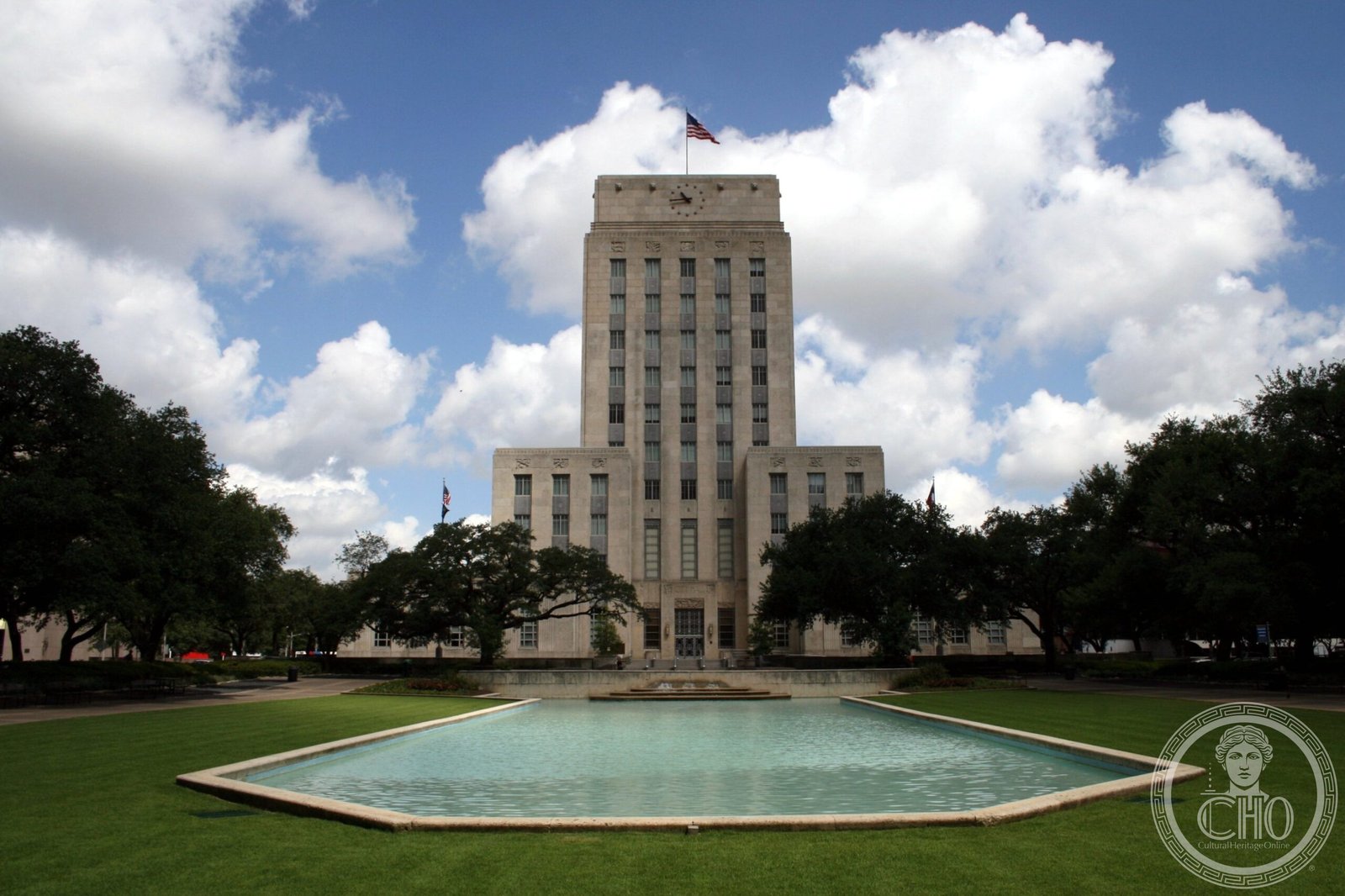

Completed in 1939 at the west edge of Houston’s civic centre, the Houston City Hall is the finest example of WPA-era Art Deco civic architecture in Texas — a monumental building in Texas Cordova limestone designed by Joseph Finger whose symmetrical facades, low-relief sculptural programme, and formal reflection pool create one of the most harmonious civic compositions in the American South.
At a glance
Standing at 901 Bagby Street in downtown Houston, the City Hall was designed by Joseph Finger — one of Houston’s most productive architects of the 1930s — and completed in 1939 as part of the civic improvement programme that rebuilt much of Houston’s institutional infrastructure during the New Deal era. The building is clad in Texas Cordova limestone and employs the streamlined Art Deco / WPA Moderne vocabulary of the period: clean horizontal lines, a restrained programme of low-relief sculptural panels at the entrance level, and a central tower element that rises above the flanking wings to mark the building’s civic identity. The formal reflection pool in front of the building, added later, creates the setting in which the City Hall is now most often photographed. The building is listed on the National Register of Historic Places.
Key facts
- Completed: 1939
- Architect: Joseph Finger
- Style: Art Deco / WPA Moderne
- Address: 901 Bagby St, Houston, TX 77002
- Cladding: Texas Cordova limestone
- NRHP: Listed; Texas Historic Landmark
- Notable: Formal reflection pool; low-relief sculptural programme; New Deal civic improvement; still functions as Houston’s city hall
History
Joseph Finger arrived in Texas from Europe in the early 20th century and established himself as one of the most versatile and productive architects in Houston. His practice ranged across commercial buildings and civic commissions, and he was well positioned to receive the City Hall commission when Houston’s civic leadership decided, in the mid-1930s, that the city needed a new seat of government commensurate with its growing status as the energy capital of the United States.
The commission came during the New Deal era, and the building reflects the WPA Moderne aesthetic that characterised much federal and municipal architecture of the period: a streamlined modernism that retained the grandeur and permanence associated with civic buildings while shedding the Beaux-Arts ornamental apparatus of the preceding generation. Finger’s design for the Houston City Hall is an elegant resolution of the civic programme — council chamber, mayoral offices, departmental spaces — into a symmetrical composition that reads as a single coherent object from the formal approach axis.
The building was completed in 1939 and has served as Houston’s city hall ever since, which is a testimony to both its functional planning and its architectural durability. The Texas Cordova limestone cladding — a buff-coloured shell limestone quarried in Travis County — has aged well, and the building’s proportions and sculptural details remain in excellent condition. The reflection pool and plaza were added as part of a later civic improvement and now frame the principal elevation in a formal composition that enhances the building’s civic character. Finger was also the architect of the 1940 Houston Municipal Airport terminal (now the 1940 Air Terminal Museum), which shares the Art Deco Moderne vocabulary of the City Hall.
What you see
The principal elevation of the Houston City Hall, facing Bagby Street and the reflection pool, is a formal composition in Cordova limestone: a central section with a tower element rising above flanking wings, all of equal cornice height, with the entrance axis marked by a recessed portal and a programme of low-relief carved panels above. The sculptural panels — in the flat, stylised idiom of WPA public art — represent the civic themes of labour, justice, and commerce, rendered in a manner that is legible from the street without requiring close reading. The stone has the warm buff tone characteristic of Texas limestone and ages gracefully in the Houston climate.
The reflection pool in front of the building is one of the most effective pieces of civic landscape in downtown Houston: the still water doubles the elevation and the sky above it, creating a formal composition that draws the eye from the street to the entrance axis and back. The best time to visit is early morning, when the low Texas sun lights the limestone and the pool is calm before the wind rises. The interior lobby is accessible during business hours and preserves original Art Deco details including bronze doors, terrazzo floors, and painted ceiling panels.
Practical information
- Access: Lobby open weekdays during business hours; reflection pool accessible at all times
- Best time: Early morning light on the limestone facade and reflection pool
- Time needed: 20–30 minutes exterior + lobby
- GPS: 29.7591° N, 95.3733° W
- Nearest transit: METRORail Theater District station (10 minutes walk); METRORail Main Street Square (12 minutes walk)
Getting there
The Houston City Hall is at 901 Bagby Street in the civic centre area of downtown Houston, adjacent to Hermann Square and the Houston Public Library. The METRORail Red Line serves Main Street Square station approximately 12 minutes east on foot; the Theater District station is 10 minutes north. George Bush Intercontinental Airport (IAH) is approximately 23 miles (37 km) north.
Nearby
- Houston Public Library — Julia Ideson Building (1926, Ralph Adams Cram) — Spanish Renaissance Revival library at 550 McKinney; 3 minutes east
- George R. Brown Convention Center — large convention facility; Discovery Green park on the east side; 10 minutes east
- Hermann Park — 445-acre urban park with the Houston Museum of Natural Science and Houston Zoo; 2 miles south via Main Street
Sources
- National Register of Historic Places, Houston City Hall nomination — nps.gov
- Texas Historical Commission, Houston City Hall records — thc.texas.gov
- Houston Preservation Alliance, Joseph Finger biography — houstonpreservation.org
- Fox, Stephen. Houston Architectural Guide. American Institute of Architects Houston Chapter, 1990.
- Wikidata, Houston City Hall — wikidata.org
Find it on the map
See this place and what’s around it →📷 Become a Cultural Heritage Online photographer
Share your photos of places: they stay published under your name as the author. The more they're seen, the more you get noticed — and soon a contest will reward the most appreciated photos.
Log in or sign up free to add a photoIs this page about you?
This page is read by travellers and heritage enthusiasts who find it on Google. Tell us how you are connected to this place and we will take it from there.