
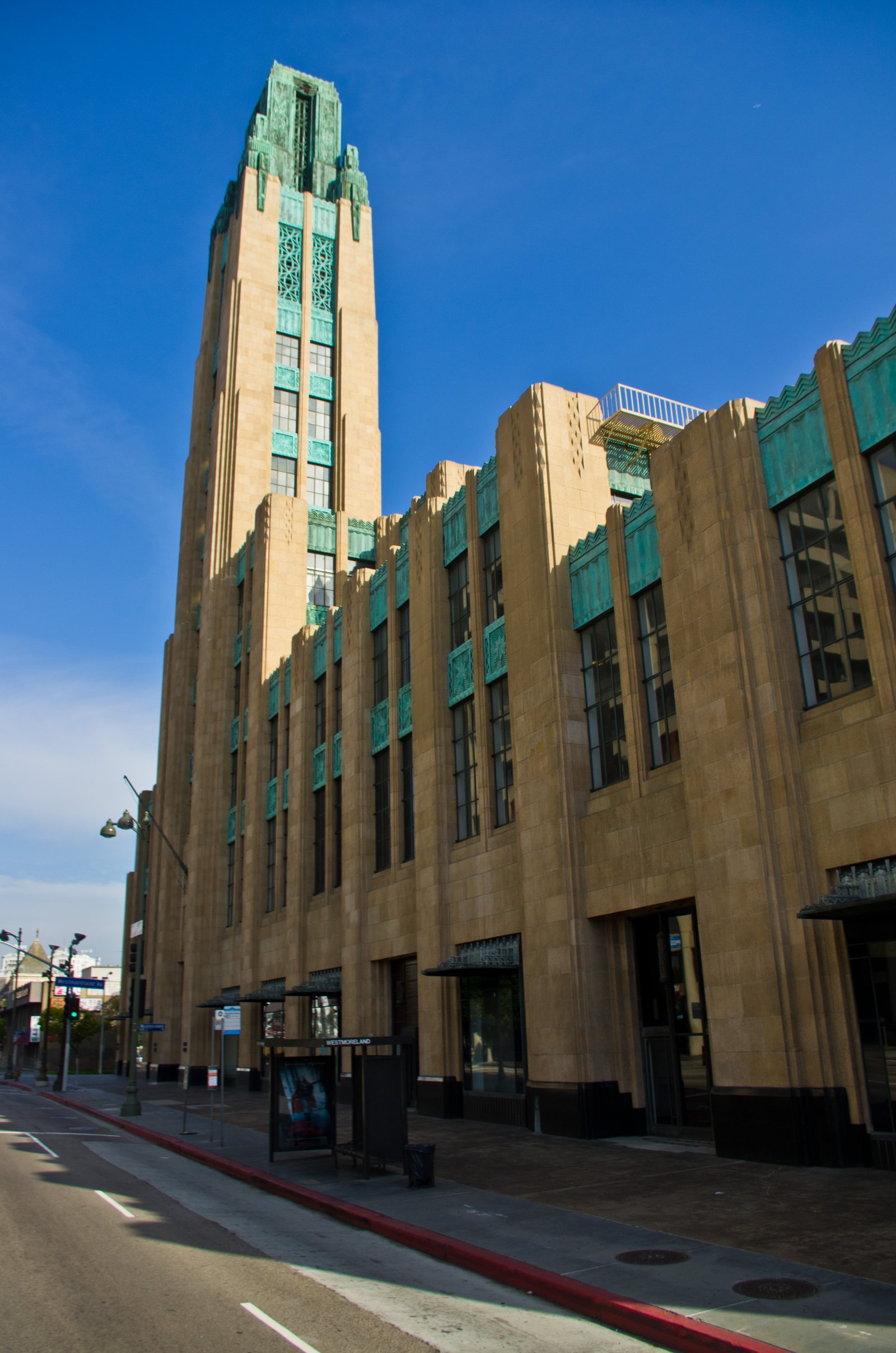

Completed in 1929 on the Wilshire Boulevard Miracle Mile, Bullocks Wilshire is one of the defining monuments of American Art Deco retail design — a copper-clad tower above a lavish department store whose main entrance was placed, for the first time in commercial architecture, at the rear of the building to face the parking lot rather than the street.
At a glance
Designed by architects John and Donald Parkinson and completed in 1929 for the Bullock’s department store chain, the Bullocks Wilshire building at 3050 Wilshire Boulevard is a National Historic Landmark that pioneered the automobile-oriented design model that would reshape American retail for the rest of the 20th century. The five-story building’s distinctive copper-clad tower — with its Zigzag Moderne ornamental programme of geometric reliefs and stylised figures — rises above a building whose plan was deliberately inverted: the porte-cochère and main customer entrance face the rear parking lot, not Wilshire Boulevard. The interiors, including the Tea Room ceiling mural, survive in excellent condition. Since 1994 the building has housed the Southwestern Law School library. Listed on the National Register of Historic Places in 1978 and designated a National Historic Landmark in 2010.
Key facts
- Completed: 1929
- Architects: John and Donald Parkinson
- Style: Art Deco / Zigzag Moderne
- Address: 3050 Wilshire Blvd, Los Angeles, CA 90010
- NRHP: Listed 1978; National Historic Landmark 2010
- Current use: Southwestern Law School library (since 1994)
- Signature features: Copper-clad tower; rear porte-cochère as main entrance; Tea Room ceiling mural; automobile-oriented plan
History
Bullock’s department store was a major force in Los Angeles retail by the late 1920s, and the decision to open a branch on Wilshire Boulevard — then emerging as the city’s prestige commercial corridor — was both a business calculation and a civic statement. The architects John and Donald Parkinson — responsible also for Los Angeles Union Station and the Coliseum — were engaged to design a building that would embody the aspirations of the new automobile city. The key innovation was the placement of the building’s main customer entrance at the rear, where the parking lot was located. This was one of the first major commercial buildings in the United States to be explicitly designed for arrival by automobile rather than on foot from the street.
The design that resulted was a Zigzag Moderne composition of exceptional richness: the copper tower above the main volume, the bronze porte-cochère at the rear, the terra cotta and coloured glass ornament across the facade, and the interiors — each department styled in a different period, with the Tea Room on the top floor featuring a ceiling mural by Herman Sachs depicting the romance of transportation in the modern age (automobiles, aeroplanes, dirigibles, ocean liners). The building opened in September 1929 and was immediately celebrated as one of the most architecturally distinguished commercial interiors in Los Angeles.
Bullock’s Wilshire operated as a department store until 1993. The parent company Federated Department Stores had filed for Chapter 11 bankruptcy in 1990 — two years before the 1992 Los Angeles riots — and the resulting restructuring eventually led to the closure of the Wilshire store. The building was acquired by Southwestern Law School in 1994 and converted into the law school’s library; the Parkinson architects’ original interiors, including the Tea Room, were preserved in the restoration. Designated a National Historic Landmark in 2010, the building is one of the most intact and significant Art Deco commercial interiors surviving in the United States.
What you see
Approaching Bullocks Wilshire from Wilshire Boulevard, the building presents a long horizontal facade of warm terracotta in buff and brown tones, punctuated by the central copper tower that rises five stories above the street. The tower’s surface is a programme of Zigzag Moderne relief ornament: stylised geometric patterns, frieze bands, and stylised figural reliefs in the spandrel zones. The copper cladding, now oxidised to a verdigris green, gives the tower a distinctive chromatic identity on the Wilshire streetscape that is immediately recognisable from a moving vehicle — which is, precisely, what the building was designed to be seen from.
The rear porte-cochère entrance, facing the parking area, is the building’s ceremonial threshold: bronze doors beneath a canopy of glass and metal, with a relief programme above depicting speed, luxury, and the promise of arrival. Inside, the restored Tea Room ceiling mural by Herman Sachs is the interior’s masterpiece: an allegory of the modern age painted in a palette of cream, gold, and umber, with dirigibles and ocean liners floating across a sky of stylised clouds. The original showcase cases, light fixtures, and flooring in several of the ground-floor spaces survive from the 1929 opening. For an Art Deco interior of this quality to remain accessible — even in its current institutional use — is unusual; the law school’s library function has proved a remarkably sympathetic adaptive use.
Practical information
- Access: Southwestern Law School library; accessible to visitors on scheduled tours (check swlaw.edu for current tour availability)
- Exterior: Always visible from Wilshire Boulevard; best viewed from the street or from the rear parking area (now accessed from Westmoreland Ave)
- Best time: Morning light on the copper tower from Wilshire facing east
- Time needed: 30 minutes exterior; 60-90 minutes with interior tour
- GPS: 34.0616° N, 118.2883° W
Getting there
Bullocks Wilshire stands at 3050 Wilshire Boulevard in the Koreatown / Miracle Mile area of Los Angeles, approximately 3 miles west of downtown LA. The Metro Purple Line (D Line) stops at Wilshire/Vermont Station (2 minutes walk east). Los Angeles International Airport is approximately 12 miles (19 km) south-west; taxi or rideshare takes 20–35 minutes depending on traffic.
Nearby
- Los Angeles County Museum of Art (LACMA) — the largest art museum in the western United States, on Wilshire Blvd at Fairfax, 2 miles west
- Wiltern Theatre (1931) — Art Deco movie palace in turquoise terracotta at Wilshire and Western, 3 minutes west on foot
- Eastern Columbia Building (1930) — turquoise Art Deco tower in Downtown LA, 15 minutes east by Metro
Sources
- National Historic Landmark designation, Bullocks Wilshire (2010) — nps.gov
- Los Angeles Conservancy, Bullocks Wilshire building record — laconservancy.org
- Gebhard, David & Winter, Robert. An Architectural Guidebook to Los Angeles. Relevant entry.
- Southwestern Law School, building history — swlaw.edu
- Wikidata, Bullocks Wilshire Q4996997 — wikidata.org
Find it on the map
See this place and what’s around it →📷 Become a Cultural Heritage Online photographer
Share your photos of places: they stay published under your name as the author. The more they're seen, the more you get noticed — and soon a contest will reward the most appreciated photos.
Log in or sign up free to add a photoIs this page about you?
This page is read by travellers and heritage enthusiasts who find it on Google. Tell us how you are connected to this place and we will take it from there.