

Three countries, one forest: the heart of the Congo Basin
At the point where Cameroon, the Central African Republic, and the Republic of Congo converge, the Sangha River flows south through one of the most biologically rich and least disturbed forest ecosystems on Earth. The Sangha Trinational World Heritage Site protects 750,000 hectares of continuous Congo Basin rainforest across three national parks — Lobéké (Cameroon), Dzanga-Ndoki (Central African Republic), and Nouabalé-Ndoki (Republic of Congo) — creating a protected area of extraordinary scale and integrity, where the full complement of Central African forest wildlife survives in populations of global significance.
UNESCO inscription: the second largest tropical forest on Earth
Inscribed in 2012, the Sangha Trinational was recognised as an outstanding example of major stages of Earth’s evolutionary history and as a refuge for globally threatened species. The site forms the core of the larger Congo Basin forest complex — the second largest continuous tropical forest in the world after the Amazon — and is considered one of the last truly intact examples of the African rainforest biome, with minimal fragmentation and full ecological connectivity across the international boundaries.
The Bai Hokou clearing: where gorillas come to drink
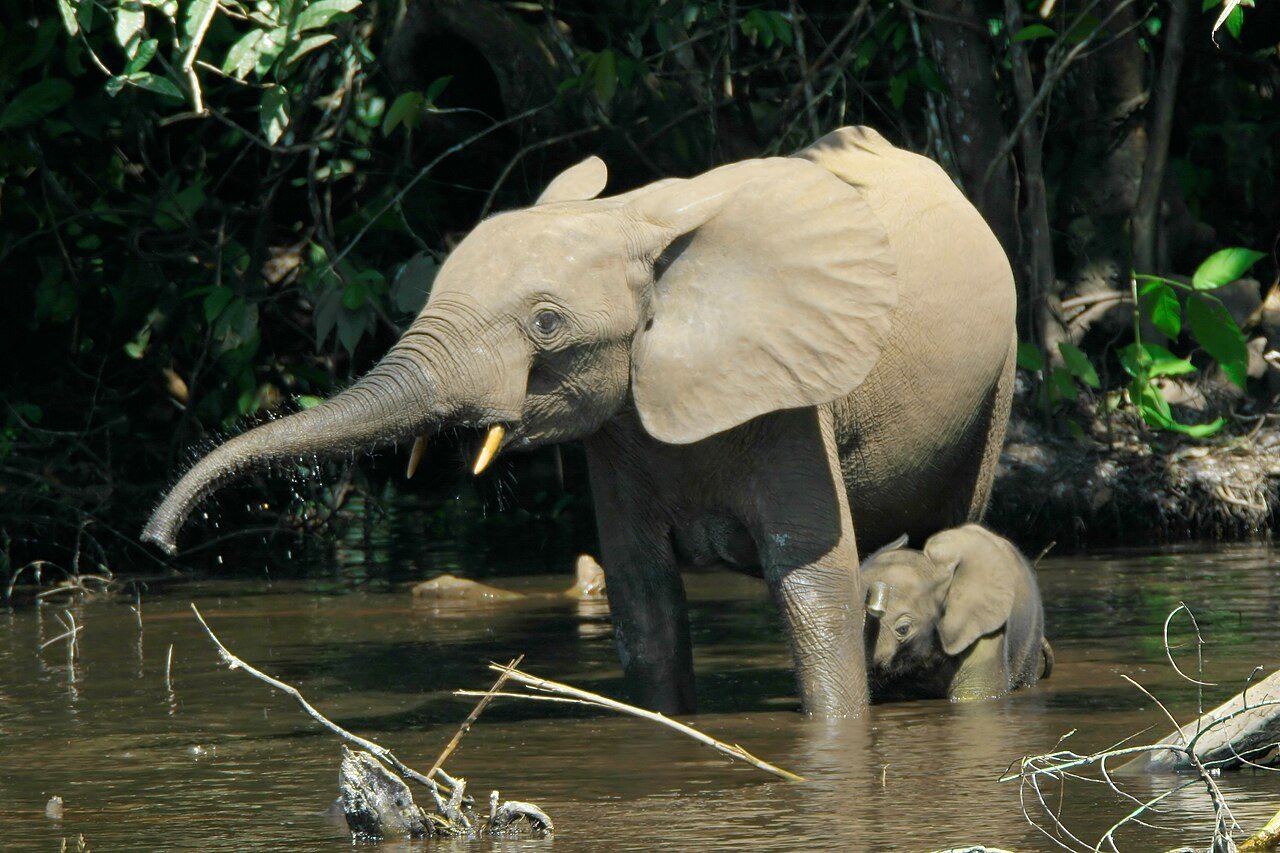
The most celebrated feature of the Sangha Trinational for visitors and researchers alike is the system of forest clearings (bais) — open areas of mineral-rich wet ground where large mammals emerge from the forest to feed and drink. The Bai Hokou bai in the Dzanga-Ndoki sector is one of the most important gorilla research sites in Africa; the Dzanga bai, visited by up to 150 forest elephants simultaneously, has been called “the greatest wildlife spectacle in Africa.” These clearings provide observation opportunities that are otherwise impossible in closed-canopy rainforest.
The western lowland gorilla: the great ape of the Congo
The Sangha Trinational supports one of the largest surviving populations of the western lowland gorilla (Gorilla gorilla gorilla) — the subspecies found throughout the Congo Basin forests of Cameroon, CAR, Congo, and Gabon. The population at Bai Hokou in the CAR sector has been studied continuously since 1990 by the Primate Habituation Programme; several family groups have been fully habituated to human presence, allowing tourism and research at distances of a few metres. The gorillas of Sangha show distinctive cultural behaviours — tool use, dietary choices, social structures — that vary between family groups.
Forest elephants, bongos, and the nocturnal world
In addition to gorillas, the Sangha Trinational supports the full guild of Central African forest megafauna: forest elephants (Loxodontia cyclotis), forest buffalo, bongo antelopes (the largest of the African forest antelopes, largely nocturnal), sitatunga, giant pangolins, and a suite of smaller carnivores including leopards, golden cats, and African civets. The Sangha River and its tributaries support hippopotamus, manatees, and numerous species of freshwater fish. The avifauna includes the Congo peacock (Afropavo congensis), the grey parrot, and the African fish eagle.
The Ba’Aka: forest people of the Sangha
The Congo Basin forest has been inhabited by the Ba’Aka (also called BaAka or Western Pygmies) for thousands of years — hunter-gatherers whose ecological knowledge of the forest is unparalleled. Ba’Aka hunters know the individual territories of forest elephant families, the seasonal fruiting patterns of hundreds of tree species, and the locations of medicinal plants for dozens of conditions. The management of the Sangha Trinational attempts to accommodate Ba’Aka rights and practices within the protected area framework, though tensions between conservation objectives and traditional land use remain a significant management challenge.
Conservation threats and the role of international cooperation
The Sangha Trinational faces the threats common to Congo Basin forests: commercial poaching (particularly for elephant ivory and bushmeat), illegal logging, and the expansion of road networks that fragment habitat and enable poaching. The transboundary framework — the three national parks governed by three different national park services, coordinated through a trinational secretariat — is both the site’s greatest strength (no poacher can simply cross a border to escape) and its greatest administrative challenge. International conservation organizations including WWF, WCS, and the German government have invested substantially in the site’s management.
Visiting Sangha Trinational
Access to the Sangha Trinational is genuinely remote. The easiest entry point is the Congolese sector (Nouabalé-Ndoki), reached via Ouesso in the Republic of Congo, accessible by plane from Brazzaville. The Dzanga-Sangha sector in CAR (with the Bai Hokou gorilla tracking) is reached via Bayanga, accessible from Bangui. Gorilla tracking permits must be booked well in advance through the Dzanga-Sangha conservation programme; the permit system limits visitors to small groups of maximum 4 people per gorilla family per day. The best time to visit is December–February (dry season), when forest tracks are passable and animal sightings at the bais are most frequent.
Find it on the map
See this place and what’s around it →📷 Become a Cultural Heritage Online photographer
Share your photos of places: they stay published under your name as the author. The more they're seen, the more you get noticed — and soon a contest will reward the most appreciated photos.
Log in or sign up free to add a photo