

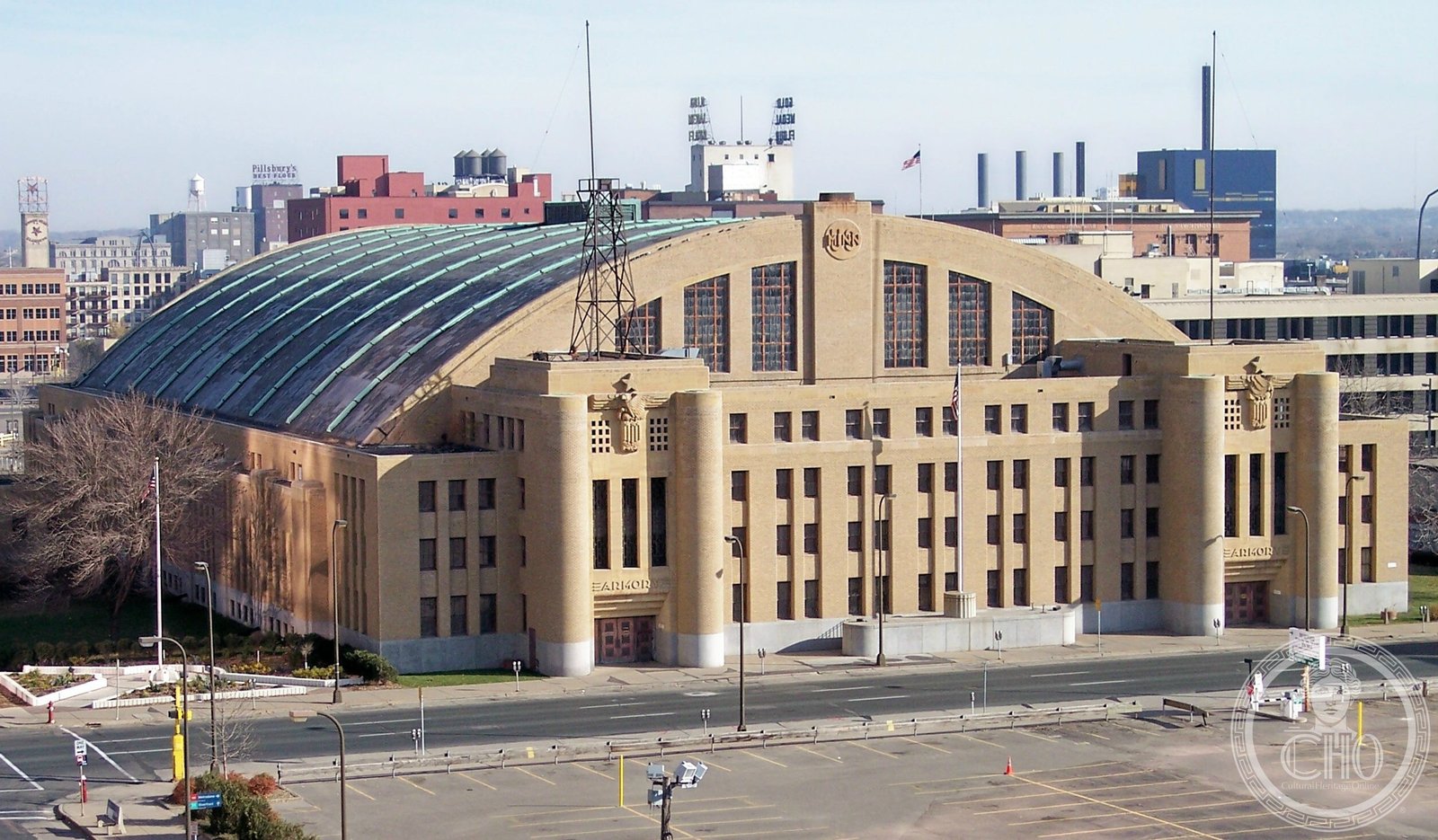

Built in 1936 with federal New Deal funding, the Minneapolis Armory is one of the most intact examples of PWA Moderne civic architecture in the upper midwest — its Indiana limestone facade, geometric ornament, and fortress-like massing serving as a National Guard drill hall, a major indoor events venue, and a music destination since its opening year.
At a glance
Standing at 500 6th Street South in downtown Minneapolis, the Armory was completed in 1936 as the headquarters and training facility for the Minnesota National Guard. The building was funded by a combination of federal Public Works Administration grants and state appropriations. Its design, in the PWA Moderne style that characterised the most ambitious New Deal civic architecture, presents a bold limestone exterior with decorative Art Deco panels, shield and eagle reliefs, and a main drill hall large enough to serve as an arena for several thousand spectators. The building was listed on the National Register of Historic Places in 1994 and is now operated as an event and concert venue.
Key facts
- Completed: 1936
- Style: PWA Moderne
- Address: 500 6th Street S, Minneapolis, MN 55415
- Original use: Minnesota National Guard headquarters and drill hall
- NRHP: Listed 1994
- Current use: The Armory Minneapolis (event and concert venue)
- Signature feature: Monumental limestone facade with Art Deco military ornament and 10,000-capacity drill hall
History
The Minneapolis Armory was built to replace earlier, inadequate National Guard facilities in the city. Federal PWA funding made the scale of the project possible: the programme, administered by Secretary of the Interior Harold Ickes, had by the mid-1930s produced hundreds of major civic buildings across the United States, from courthouses and post offices to libraries, schools, and military installations. In Minneapolis the PWA contribution was directed toward an armory that could function simultaneously as a military training facility and as a major public assembly space — a dual mandate that shaped both the scale and the character of the design.
Completed in 1936, the Armory served Minnesota National Guard units throughout World War II and the postwar decades. Its enormous drill hall, convertible for spectator events, meant the building was from the beginning used for purposes beyond its military function: boxing matches, political rallies, trade shows, and basketball games all took place in the hall during the mid-twentieth century. The Minneapolis Lakers, who became the Los Angeles Lakers after moving in 1960, played games in the Armory before moving to the Minneapolis Auditorium.
As National Guard priorities changed and newer facilities were built, the Armory’s military function diminished. The building was listed on the National Register of Historic Places in 1994, recognising its architectural quality and civic history. In the twenty-first century it was renovated and reopened as a major concert and event venue under the name The Armory Minneapolis, with a capacity of approximately 8,500 for standing concerts. Its interior now hosts major touring music acts; its exterior remains one of the finest examples of PWA Moderne civic architecture in Minnesota.
What you see
The Armory’s exterior is defined by its monumental limestone facade — a wall of Indiana buff limestone organised into bays by shallow pilasters, with decorative panels at the parapet level carrying shield, eagle, and geometric ornament in the Art Deco military vocabulary. The scale is deliberately civic and imposing: the building fills most of its block, its horizontal massing punctuated by the vertical emphasis of the entrance tower on 6th Street South. The entrance facade presents a composed sequence of ornamental limestone panels, recessed doorways, and lettered inscription identifying the building as a National Guard facility. The ornamental programme draws on military heraldry — crossed cannons, regimental shields, stylised eagles — rendered in the flat relief carving that characterises the best PWA Moderne decorative work.
The interior drill hall, now configured as a concert arena, retains the barrel-vaulted structure and the scale that made it one of the largest indoor spaces in Minneapolis at the time of its construction. The upper walls and balcony level preserve much of the original fabric, including steel trusses, terrazzo floors in the lobby, and Art Deco light fixtures. Seen from the corner of 6th Street and Chicago Avenue, the full length of the Armory’s limestone facade reads as a single disciplined composition — its proportions and material consistency a reminder of what federal investment in public architecture could achieve in the 1930s.
Practical information
- Access: Open for events; exterior visible at all times. Exterior tours available by arrangement
- Best time: Exterior any time; interior on event nights or by tour arrangement
- Time needed: 20 minutes exterior; concert visit 2–4 hours
- GPS: 44.9751° N, 93.2633° W
Getting there
The Minneapolis Armory stands at 500 6th Street South in downtown Minneapolis, 5 minutes’ walk from the Foshay Tower and 4 minutes from the Rand Tower. The Blue Line light rail (Government Plaza station) stops one block east. Minneapolis–Saint Paul International Airport connects to downtown by light rail in approximately 25 minutes.
Nearby
- Foshay Tower (1929) — Art Deco obelisk hotel at 821 Marquette Avenue, 5 minutes west
- Rand Tower (1929) — Holabird & Root Art Deco skyscraper at 527 Marquette Avenue, 6 minutes west
- Minneapolis City Hall (1906) — Richardsonian Romanesque civic complex at 350 S 5th Street, 3 minutes north-east
Sources
- National Register of Historic Places, Minneapolis Armory nomination (1994) — nps.gov
- Minnesota Historical Society, National Guard armory records — mnhs.org
- Living New Deal, Minneapolis Armory entry — livingnewdeal.org
- Millett, Larry. AIA Guide to the Twin Cities. Minnesota Historical Society Press, 2007
- Wikidata, Minneapolis Armory Q745327 — wikidata.org
Find it on the map
See this place and what’s around it →📷 Become a Cultural Heritage Online photographer
Share your photos of places: they stay published under your name as the author. The more they're seen, the more you get noticed — and soon a contest will reward the most appreciated photos.
Log in or sign up free to add a photoIs this page about you?
This page is read by travellers and heritage enthusiasts who find it on Google. Tell us how you are connected to this place and we will take it from there.