
Iraq holds some of the oldest built environments on earth — the cities where writing, law codes, and monumental architecture were invented. Three UNESCO World Heritage Sites lie within reach of Baghdad, spanning five millennia of civilisation from the world’s first cities to a Parthian desert capital. From Cultural Heritage Online.
Babylon 90 km south · 1.5 hr by road
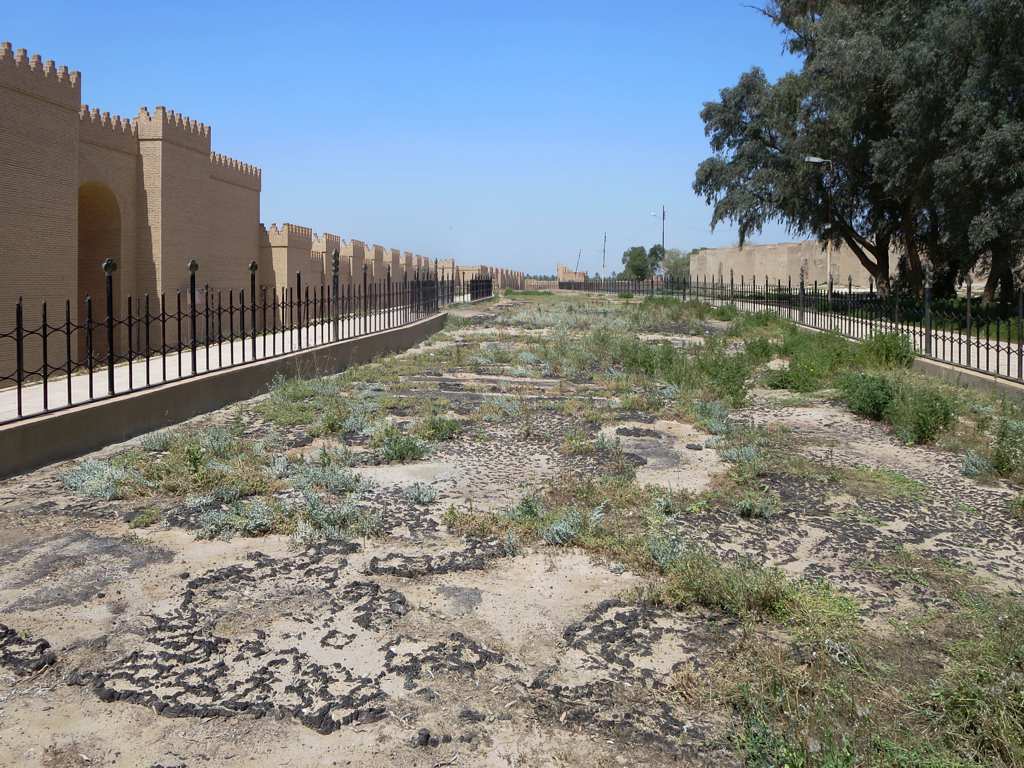
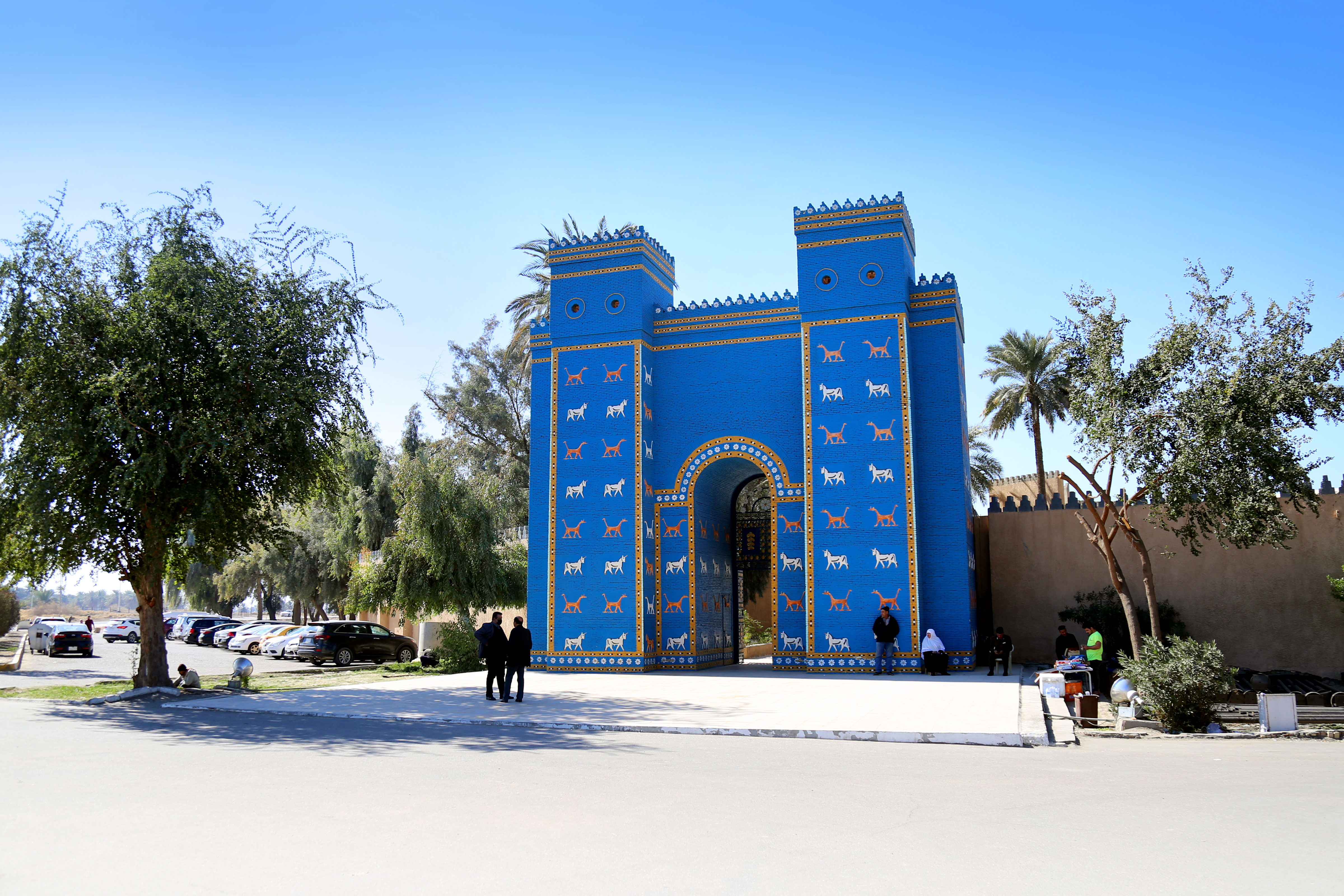
Babylon was the capital of the most powerful empire in the ancient Near East, reaching its apex under Nebuchadnezzar II between 605 and 562 BC. The site inscribed by UNESCO in 2019 covers the ruins of that city — its walls, palaces, temples, and the excavated foundations of the Processional Way, the ceremonial road that once ran north from the Esagila temple complex to the Ishtar Gate. The original gate’s glazed brick panels — columns of lions, aurochs, and dragons in cobalt blue — were excavated by the German Archaeological Society in the early twentieth century and reassembled in the Pergamon Museum in Berlin; what remains in Iraq is the reconstructed lower section and the earthen platform beneath.
At the southern end of the city lies the Esagila, principal sanctuary of the god Marduk, whose foundation reaches back to the early second millennium BC. Nearby, the ziggurat Etemenanki — the tower scholars identify as the probable origin of the biblical story of Babel — survives only as its enormous mud-brick base, roughly 91 metres square. Standing on that platform, looking across the date palms and the flat Euphrates floodplain, the scale of what was once here becomes tangible in a way no photograph quite conveys.
The site sits just outside the modern town of Hillah. Decades of reconstruction under Saddam Hussein added new brick above ancient fabric — a complication the UNESCO inscription acknowledges — but the archaeological layers underneath are genuine and extensive. Access is straightforward from Baghdad via the main highway south.
Getting there: Highway south to Hillah, then local road to the site; taxi or hired car recommended. Roughly 1.5 hours each way. Allow: Half a day minimum; a full day if including the Babylon Museum in Hillah. Best for: Visitors with a serious interest in ancient Mesopotamia, archaeology students, travellers who have already seen the Pergamon reconstruction in Berlin.
Ahwar of Southern Iraq — Mesopotamian Marshes and Ancient Cities 300–400 km south · 4–5 hr by road
This dual-component UNESCO inscription from 2016 combines ecology and archaeology in a way unique among World Heritage Sites. The Mesopotamian Marshes — the Ahwar — are a vast wetland system in the Tigris–Euphrates delta where Marsh Arab communities, the Madans, have lived in reed houses built on floating islands for at least 5,000 years. Saddam Hussein drained more than ninety per cent of the marshes in the 1990s, reducing some 20,000 square kilometres of habitat to under 1,000, in a deliberate campaign to destroy Madan resistance. Partial restoration after 2003 has brought back significant areas; migratory birds now return in numbers that had been absent for a generation.
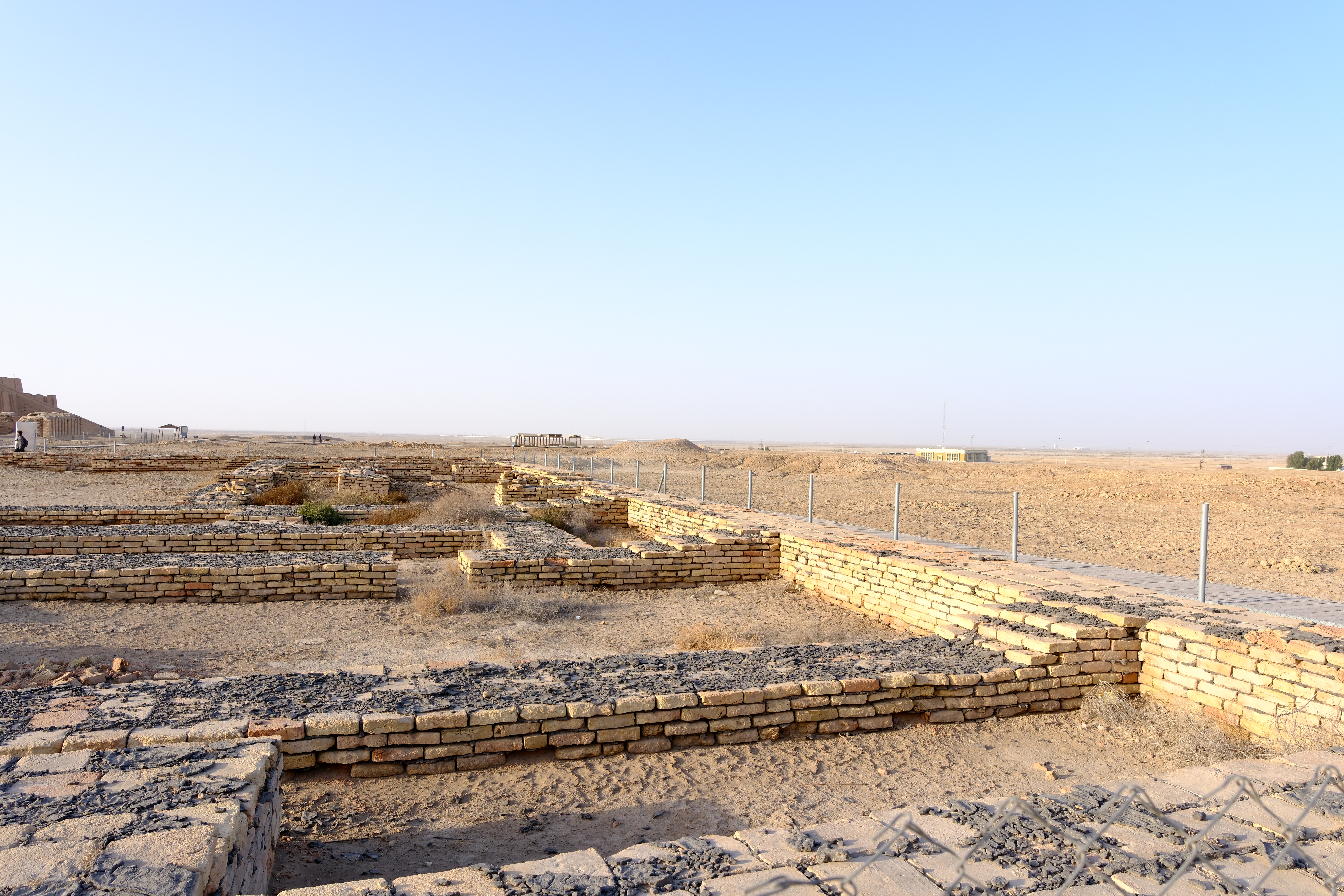
Embedded within the inscription are three of the most significant archaeological sites in human history. Eridu, founded around 5000 BC, is the oldest city known in Mesopotamia — a collection of temples and houses rising from the desert edge where the delta once reached. Ur, birthplace in Abrahamic tradition of the patriarch Abraham, holds the ziggurat of Nanna, built around 2100 BC by the king Ur-Nammu; three storeys of its mud-brick terracing survive, and the Royal Tombs excavated by Leonard Woolley in the 1920s yielded a gold headdress and lyres now in the British Museum and the Penn Museum. Uruk, founded around 5000 BC, was one of the world’s first true urban centres and the likely origin of cuneiform writing; its ziggurat of Anu and the remains of its mud-brick city walls extend across the plain.
The distance from Baghdad makes this a full-day or overnight trip, typically via Nasiriyah, which serves as a base for both Ur and the southern marshes. The marsh visits require a local boat; guides and small wooden motor craft can be arranged in the town of Chibayish.
Getting there: Drive or bus to Nasiriyah (4–5 hours south of Baghdad). Ur is 15 km from the city; Eridu a further 25 km into the desert. Marsh visits depart from Chibayish, roughly 80 km west of Nasiriyah. Allow: Two days minimum to see the marshes and at least one ancient city properly. Best for: Travellers who want layered itineraries combining natural landscape and deep archaeological history.
Hatra 350 km northwest · 4–5 hr by road (security check required)
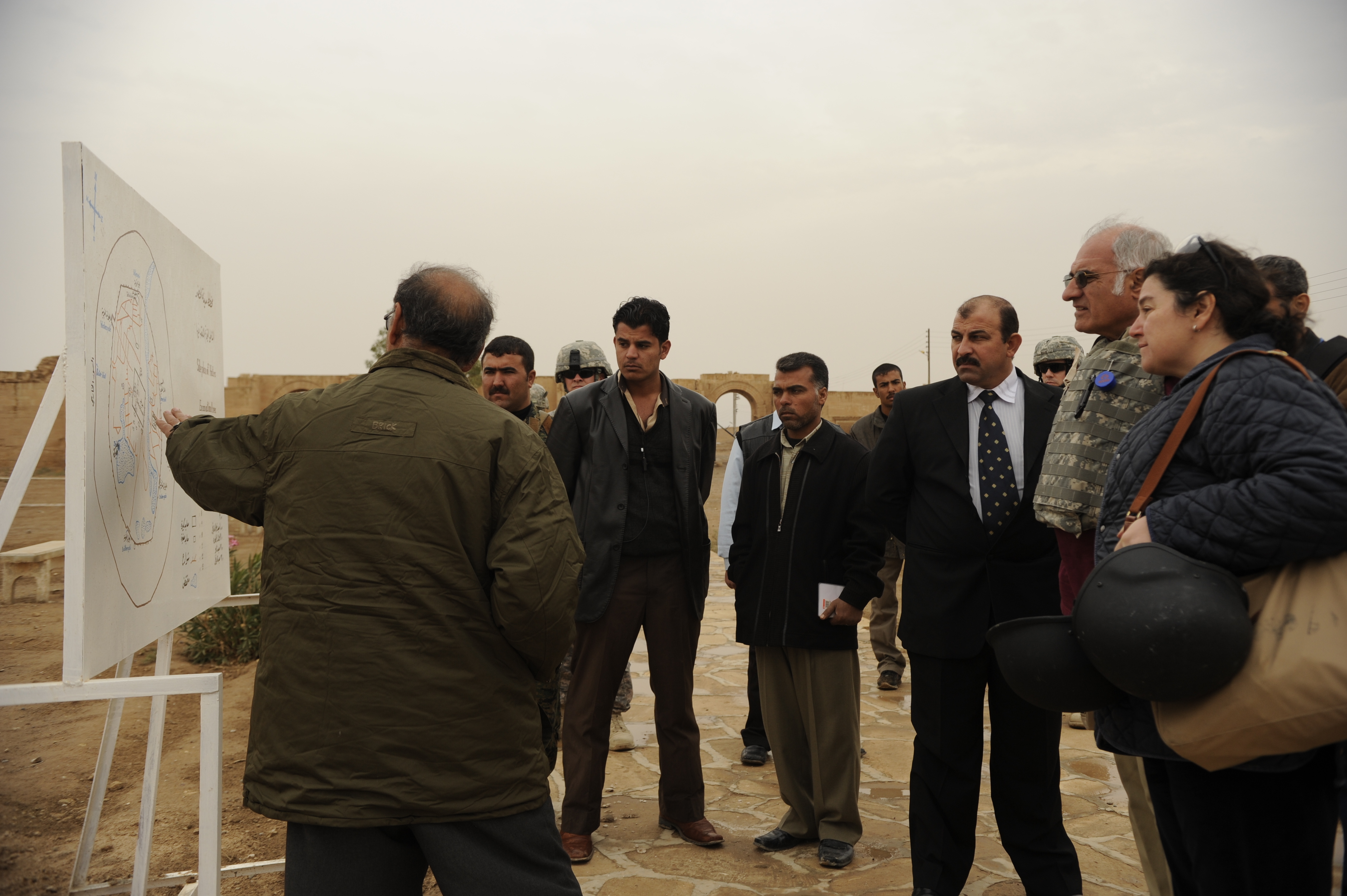
Hatra was a walled city of the Parthian empire, flourishing in the first and second centuries AD at the intersection of Hellenistic, Parthian, and Arab cultural streams. Its circular plan, unusual in the ancient world, surrounds a sacred precinct of temples dedicated to a composite sun god — reliefs mixing Roman imperial iconography with Aramaic inscription and Parthian dress. UNESCO inscribed the site in 1985 as an exceptional example of early Arab urbanism. In 2015, ISIL fighters used sledgehammers and power tools to destroy carved reliefs and statues; the damage to the temple facades was significant and has been documented in detail by Iraqi and international heritage teams. Partial restoration work has since begun.
The site lies in the Ninawa Governorate northwest of Baghdad, in the same region as Mosul. Security conditions in this corridor have improved substantially since the defeat of ISIL in 2017, and the site has been reopened to visitors, but the road from Baghdad passes through areas where conditions can shift. Consulting your government’s current travel advisory for Ninawa Province is not optional — it is the baseline before any itinerary is planned.
Getting there: By road from Baghdad via Tikrit and Mosul direction; Hatra is approximately 110 km southwest of Mosul. Check advisories for Ninawa Governorate before travel. Arranging transport with a local licensed guide company in Baghdad or Erbil is strongly recommended. Allow: Full day from Baghdad; consider overnight in Mosul. Best for: Travellers already operating in northern Iraq with confirmed local logistical support.
Frequently Asked Questions
How many UNESCO World Heritage Sites are accessible from Baghdad?
Three UNESCO World Heritage Sites are within practical reach of Baghdad: Babylon (inscribed 2019), the Ahwar of Southern Iraq including the ancient cities of Ur, Uruk, and Eridu (inscribed 2016), and Hatra (inscribed 1985, on the Danger List since 2015). Iraq has six UNESCO sites in total; the others — Ashur and Samarra — lie north of Baghdad and require separate security assessment.
How do you get from Baghdad to Babylon, and how long does it take?
Babylon is approximately 90 kilometres south of Baghdad, near the town of Hillah. By road the journey takes around 1.5 hours in normal traffic. The most practical option is a hired car or taxi arranged through your hotel; shared transport to Hillah is available but the final stretch to the archaeological site requires a separate vehicle. There is no direct train service. Half a day is sufficient for the site itself; a full day allows time for the Babylon Museum in Hillah.
What is the best time of year to visit Iraq’s UNESCO sites?
October through April is the viable window for most travellers. Summer temperatures in the Mesopotamian plain regularly exceed 45°C (113°F), making outdoor archaeological sites uncomfortable and sometimes dangerous from June through September. The southern marshes are best visited in spring (February–April) when migratory birds are present and the reed landscape is green. Winter days are mild and clear, though nights can be cold in the desert sites north and west of Baghdad.
What does the Ahwar inscription include, and why does it matter?
The Ahwar inscription is unusual in combining a living cultural landscape — the Iraqi Marshlands, home to Marsh Arab communities whose reed-island settlements represent an unbroken tradition of at least five millennia — with three ancient city sites: Eridu, possibly the oldest city in Mesopotamian history; Ur, whose ziggurat survives to three storeys and whose Royal Tombs yielded some of the most spectacular grave goods of the ancient world; and Uruk, one of the earliest urban settlements on earth and the probable origin of cuneiform writing. The combination argues that the same delta landscape that shaped the world’s first cities still shapes a distinct way of life today.



.jpg)

