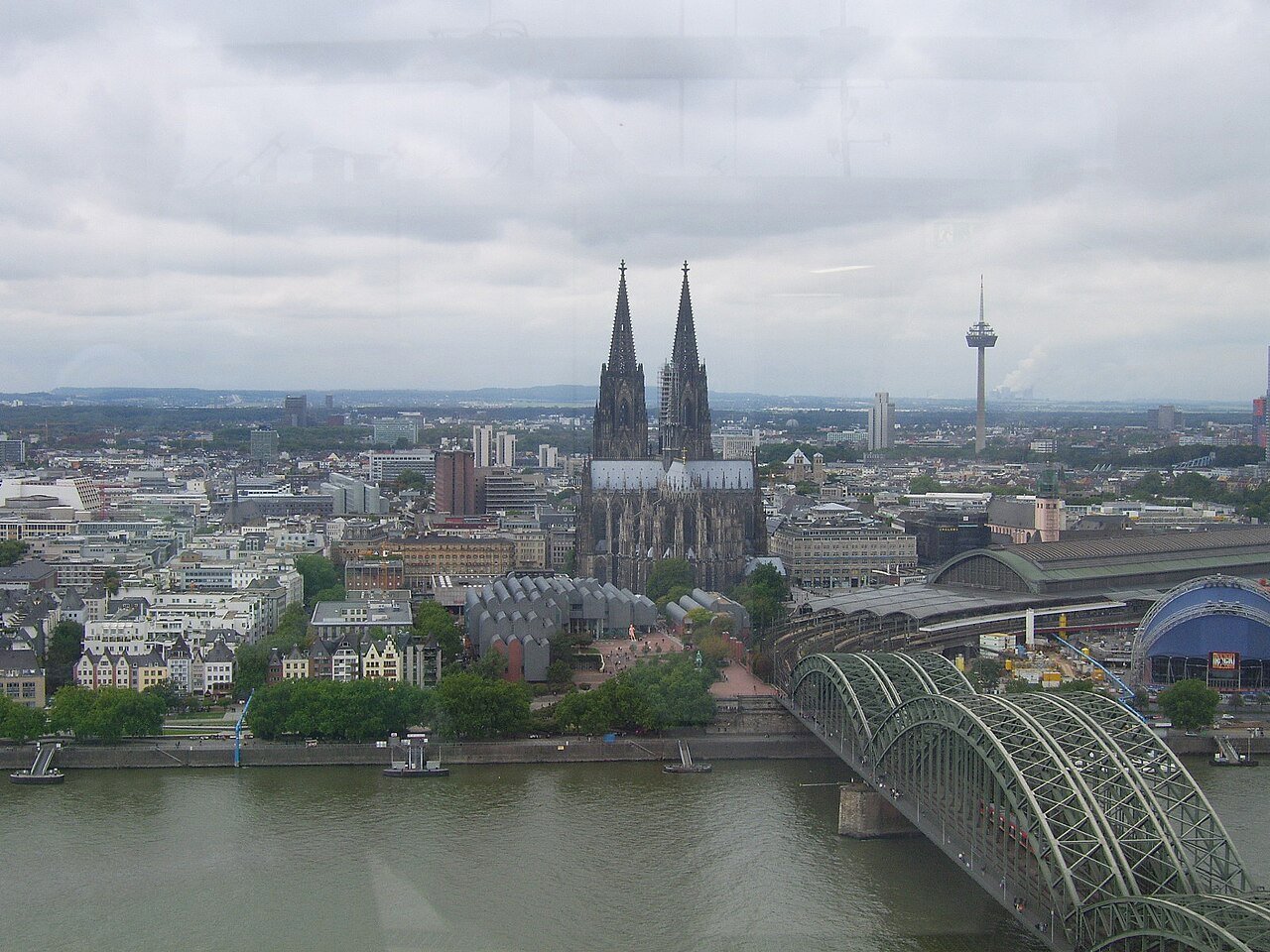
Cologne Cathedral — its twin Gothic spires the tallest in the world when completed in 1880 — is Germany’s most-visited monument and a UNESCO World Heritage Site since 1996. Within two hours, Aachen Cathedral (Charlemagne’s palace chapel), the Upper Middle Rhine Valley, and the Zollverein coal mine industrial complex extend one of Germany’s richest heritage itineraries.
Cologne Cathedral: Six Centuries of Gothic Ambition City centre
Cologne Cathedral, inscribed in 1996 under criteria (i), (ii), and (iv), is the largest Gothic cathedral in northern Europe and the most ambitious building project of the medieval period — construction began in 1248 and was not completed until 1880, a 632-year building campaign. The original medieval builders completed the choir (1322) and erected the south tower to 59 metres (1437) before halting construction for four centuries; the nineteenth-century Romantics, inspired by the discovery of the original thirteenth-century architect’s plans in the Darmstadt city archive in 1814, completed the nave and raised both towers to 157 metres. The Shrine of the Three Kings (c. 1190–1220), the largest reliquary in the Western world, holds the bones of the Magi and was the medieval reason for Cologne’s importance as a pilgrimage destination. The Gero Cross (c. 970 CE), carved in oak, is the oldest surviving large monumental crucifix north of the Alps.
Aachen Cathedral: Charlemagne’s First Capital 🚅 50 mins by IC train
Aachen Cathedral, the first German site on the World Heritage List (1978, criteria (i), (ii), and (vi)), houses the palace chapel that Charlemagne built between 792 and 805 CE. The Palatine Chapel’s octagonal rotunda — derived from the Byzantine prototype of San Vitale in Ravenna — is still structurally intact; the upper gallery where the throne of Charlemagne stands received 37 coronations of Holy Roman Emperors. The Cathedral Treasury contains the golden Bust Reliquary of Charlemagne (1349), the Lothar Cross encrusted with antique gems, and the Aachen Gospels — one of the finest Carolingian illuminated manuscripts in existence. Aachen is 70 kilometres from Cologne and reachable in 50 minutes by IC train.
Upper Middle Rhine Valley: Lorelei Rock and Rhine Castles 🚗 ~1 hr south to Koblenz
The Upper Middle Rhine Valley, inscribed in 2002 under criteria (ii), (iv), and (v), begins 100 kilometres south of Cologne where the Rhine narrows between Bingen and Koblenz. The 65-kilometre inscribed section passes forty medieval castles, the Lorelei rock, and terraced Riesling vineyards in what is, from a tourist’s viewpoint, the defining Rhine landscape. The easiest access from Cologne is by train to Koblenz (1 hr 10 mins, Deutsche Bahn IC) and then by KD river cruise upstream, or by bus from Koblenz to Bacharach along the right bank. The Deutsches Eck at Koblenz — the confluence of Moselle and Rhine — is the natural starting point for any Rhine gorge exploration.
Zollverein Coal Mine Industrial Complex: The Cathedral of Coal 🚅 ~1 hr north to Essen
The Zollverein Coal Mine Industrial Complex in Essen, inscribed in 2001 under criteria (ii) and (iii), is a complete colliery and coking plant from the peak of the Ruhr’s coal industry — built in the Bauhaus style between 1928 and 1932 by the architects Fritz Schupp and Martin Kremmer. The Shaft XII headframe (the “most beautiful coal mine in the world” in the words of the architectural press) rises 55 metres above the former colliery yard in black steel; the adjacent coking plant, equally unaltered, is the largest preserved industrial monument in Germany. The complex now houses the Ruhr Museum of regional history, the Design Museum Essen, and the Red Dot Design Museum in the former boiler house. The industrial landscape of the Ruhr, which powered Germany’s twentieth-century economy, is documented here with a completeness unmatched anywhere in Europe.
Practical information
Cologne Hauptbahnhof stands directly beneath the cathedral — the most dramatically sited major railway station in Germany, with the spires visible through the concourse windows. ICE connections to Frankfurt (1 hr), Amsterdam (2.5 hrs), Brussels (1.5 hrs), and Paris (3.5 hrs). Aachen IC trains leave hourly from Cologne Hauptbahnhof. Koblenz is 1 hr 10 mins by IC; regional trains to Bacharach along the Rhine gorge run from Koblenz. Essen (for Zollverein) is 30 mins by S-Bahn or IC. Cologne’s Carnival season (Karneval, peaking on Rosenmontag in February/March) transforms the city; the Christmas markets around the cathedral (from late November) are among the most crowded in Germany.
Frequently Asked Questions
Is Cologne Cathedral a UNESCO World Heritage Site?
Yes. Cologne Cathedral was inscribed in 1996 under criteria (i), (ii), and (iv). It was briefly placed on the UNESCO List of World Heritage in Danger in 2004–2006 over concerns about planned high-rise development on the Rhine riverbanks; the threat was resolved when Cologne amended its building height regulations.
How long does it take to see the interior of Cologne Cathedral?
The main nave requires 30–45 minutes for a thorough walk. The Treasury (separate admission) takes another 30–45 minutes and contains the Shrine of the Three Kings and the Gero Cross. Climbing the south tower (533 steps, 97 metres, open April–October) adds another 45–60 minutes. Allow 2.5–3 hours total for a comprehensive visit.
Can you see Cologne Cathedral from a boat on the Rhine?
Yes. The KD River Cruises and multiple tourist boat operators offer Rhine cruises from Cologne’s Altstadt quays; the cathedral’s twin spires are visible from the river for several kilometres. River cruises toward Koblenz pass through the full Upper Middle Rhine Valley and can be combined with a return by regional train.
Sources
- S1 — Wolff, Arnold. The Cologne Cathedral. Vista Point Verlag, 2003. ISBN 978-3-88973-066-4.
- S2 — Binding, Günther. Was ist Gotik? Eine Einführung in die gotische Architektur. Primus Verlag, 2000. ISBN 978-3-89678-185-7.
Spotted an error? Write to editorial@culturalheritageonline.com and we correct it the same day.