

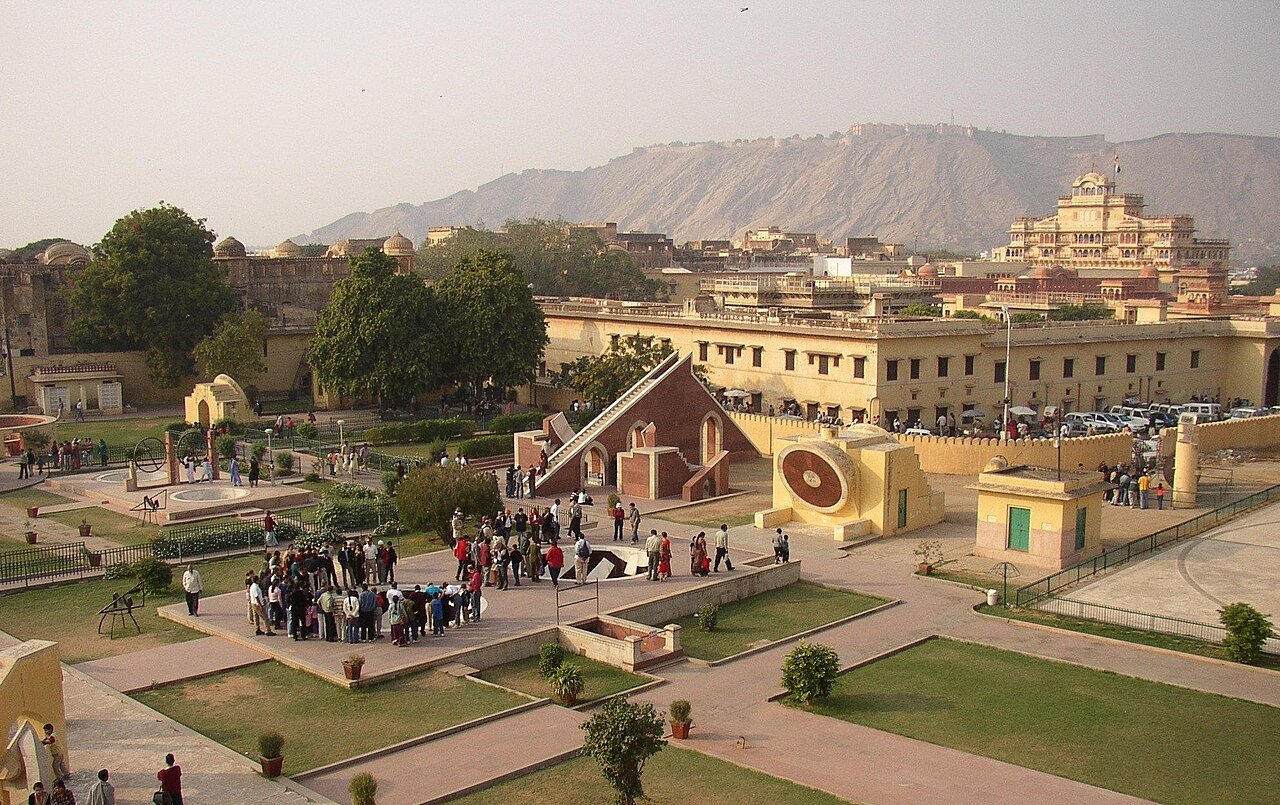
Stones that read the sky: the science of Jantar Mantar
Built between 1727 and 1734 by Maharaja Sawai Jai Singh II of Jaipur, the Jantar Mantar (“instrument of calculation” in Sanskrit) is an observatory of extraordinary ambition. Its nineteen stone-and-mortar instruments measure time, track the sun and planets, predict eclipses, and record the positions of stars — all without lenses or mechanical parts, using only geometry, shadow, and scale. At its heart stands the Samrat Yantra: at 27 metres, the largest gnomon on Earth, capable of reading local time to within two seconds.
UNESCO inscription: geometry as scientific heritage
Inscribed in 2010, Jantar Mantar was recognised by UNESCO as an outstanding example of the astronomical achievements of the Mughal and Rajput courts, and as a masterpiece of the scientific understanding of the cosmos in the early 18th century. The site demonstrates an extraordinary synthesis of cosmological knowledge drawn from Hindu, Islamic, and European traditions.
Maharaja Jai Singh II: astronomer king
Jai Singh II (r. 1699–1743) was a ruler of unusual intellectual range. He corresponded with the Portuguese mission in Goa, obtained European astronomical tables, and sent emissaries to study observatories in Samarkand and Egypt. His aim was to correct the existing astronomical tables — both Hindu and Islamic — which he found imprecise for calculating auspicious dates and the positions of celestial bodies. He built five observatories: at Jaipur, Delhi, Ujjain, Varanasi, and Mathura (only the first two survive intact).
The instruments: nineteen monuments to measurement
The Jantar Mantar consists of nineteen major instruments, each designed to measure a specific astronomical phenomenon. The Samrat Yantra (Supreme Instrument) is a right-triangle gnomon whose sloping hypotenuse tracks the sun across a curved scale — its shadow moves fast enough to be timed by eye. The Jai Prakash Yantra consists of two complementary hemispherical bowls, their surfaces ruled with coordinates, allowing observers to read the position of any celestial body directly. The Ram Yantra measures altitude and azimuth of the sun and stars with a circular room open to the sky.
Why stone? The epistemology of permanence
Jai Singh chose stone and masonry because he distrusted the small brass instruments that European astronomers used, arguing their scale introduced error. By building instruments at architectural scale — some large enough to walk inside — he minimised the proportional error of each reading. The materials also ensured permanence: the instruments were designed to outlast any individual observer and to remain calibrated across generations.
A living observatory: the Jaipur sky today
The Jantar Mantar still works. During the summer solstice, the Samrat Yantra casts a shadow that moves visibly by the minute. The instruments are calibrated for Jaipur’s latitude (26.9°N) and remain accurate for local solar time. Astronomers still use them to check equinoctial observations, and every year at the solstice a small ceremony marks the moment the shadow reaches its northernmost point.
Visiting Jantar Mantar
The observatory is located in the heart of Jaipur’s walled city, adjacent to the City Palace. It is open daily from sunrise to sunset; guided audio tours explain each instrument. The best time to visit is early morning, when the shadows are sharpest and the temperature manageable. Jantar Mantar is part of a “Hill Forts of Rajasthan” UNESCO cluster that includes Amber Fort, Jaisalmer Fort, and Chittorgarh, all reachable by day-trip from Jaipur.
The legacy: where tradition met modernity
Jai Singh II compiled his observations into the Zij-i Muhammad Shahi, a set of astronomical tables dedicated to the Mughal emperor Muhammad Shah. His work represented the last great flowering of pre-telescopic observational astronomy in Asia — the moment when ancient geometric methods, refined over two millennia, were pushed to their ultimate limit by a ruler determined to measure the universe with stone.
Find it on the map
See this place and what’s around it →📷 Become a Cultural Heritage Online photographer
Share your photos of places: they stay published under your name as the author. The more they're seen, the more you get noticed — and soon a contest will reward the most appreciated photos.
Log in or sign up free to add a photo