
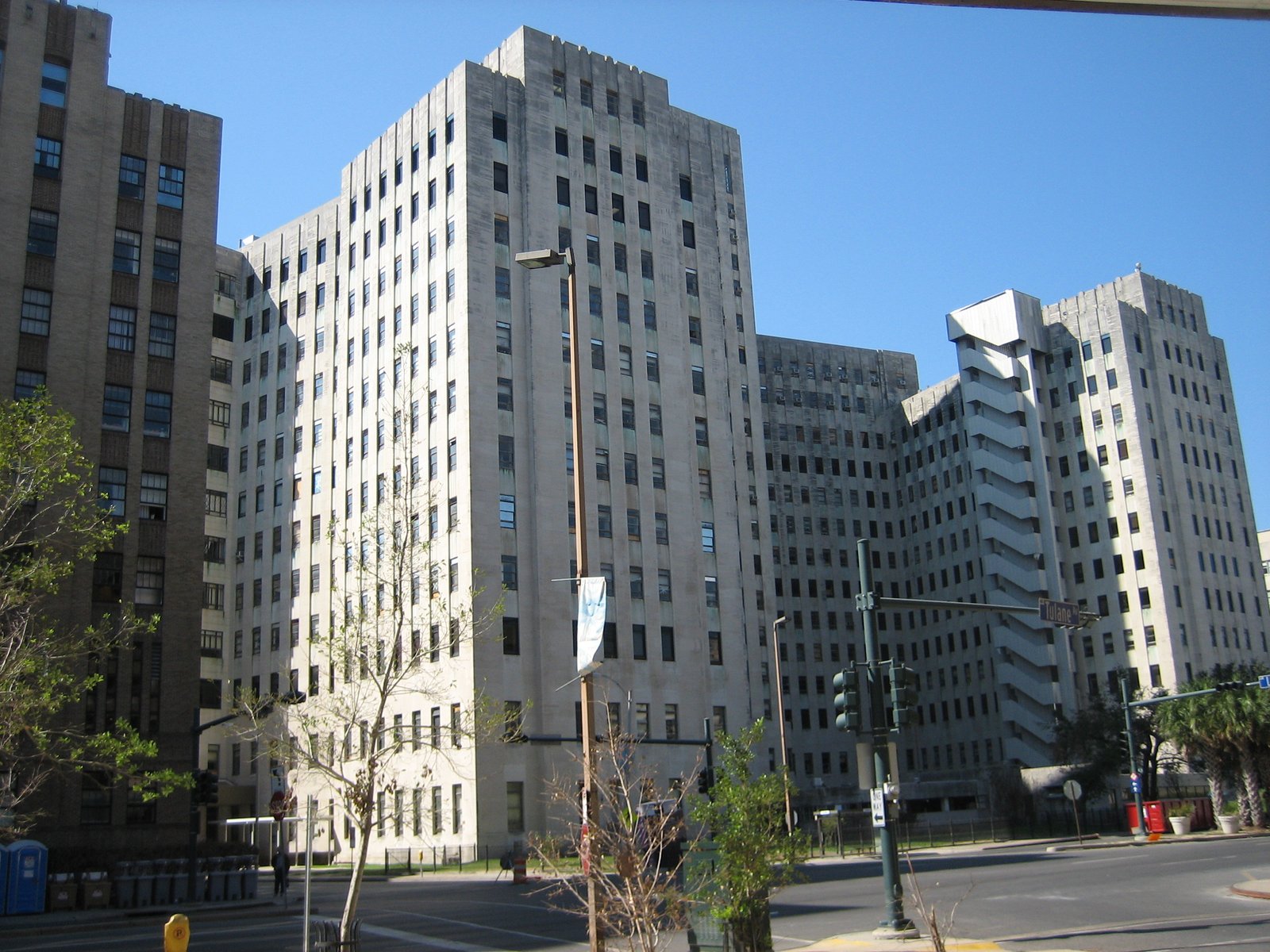

Built in 1939 under the New Deal’s Public Works Administration, Charity Hospital was once the second-largest hospital in the United States — a 20-story Art Deco tower whose stripped, monumental facade defined the institutional ambitions of Depression-era Louisiana.
At a glance
Standing at 1532 Tulane Avenue in the New Orleans medical district, Charity Hospital was completed in 1939 as the flagship public hospital of Louisiana, designed by the state architectural firm Weiss, Dreyfous & Seiferth. Its 20-story tower in the PWA Moderne style — a variant of Art Deco developed specifically for large government and institutional buildings under the New Deal — was among the most ambitious public building projects in the American South in the 1930s. At its opening it was reportedly the second-largest hospital in the United States by bed count. The hospital served New Orleans’ most vulnerable residents for over six decades before Hurricane Katrina in 2005 forced its closure, ending a tradition of public healthcare at the site that stretched back to 1736. The building has stood vacant since.
Key facts
- Completed: 1939
- Architects: Weiss, Dreyfous & Seiferth
- Style: PWA Moderne (Art Deco)
- Height: 20 stories
- Address: 1532 Tulane Avenue, New Orleans, LA 70112
- Status: Vacant since Hurricane Katrina, 2005; future undetermined
- Signature feature: Stripped limestone tower with monumental PWA reliefs and setback massing
History
Louisiana’s tradition of public healthcare in New Orleans is among the oldest in North America — the first Charity Hospital was founded in 1736, making it one of the oldest continuously operating hospitals in the United States by the early twentieth century. By the 1930s, Governor Huey Long’s commitment to expanded public services, combined with New Deal federal funds from the Public Works Administration, made the construction of a new flagship hospital politically viable. The commission went to Weiss, Dreyfous & Seiferth, the state architectural firm that had worked extensively with the Long administration on public buildings across Louisiana.
Completed in 1939, the new Charity Hospital represented both a public health ambition — centralised, modern, and accessible — and an architectural statement about the role of the state in Depression-era America. The PWA Moderne style, with its simplified ornament, monumental scale, and stripped limestone surfaces, was the New Deal’s preferred institutional language: modern enough to signal progress, substantial enough to project permanence. At opening, the hospital’s bed count made it one of the largest in the country.
The hospital’s closure in the immediate aftermath of Hurricane Katrina in August 2005 ended sixty-six years of continuous operation. Controversy over the decision not to reopen — a plan to replace it with a new medical complex was eventually implemented — made Charity Hospital a flashpoint in the debates over New Orleans’ post-Katrina recovery. The building has stood vacant since 2005, and proposals for its reuse or demolition have circulated without resolution.
What you see
Charity Hospital’s 20-story tower rises above Tulane Avenue with the characteristic restraint of PWA Moderne: a limestone-clad facade with setback geometry at the upper floors, vertical window bands that emphasise the shaft’s height, and sparse decorative relief panels at the entrance level whose simplified figurative and geometric motifs are the only concession to ornament. The palette — pale stone, clean horizontal spandrels, grid-like window patterning — is deliberately institutional, calibrated to project authority and reliability rather than the commercial exuberance of private Deco towers of the same period.
The entrance on Tulane Avenue was framed by the scale devices typical of PWA civic architecture: a monumental portal with recessed reveals, relief panels flanking the entrance bay, and a vertical projection above the doorway that anchors the building to the street without resorting to historicist ornament. In its abandoned state the building’s stripped geometry is even starker than it would have been in active use — the absence of signage and movement accentuating the deliberate sobriety of the PWA design language.
Practical information
- Access: Exterior only; building closed and vacant since 2005. No public interior access
- Best view: Tulane Avenue, from the south pavement; or from the University Medical Center building looking north
- Time needed: 15–20 minutes exterior
- GPS: 29.9554° N, 90.0780° W
- Nearest transit: Bus routes on Tulane Avenue and Broad Street
Getting there
Charity Hospital stands at 1532 Tulane Avenue in New Orleans’ medical district, approximately 1.5 miles (2.5 km) north of the French Quarter and walking distance from the new University Medical Center. Louis Armstrong International Airport is 15 miles (24 km) west of the city centre, with taxis, rideshare, and shuttle services available. The area is also served by New Orleans Regional Transit Authority bus routes along Tulane Avenue.
Nearby
- University Medical Center (2015) — the hospital complex that replaced Charity; architectural contrast illustrating six decades of institutional design
- Saenger Theatre (1927) — Emile Weil’s atmospheric cinema, 1.5 miles east on Canal Street
- Mid-City — residential district stretching north from the medical campus, with pre-Katrina architecture largely intact
Sources
- Campanella, Richard. Bienville’s Dilemma: A Historical Geography of New Orleans. Center for Louisiana Studies, 2008
- Sublette, Ned. The World That Made New Orleans. Lawrence Hill Books, 2009
- Louisiana Division of Historic Preservation, Charity Hospital documentation — crt.state.la.us
- Preservation Resource Center of New Orleans, post-Katrina institutional surveys — prcno.org
- Wikidata, Charity Hospital (New Orleans) Q5074514 — wikidata.org
Find it on the map
See this place and what’s around it →📷 Become a Cultural Heritage Online photographer
Share your photos of places: they stay published under your name as the author. The more they're seen, the more you get noticed — and soon a contest will reward the most appreciated photos.
Log in or sign up free to add a photoIs this page about you?
This page is read by travellers and heritage enthusiasts who find it on Google. Tell us how you are connected to this place and we will take it from there.