

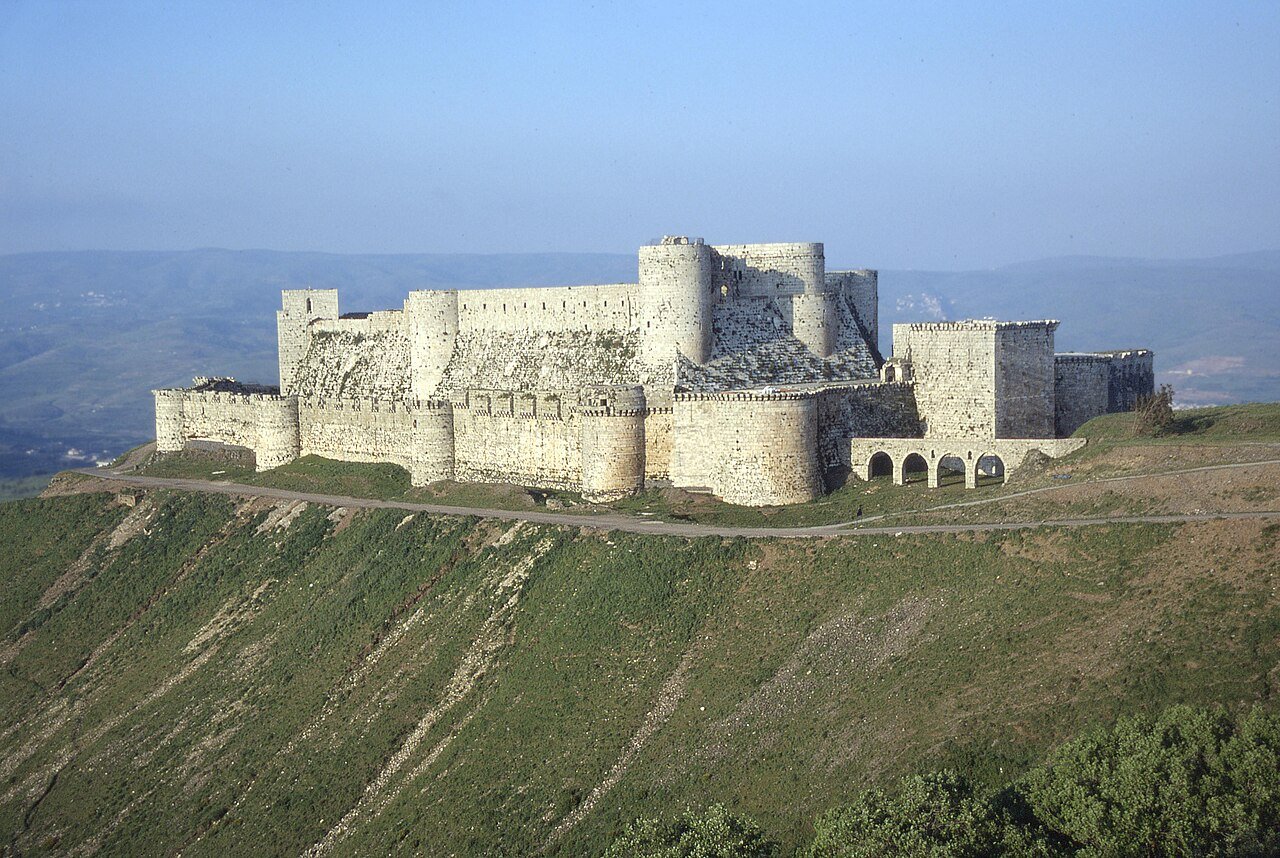
The finest castle in the world: Lawrence of Arabia’s verdict
T. E. Lawrence visited the Krak des Chevaliers in 1909 as a young Oxford student researching his thesis on Crusader military architecture. His verdict — “perhaps the finest castle in the world” — has been widely echoed since. Rising 650 metres above sea level on a natural spur in the Homs Gap, the strategic pass connecting the Syrian coast to the interior, the Krak commands one of the most important military positions in the eastern Mediterranean.
UNESCO inscription: the pinnacle of military architecture
Inscribed in 2006, together with the castle of Qal’at Salah El-Din 60 km to the north, the Krak des Chevaliers was recognised by UNESCO as an outstanding example of the interchange of human values in the development of military architecture during the Crusader period — and as the most complete surviving example of the concentric castle design that the Crusaders developed in the Holy Land.
The Knights Hospitaller and six centuries of occupation
The castle’s origins are Muslim: a Kurdish garrison occupied the hilltop site before 1099. The Crusaders captured it, and in 1142 the Count of Tripoli entrusted it to the Knights Hospitaller, the military-religious order founded to care for pilgrims in Jerusalem. The Hospitallers occupied the Krak for 130 years, continuously expanding and strengthening it until it reached its present extent — capable of garrisoning 2,000 soldiers and withstanding any medieval siege engine.
Architecture of war: the concentric design
The castle is organised in two concentric rings of defences. The outer ring — lower, thinner, equipped with towers — provided a first line of defence and contained stable areas. The inner citadel — a massive structure with walls 3 metres thick and seven great towers — was virtually impregnable. Between the two rings runs a moat. The design means that even if the outer ring fell, an enemy army found itself trapped between two fortifications under fire from all sides.
The Mamluk capture: Baybars and the forged letter
The Krak fell in 1271 not through assault but through ruse. Sultan Baybars of Egypt had besieged the castle for over a month when he allegedly sent the 200-man garrison a forged letter purportedly from the Crusader Grand Master in Tripoli, authorising surrender. The Hospitallers departed under safe conduct; the Mamluk sultan occupied the finest fortress in Syria. Baybars made significant additions, including the three towers on the outer southern wall that bear his inscriptions.
The loggia and the Great Hall: a Crusader interior
Inside the inner citadel, the most remarkable survival is the Gothic loggia (late 12th century) — a barrel-vaulted gallery with slender columns giving onto an internal courtyard. Nearby stands the Great Hall, now roofless but preserving its Romanesque portal and the remains of carved stone benches. These spaces housed the chapter meetings of the Knights, their dormitories, the infirmary, and the great chapel (converted to a mosque after 1271).
War and conservation: the Syrian Civil War’s impact
The Krak des Chevaliers was occupied by opposition fighters during the Syrian Civil War and subjected to aerial bombardment by the Syrian government in 2013. Significant damage was inflicted on the outer walls and several towers. UNESCO has coordinated international efforts to document and stabilise the castle, but political instability has slowed conservation work. The site remains technically open to visitors, though access requires careful advance planning given the security situation.
A fortress for contemplation: the Krak in context
The Krak des Chevaliers sits in a landscape that has been fought over for 3,000 years — Hittites, Assyrians, Persians, Romans, Byzantines, Arabs, Crusaders, Mongols, Mamluks, Ottomans, French Mandate forces, and Syrian military factions have all sought to control the Homs Gap. The castle is not an isolated monument but the most articulate expression of a landscape whose strategic value has never diminished.
Find it on the map
See this place and what’s around it →📷 Become a Cultural Heritage Online photographer
Share your photos of places: they stay published under your name as the author. The more they're seen, the more you get noticed — and soon a contest will reward the most appreciated photos.
Log in or sign up free to add a photo