
At a Glance
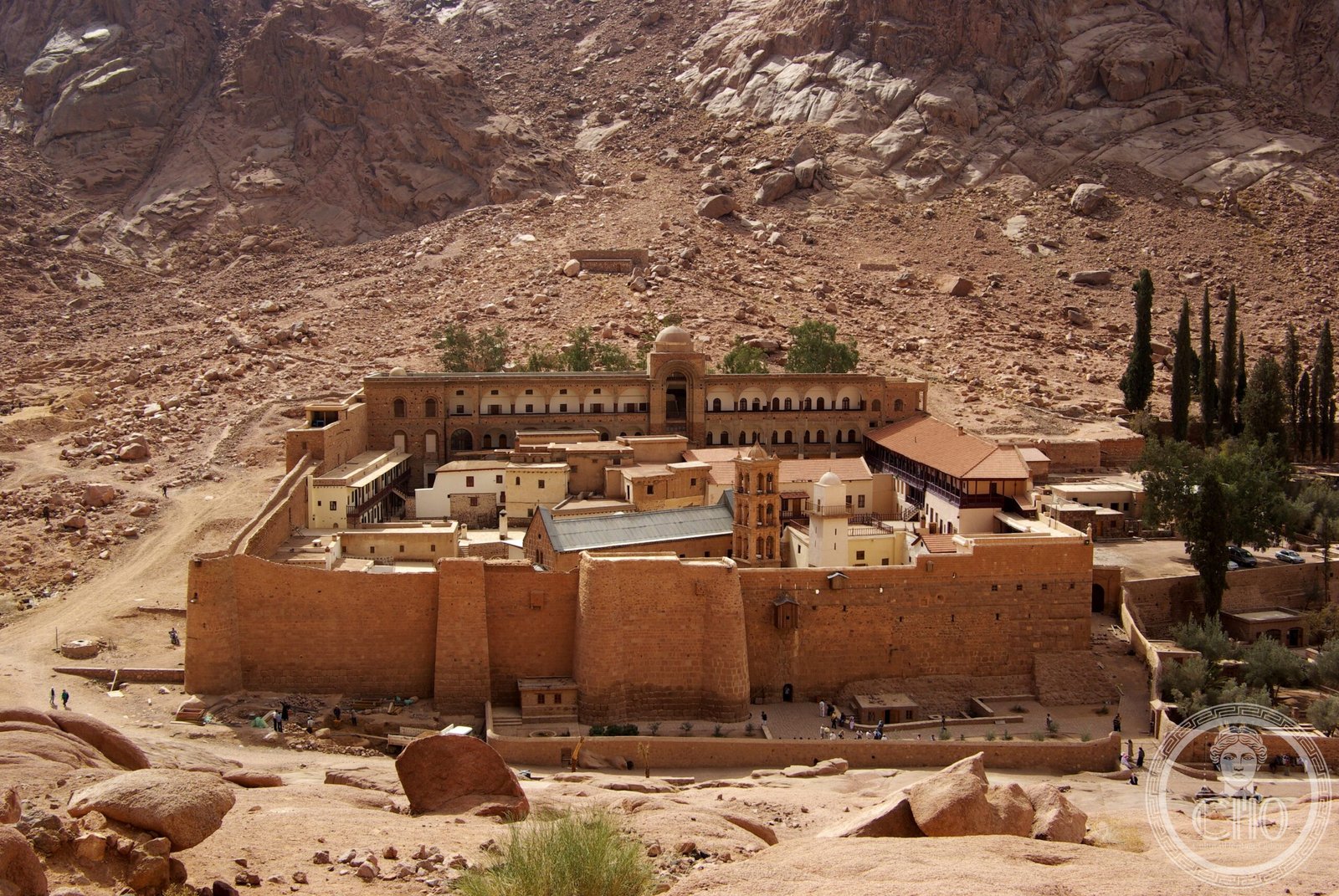
In the granite heart of the Sinai Peninsula, at 1,570 metres altitude at the foot of Jebel Musa (Mount Sinai, 2,285 m), the Monastery of Saint Catherine is the world’s oldest continuously operating Christian monastery. Founded by the Byzantine Emperor Justinian between 527 and 565 AD, it has never been abandoned in nearly 1,500 years. UNESCO inscribed the Saint Catherine Area in 2002 (ref. 954) for its outstanding universal value as a place of exceptional religious significance to Christianity, Islam and Judaism, and for its peerless collections of early Christian art.
Biblical Significance
Mount Sinai is traditionally identified as the site where God spoke to Moses from the Burning Bush and where Moses received the Ten Commandments. The site has been a destination for Jewish, Christian and later Muslim pilgrims since the 3rd century AD. The Burning Bush — a living bramble (Rubus sanctus) still growing within the monastery precinct — is venerated by all three faiths. Justinian built the current monastery around the earlier chapel of the Burning Bush (founded by Empress Helena in the 4th century), creating both a place of worship and a fortified refuge for the desert monks who had been living in the Sinai wilderness since the 3rd century.
The Collections
Saint Catherine’s holds what is arguably the most important collection of early Christian art in the world outside the Vatican. The Basilica of the Transfiguration (6th century) contains a magnificent apse mosaic of the Transfiguration of Christ, one of the finest surviving examples of Byzantine art from the Justinianic era. The monastery’s icon collection — over 2,000 icons ranging from the 6th century to the 19th century — is unmatched anywhere in the Christian world; it includes the only surviving icons painted in the encaustic (wax-pigment) technique used before the 8th-century Iconoclasm, icons of a type destroyed almost everywhere else. The library holds over 3,300 manuscripts in Greek, Arabic, Syriac, Georgian, Armenian and other languages — the second largest collection of illuminated manuscripts in the world, after the Vatican.
Architecture
The monastery enclosure is a roughly rectangular fortress of granite walls up to 3 metres thick and 18 metres high, enclosing an area of about 84 by 74 metres. Within the walls are the 6th-century basilica (still holding Greek Orthodox services daily), the Burning Bush chapel, a mosque built in the 10th century for Muslim visitors, a minaret, a bell tower, monks’ cells, a well, a library building and a small museum. The bell tower was rebuilt in 1871 and houses nine bells donated by Tsar Alexander II of Russia. The entire complex is virtually unchanged in layout since the 6th century — a living monument to early Christian desert monasticism.
The Sinai Landscape
The surrounding area — dramatic granite mountains streaked red, orange and grey — is one of the most austere and sublime landscapes on Earth. The ascent of Mount Sinai via the Steps of Repentance (3,750 stone steps cut by monks) or the Camel Path is a pilgrimage in itself; the summit chapel marks the traditional site of the Covenant. The high-altitude desert environment supports endemic plants and insects, including the Sinai rose (Rosa arabica) and the Sinai leopard (extremely rare).
Visiting
The monastery is open Monday–Thursday and Saturday mornings (09:00–12:00); closed Friday, Sunday and Greek Orthodox holy days. Entrance to the basilica and Burning Bush is free (donations welcomed); the icon museum charges a small fee. The summit of Mount Sinai is typically climbed at night to reach the top for sunrise — a 2–3 hour ascent from the monastery gate. Modest dress is mandatory.
Practical Information
The nearest town is Saint Catherine (10 km), with basic hotels and restaurants. From Sharm El Sheikh (200 km), organised day trips run nightly for the sunrise ascent. From Cairo by bus (7–8 hrs) or by plane to Sharm, then road transfer. GPS (monastery): 28.560° N, 33.980° E.
Nearby
The Saint Catherine Protectorate (600 km²) surrounds the monastery and contains the most biologically diverse area of the Sinai peninsula. The Coloured Canyon — a slot canyon of red, yellow and purple sandstone — is 120 km north near Nuweiba. Dahab’s famous Blue Hole diving site is 130 km east on the Gulf of Aqaba.
Find it on the map
See this place and what’s around it →📷 Become a Cultural Heritage Online photographer
Share your photos of places: they stay published under your name as the author. The more they're seen, the more you get noticed — and soon a contest will reward the most appreciated photos.
Log in or sign up free to add a photoIs this page about you?
This page is read by travellers and heritage enthusiasts who find it on Google. Tell us how you are connected to this place and we will take it from there.