
At a Glance
Karlskrona, on Sweden’s southern Baltic coast, is the best-preserved planned naval city in northern Europe. Founded in 1680 by King Charles XI of Sweden as the permanent base for the Swedish Royal Navy, the city was designed from scratch on a group of islands in Blekinge archipelago, according to a unified Baroque plan. UNESCO inscribed it in 1998 (ref. 871) as an outstanding example of a late 17th-century European planned city and of naval urban planning whose influence spread across Europe.
Foundation and Urban Plan
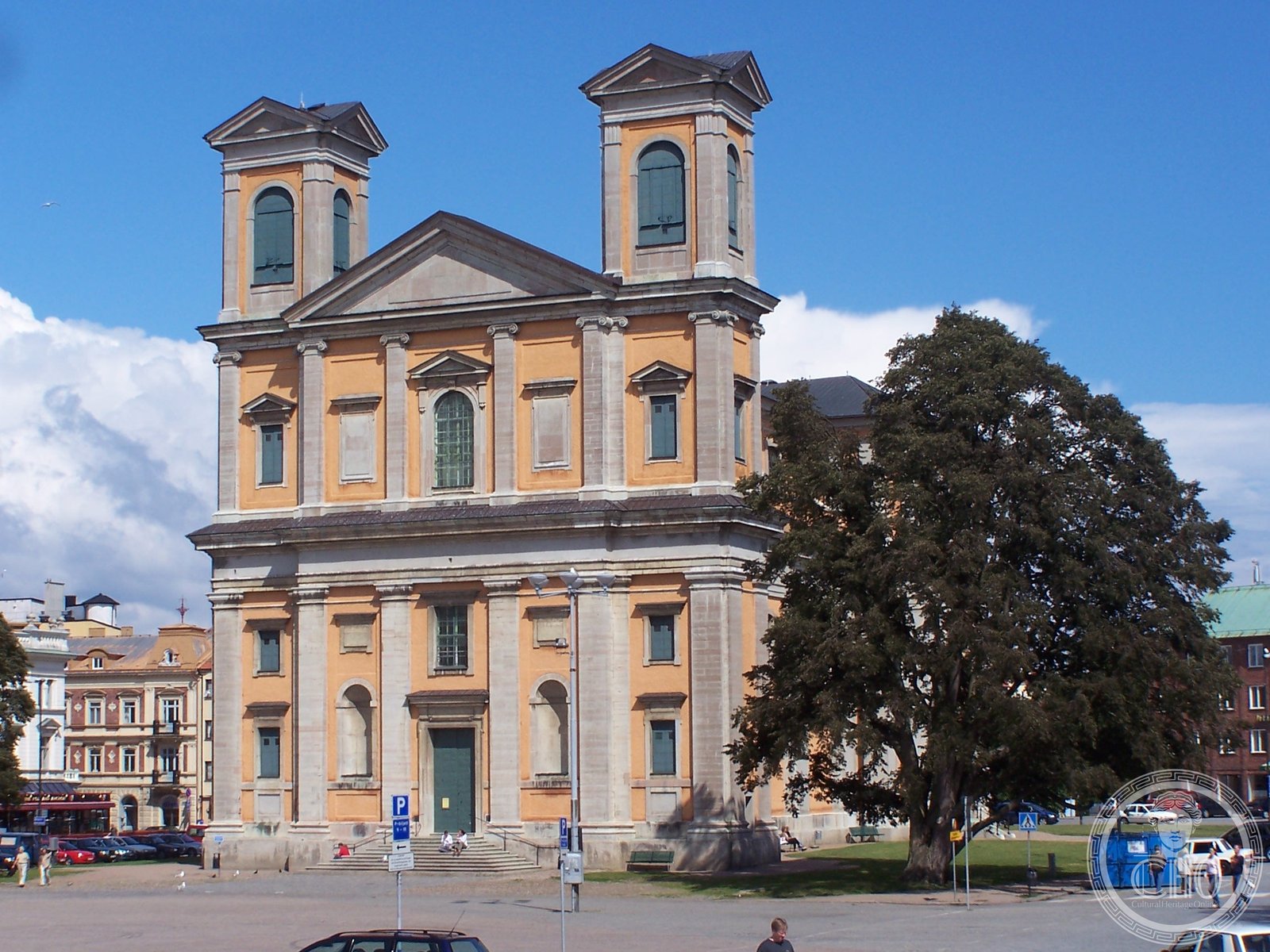
Charles XI chose the Trossö island in 1679 for strategic reasons: the deep-water harbour was ice-free longer than Stockholm, and the archipelago offered natural protection from naval attack. The city was planned by Erik Dahlbergh, one of Sweden’s foremost military engineers, in a radial Baroque pattern centred on the main square (Stortorget). Two great Baroque churches — the Trefaldighetskyrkan (Trinity Church, for the Swedish garrison) and Fredrikskyrkan (Frederick’s Church, for the German naval officers) — frame the square, both designed by Nicodemus Tessin the Elder. The street grid of the original town survives largely intact, making Karlskrona a remarkably legible example of 17th-century urban planning.
The Naval Yard
The Marinmuseum and the surviving naval shipyard (Örlogsvarvet, founded 1679) are among the most remarkable features. The shipyard — still partly active as a Swedish naval base — contains a unique ensemble of Baroque naval architecture: the rope walk (Repslagarbanan, 1692), the sail loft, and the remarkable Amiralitetskyrkan (Admiralty Church, 1685), a wooden church built for the naval community with its famous wooden beggar statue “Rosenbom” at the gate. The Karlskrona shipyard trained naval architects whose methods influenced yards across Europe.
Architecture
The two monumental churches on Stortorget illustrate Tessin’s ability to create Baltic Baroque in a northern European context: plain, powerful stone exteriors with well-proportioned towers, and white-plastered interiors of exceptional clarity and light. The Admiralty Church, a little to the north, is more intimate — a timber construction that has been continuously used by Swedish sailors since the 17th century and retains its original box pews and atmospheric wooden galleries. The naval buildings (storehouses, fortifications, docks) are built in the same rational Baroque idiom: brick and stone, functional but not without aesthetic ambition.
Influence on European Naval Planning
Karlskrona became a model for planned naval cities across northern Europe and beyond. Peter the Great of Russia visited in 1711, and his new naval base at Kronstadt (1703) drew directly on the Karlskrona model. Several Scandinavian naval bases and the British Devonport were influenced by Karlskrona’s integration of city, harbour, shipyard and naval infrastructure within a single coherent plan. UNESCO’s inscription specifically recognises this influence.
What to See
The Stortorget with its two Baroque churches is the natural starting point. The Marinmuseum (Naval Museum) on the harbourfront is one of Scandinavia’s best maritime museums, with a full-scale frigate section, figureheads and a submarine you can walk through. The old Trefaldighetskyrkan is open for visits; Fredrikskyrkan hosts regular concerts. Guided tours of the naval base (on pre-arranged public days) reveal the Baroque dockyard buildings.
Practical Information
Karlskrona is 200 km south of Malmö and 170 km from Kalmar. Direct trains from Malmö (2 hrs) and Gothenburg (3.5 hrs). The city is compact and easily walkable; a free city map with UNESCO sites is available at the tourist office on Stortorget. GPS (Stortorget): 56.160° N, 15.590° E.
Nearby
The Blekinge archipelago surrounding the city offers kayaking and island-hopping. The Glass Kingdom (Glasriket) region — home to Sweden’s famous crystal glassworks — is 60 km north. The Viking fortress-ring of Trelleborg (Borgeby) is 120 km west near Malmö.
Find it on the map
See this place and what’s around it →📷 Become a Cultural Heritage Online photographer
Share your photos of places: they stay published under your name as the author. The more they're seen, the more you get noticed — and soon a contest will reward the most appreciated photos.
Log in or sign up free to add a photo