
At a Glance
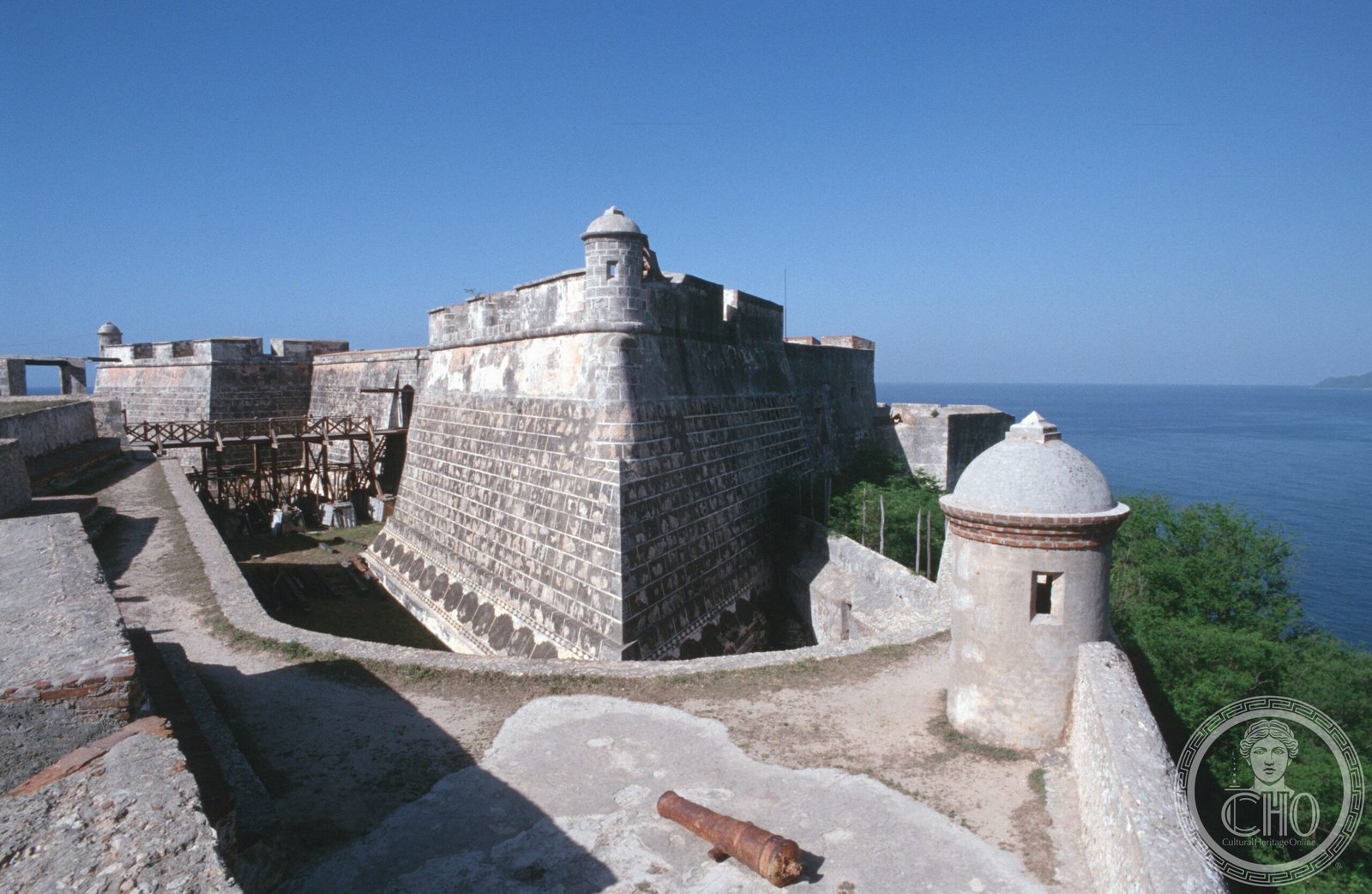
The Castillo de San Pedro de la Roca — universally known as El Morro — stands on a rocky promontory at the entrance to Santiago de Cuba’s harbour, commanding sweeping views across the Caribbean. Built from 1638 and expanded repeatedly over the following century and a half, it is considered the finest surviving example of Spanish-American military Renaissance architecture, and one of the best-preserved baroque fortifications in the Americas. UNESCO inscribed it in 1997 (ref. 841).
History
Santiago de Cuba, founded in 1515, was Spain’s first capital of Cuba and a key hub of Caribbean trade. From the mid-16th century it suffered repeated attacks by French, English and Dutch pirates and privateers, culminating in a devastating raid by Christopher Myngs in 1662. The governor Venegas Osorio commissioned the Genoese military engineer Juan Bautista Antonelli to design a permanent fortress; construction began in 1638. A series of earthquakes and pirate attacks forced repeated rebuilding and expansion throughout the 17th and 18th centuries, creating a layered complex of bastions, batteries, moats and ramps that spread across the promontory.
Architecture
El Morro is an extraordinary piece of military engineering adapted to extreme topography. The fortress is not a single building but a cascade of defensive systems: a lower gun battery at sea level (the Batería de los Doce Apóstoles), a series of intermediate batteries on rock shelves, an upper platform with the main keep, and a dry moat cutting across the promontory’s landward neck. The whole complex is built in warm-toned Cuban limestone and achieves a stark geometric beauty typical of Renaissance military design. Semicircular bastions at the corners provide interlocking fields of fire. The lighthouse added in 1844 remains active today.
Military Significance
El Morro was tested repeatedly in battle. English admiral Edward Vernon failed to take Santiago de Cuba in 1741; Henry Morgan sacked the bay but could not reduce the castle. The fortress saw its last military action during the Spanish-American War of 1898, when US naval forces blockaded Santiago harbour and defeated the Spanish fleet in the Battle of Santiago de Cuba (3 July 1898), effectively ending Spanish colonial rule in Cuba. The castle was never taken by assault — it surrendered only after the Spanish fleet was destroyed at sea.
What to See Inside
The castle is now a museum (Museo de la Piratería) tracing the history of piracy in the Caribbean and the military history of Cuba. Exhibits include 16th–18th-century weapons, armour, ship models, navigation instruments and detailed accounts of the pirate raids on Santiago. The castle’s upper platforms offer exceptional panoramic views over the harbour mouth and the Sierra Maestra mountains beyond. Cannon firings are performed for visitors on special occasions.
Visiting
El Morro is 10 km south-west of Santiago de Cuba city centre, reachable by taxi (15 minutes) or by the coastal road. The site is open daily; entrance fee applies. Allow 1.5–2 hours for the full circuit of batteries, ramp system, keep and museum. The nearby Cayo Granma — a small island in the bay — is reachable by ferry from the city port and makes a good half-day addition.
Practical Information
Nearest airport: Antonio Maceo International Airport (SCU), 12 km from El Morro. The site can be combined with a tour of Santiago de Cuba’s historic centre (Cathedral, Calle Heredia, Casa de Diego Velázquez). GPS: 19.970° N, 75.870° W.
Nearby
The Baconao Biosphere Reserve, 30 km east, protects coastal dry forest and contains a dinosaur park and valley of prehistoric art. The Gran Piedra mountain range offers cloud forest hiking 25 km north-east of the city. Siboney Beach — a strip of grey-pebble Caribbean coast — is 15 km from the castle.
Find it on the map
See this place and what’s around it →📷 Become a Cultural Heritage Online photographer
Share your photos of places: they stay published under your name as the author. The more they're seen, the more you get noticed — and soon a contest will reward the most appreciated photos.
Log in or sign up free to add a photo