
At a Glance
The Medieval Monuments in Kosovo is a UNESCO World Heritage site (ref. 724, inscribed 2004, extended 2006) comprising four Serbian Orthodox monasteries: Visoki Dečani, the Patriarchate of Peć, Our Lady of Ljeviš, and Gračanica. Together they represent the zenith of a distinctive artistic synthesis: Byzantine-Romanesque architecture and iconographic programmes, enriched by contact with the Gothic and Romanesque traditions of the Adriatic coast. They survive as outstanding repositories of 13th- and 14th-century fresco painting, among the finest in the entire medieval world.
History and Context
The monasteries were built during the reign of the Nemanjić dynasty, the medieval Serbian royal house that ruled from the 12th to the 14th century. This was Kosovo’s cultural golden age: Serbian kings, princes and archbishops competed in founding and endowing monasteries as acts of dynastic piety, producing a remarkable burst of religious architecture concentrated in the Raška, Kosovo Polje and Metohija regions. Dečani, built between 1327 and 1335 by King Stefan Dečanski and his son Stefan Dušan, is the largest surviving medieval church in the Balkans and contains over 1,000 fresco compositions — a complete theological encyclopaedia painted in stone. The Patriarchate of Peć served as the seat of the Serbian Orthodox Church and contains a complex of three interconnected churches built between the 13th and 14th centuries beneath a shared narthex.
Architecture and Art
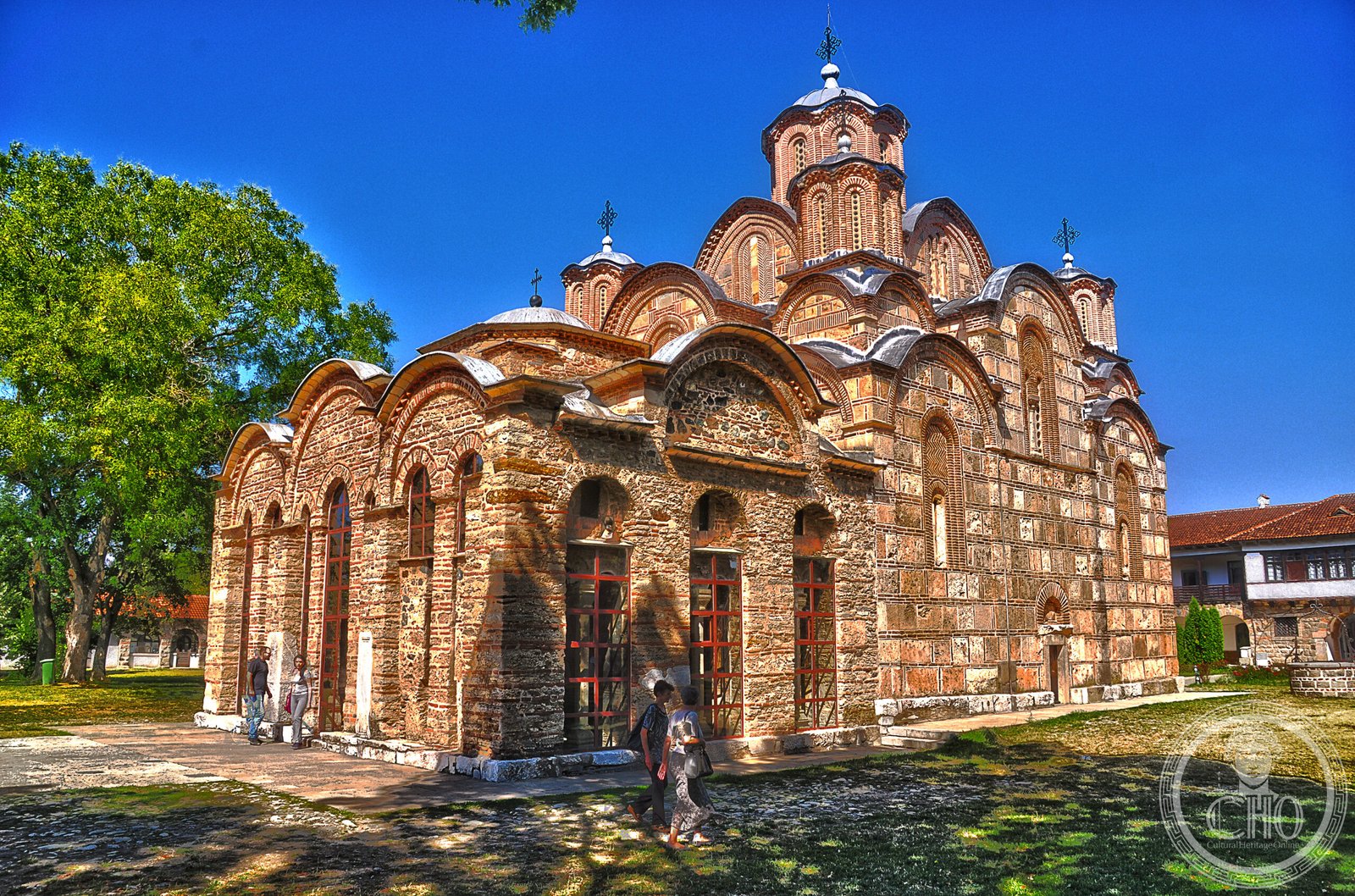
Each monastery is architecturally and artistically distinct, yet all share the same cultural grammar. Gračanica (1321) is the supreme expression of the Serbian Raška school of architecture: a complex cross-in-square plan with five domes, clad in alternating courses of stone and brick in the Byzantine manner, and frescoed inside with an elaborate programme that includes the famous genealogical tree of the Nemanjić dynasty. Our Lady of Ljeviš in Prizren represents the most ambitious fusion of Byzantine and Western Gothic spatial ideas, with five naves covered by six domes — a unique arrangement anywhere in the medieval world.
The Frescoes
The frescoes of these four monasteries are recognised by art historians as among the greatest achievements of Byzantine painting outside Constantinople. The Dečani frescoes (c. 1335–1350) display a new naturalism and narrative complexity — figures with individuated faces, dramatic scenes of the Passion and the Apocalypse rendered with cinematic intensity. Gračanica’s fresco programme retains the more hieratic, golden-ground style of earlier Byzantine painting, making the two sites visually complementary. Both survive in extraordinary condition.
UNESCO Inscription and Current Status
The site was inscribed on the UNESCO World Heritage List in 2004 (Dečani alone) and extended in 2006 to include the other three monasteries. It was simultaneously inscribed on the List of World Heritage in Danger, where it remains today due to the unresolved political status of Kosovo and intermittent security incidents. All four monasteries are garrisoned by KFOR (NATO) peacekeeping troops, who provide continuous protection to the monastic communities and their priceless heritage.
Visiting
Visoki Dečani is the most accessible and most visited, located 13 km south of Dečani town in western Kosovo. The monastery receives visitors daily and the monks offer tours of the church. Gračanica is 10 km south-east of Pristina and easily reached by taxi or bus. The Patriarchate of Peć is in the Rugova valley near Peć/Pejë; Our Lady of Ljeviš is in central Prizren. Security conditions vary — check current advisories before visiting.
Practical Information
The nearest international airport is Pristina (PRN), 30 minutes from Gračanica. Car hire is advisable for visiting multiple sites. Entrance to all four monasteries is free; modest dress is required. The monasteries remain active religious communities — observe silence and photograph only where permitted. GPS (Gračanica): 42.660° N, 20.270° E.
Nearby
Pristina city centre is 10 km from Gračanica; the National Museum of Kosovo has artefacts from all periods of the region’s history. Prizren’s Ottoman old town, with its mosques, hans and the Sinan Pasha Mosque, is 80 km south-west. The Rugova Gorge near Peć offers spectacular canyon landscapes.
Find it on the map
See this place and what’s around it →📷 Become a Cultural Heritage Online photographer
Share your photos of places: they stay published under your name as the author. The more they're seen, the more you get noticed — and soon a contest will reward the most appreciated photos.
Log in or sign up free to add a photoIs this page about you?
This page is read by travellers and heritage enthusiasts who find it on Google. Tell us how you are connected to this place and we will take it from there.