

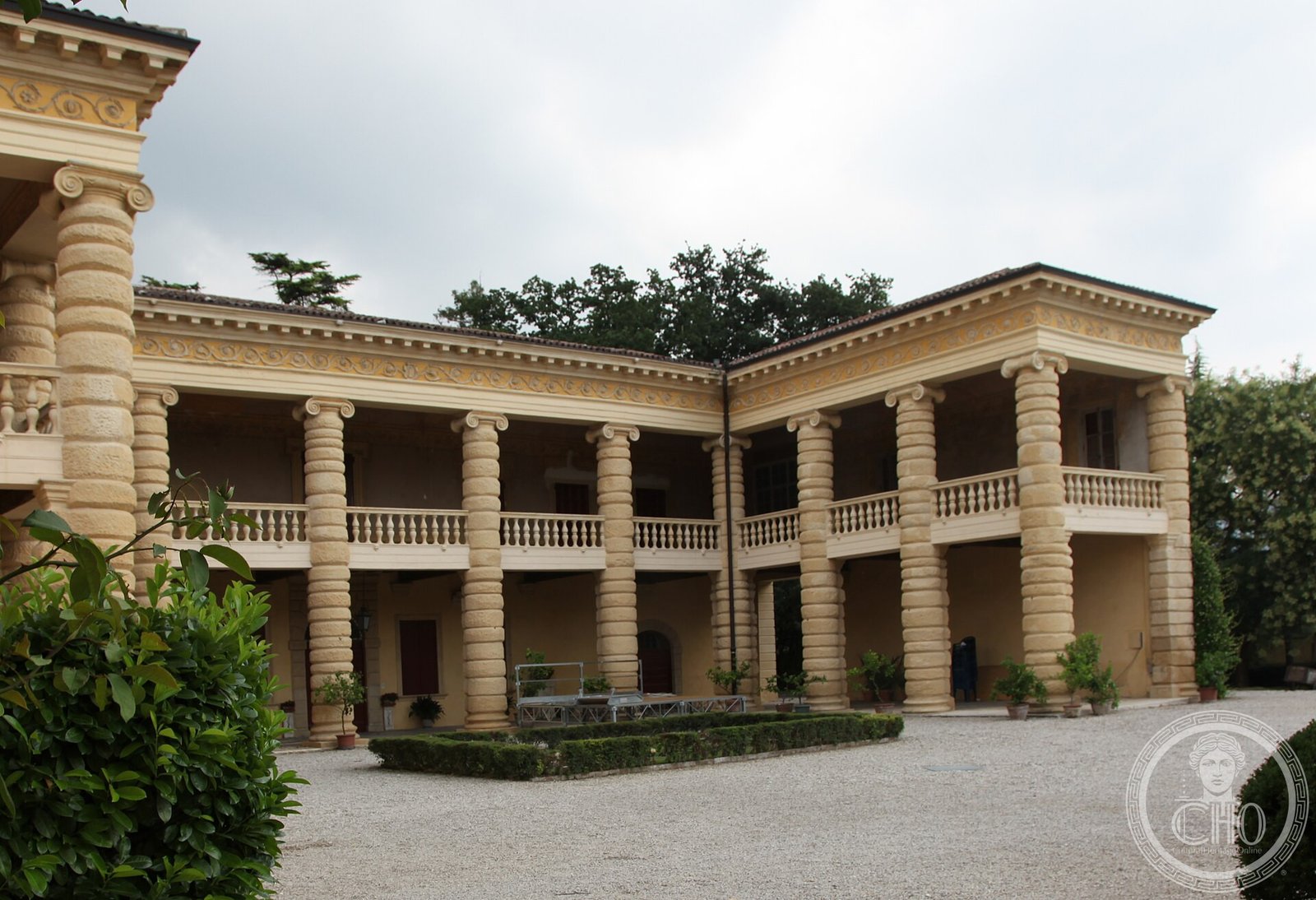
Andrea Palladio’s only surviving villa in the Province of Verona, this Renaissance masterwork remains a testament to ambitious architectural vision despite its incomplete construction.
At a glance
Villa Serego stands in Santa Sofia di Pedemonte as a rare surviving example of Palladio’s work in the Verona province. Commissioned by Marcantonio Serego in 1565, the villa represents one of the architect’s grandest designs—yet only a fraction was ever built. The complex joins other Palladian villas across the Veneto in UNESCO World Heritage recognition since 1996.
History
Marcantonio Serego acquired the Santa Sofia property in 1552, inheriting a medieval structure from his father. For thirteen years he left it unchanged before deciding in 1565 to commission Palladio for a complete architectural renewal. Palladio’s vision, published in his Four Books of Architecture (1570), was monumental: a vast rectangular courtyard enclosed by symmetrical wings.
Construction began but stalled dramatically. By 1740, architect Francesco Muttoni observed the courtyard’s foundation—column bases laid to mark the planned perimeter—yet most remained unfinished. Marcantonio’s death in the 1580s likely halted work permanently, though contemporaries evidently attempted to complete at least the residential quarters.
What you see
The villa presents less than half of Palladio’s original courtyard scheme, notably the northern section with its stately apartments. Enough foundations and architectural elements remain to suggest the grand proportions Palladio envisioned. The surviving structures reflect his characteristic use of classical orders and harmonious proportions, even in their incomplete state.
Cultural significance
Villa Serego embodies both Palladian ambition and Renaissance compromise. Its incompleteness paradoxically illuminates Palladio’s design philosophy: the surviving portions faithfully express his architectural principles despite financial and circumstantial constraints. The villa’s UNESCO listing recognizes it as integral to understanding Palladio’s influence across the Veneto and beyond.
Key facts
- Address: 37029 Santa Sofia di Pedemonte, San Pietro in Cariano, Verona
- Architect: Andrea Palladio (designed 1565)
- Patron: Marcantonio Serego
- UNESCO World Heritage: Listed 1996 (Venetian Villas of the Veneto)
- Coordinates: 45.4991888, 10.9235885
Getting there
The villa is located in Pedemonte, part of San Pietro in Cariano in the province of Verona. Public transport options to the Veneto region are available via train and bus; local transportation to the villa site should be arranged in advance.
Sources & resources
Find it on the map
See this place and what’s around it →📷 Become a Cultural Heritage Online photographer
Share your photos of places: they stay published under your name as the author. The more they're seen, the more you get noticed — and soon a contest will reward the most appreciated photos.
Log in or sign up free to add a photoIs this page about you?
This page is read by travellers and heritage enthusiasts who find it on Google. Tell us how you are connected to this place and we will take it from there.