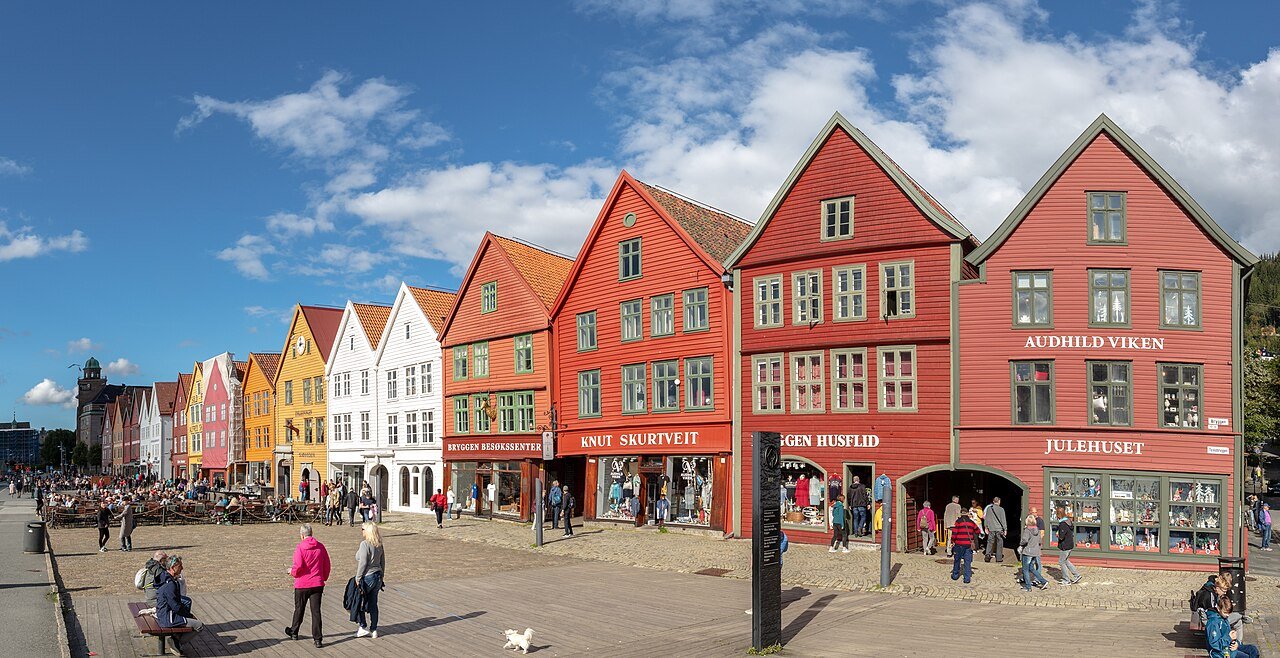
The Nordic Countries is home to 49 UNESCO World Heritage Sites across seven countries, ranging from the prehistoric rock carvings of Scandinavia to the modernist boulevards of Kaunas and the glacially sculpted coastlines of the Baltic rim. This is one of Europe’s most geographically and culturally varied World Heritage regions, where Viking-age fortresses, Hanseatic merchant quarters, ancient geodetic survey points, and vast wilderness landscapes hold equal standing on the global register. From Cultural Heritage Online.
The shape of the Nordic Countries’s World Heritage list
Of the 49 inscribed properties, the overwhelming majority — 42 — are classified as cultural sites under UNESCO criteria. Four sites hold natural designation, and three carry mixed status, reflecting the region’s strong tradition of placing human settlement and industrial heritage at the centre of its conservation identity. The earliest inscriptions date to 1979, when Norway placed two sites on the inaugural list: the Urnes Stave Church, with its intricate Norse wood carvings, and Bryggen, the medieval Hanseatic wharf quarter of Bergen.
The most recent addition is Møns Klint in Denmark, inscribed in 2025 for its exceptional glaciotectonic chalk cliffs on the island of Møn. The list has grown steadily across four decades, with particularly active periods in the 1990s and 2000s as the Baltic states of Estonia, Latvia, and Lithuania joined UNESCO’s expanded European heritage programme following independence. The region’s inscriptions span roughly 10,000 years of human presence, from Bronze Age burial mounds to twentieth-century industrial and modernist architecture.
Countries with the most inscriptions
Sweden leads the region with 15 World Heritage Sites, a figure that reflects both the breadth of Scandinavian prehistory and the country’s well-documented industrial past. The list runs from the Bronze Age rock carvings at Tanum and the Viking trading settlement of Birka to the seventeenth-century naval port of Karlskrona and the decorated timber farmhouses of Hälsingland, inscribed as late as 2012. Denmark follows with 10 sites, Norway with 8, and Finland with 7.
Among the Baltic states, Lithuania holds 5 inscriptions, including the Vilnius Historic Centre and the recently recognised Modernist Kaunas (2023) — a rare interwar city planned almost entirely in the International Style. Estonia and Latvia each hold 2 inscriptions, with Estonia’s Historic Centre of Tallinn and Latvia’s Historic Centre of Riga both representing outstanding examples of medieval urban fabric overlaid with Art Nouveau and later architectural layers. The gap in site counts between Scandinavia and the Baltic states partly reflects the longer UNESCO membership history of the Nordic countries, rather than any disparity in heritage significance.
Cross-border and serial sites
The Nordic region contains several of UNESCO’s most ambitious transboundary inscriptions. The Struve Geodetic Arc — a chain of triangulation survey points stretching from Norway to the Black Sea, used to measure the precise shape and size of the Earth — spans ten countries and stands as one of the longest serial properties on the World Heritage List. Six of those countries are within the Nordic region covered here: Estonia, Finland, Latvia, Lithuania, Norway, and Sweden. Its 2005 inscription recognised a scientific achievement as much as a physical monument.
The High Coast/Kvarken Archipelago is shared between Sweden and Finland and inscribed as a natural site for its remarkable post-glacial land uplift, one of the fastest in the world. As the land continues to rise, new islands and skerries emerge each year, making this a living laboratory of geological change. The Curonian Spit, a 98-kilometre sand dune peninsula on the Baltic coast, is co-inscribed between Lithuania and Russia and protects one of Europe’s largest dune systems alongside centuries of fishing village culture. The Wadden Sea extends from Denmark’s North Sea coast to Germany and the Netherlands, recognised for its extraordinary tidal biodiversity.
Natural and mixed-criteria sites
Despite the dominance of cultural properties, the Nordic region’s natural sites are among the most ecologically significant in all of Europe. The West Norwegian Fjords — encompassing the Geirangerfjord and the Nærøyfjord — were inscribed in 2005 as a natural site, recognised for their superlative fjord scenery, geological depth, and the ecological integrity of their surrounding mountain landscapes. They remain Norway’s only purely natural World Heritage property. The Laponian Area in northern Sweden, inscribed in 1996 as a mixed site, combines some of the world’s largest unmodified river delta systems with the living Sámi reindeer herding culture that has shaped the landscape for thousands of years.
The High Coast/Kvarken Archipelago’s natural designation places it alongside these sites as evidence of the dramatic geological forces that have shaped northern Europe since the last ice age. Isostatic rebound here averages eight millimetres per year, creating a dynamic coastline that is fundamentally different from the stable shorelines of much of the rest of the continent. Stevns Klint in Denmark, while inscribed as a natural site in 2014, is notable for its geological record of the mass extinction event at the Cretaceous-Palaeogene boundary, visible in the cliff strata.
Explore the Nordic Countries’s UNESCO heritage
CHO maintains editorial guide pages for every country in this regional overview, each with verified site information, GPS coordinates, and contextual history.
- Sweden (15 sites)
- Norway (8 sites)
- Denmark (10 sites)
- Finland (7 sites)
- Estonia (2 sites)
- Latvia (2 sites)
- Lithuania (5 sites)
Every site in this list is pinpointed on CHO’s interactive heritage map, with GPS coordinates and sourced editorial history. See our guide to UNESCO World Heritage criteria, and our piece on cultural travel beyond mass tourism.
Frequently Asked Questions
How many UNESCO World Heritage Sites does the Nordic Countries have?
The seven countries covered in this overview — Sweden, Norway, Denmark, Finland, Estonia, Latvia, and Lithuania — collectively hold 49 UNESCO World Heritage Sites. The tally includes cultural, natural, and mixed properties, as well as several transboundary sites shared with countries outside the region.
Which country in the Nordic Countries has the most UNESCO World Heritage Sites?
Sweden has the most inscriptions in the region with 15 World Heritage Sites. The list spans prehistoric rock art, Viking-age settlements, industrial ironworks, a naval port, and decorated rural farmhouses, making it one of the most thematically diverse national World Heritage portfolios in Europe.
What is the oldest UNESCO World Heritage Site in the Nordic Countries?
The oldest inscriptions in the region date to 1979, when two Norwegian sites joined the World Heritage List in its inaugural expansion: the Urnes Stave Church in Sogn og Fjordane, celebrated for its exceptional Viking-age wood carving, and Bryggen, the medieval Hanseatic wharf quarter in Bergen.
What makes the Struve Geodetic Arc unusual as a World Heritage Site?
The Struve Geodetic Arc is one of the few World Heritage Sites inscribed primarily for its scientific significance rather than its visual or architectural character. It consists of 265 survey station points, stretching 2,820 kilometres from Norway to Ukraine, used between 1816 and 1855 to calculate the exact size and shape of the Earth. Six of the ten countries sharing the inscription are within the Nordic region.
Sources used in this article
- UNESCO — List of World Heritage Sites in the Nordic Countries.
- CHO magazine — What is a World Heritage Site?
- CHO — Interactive map of heritage sites.