
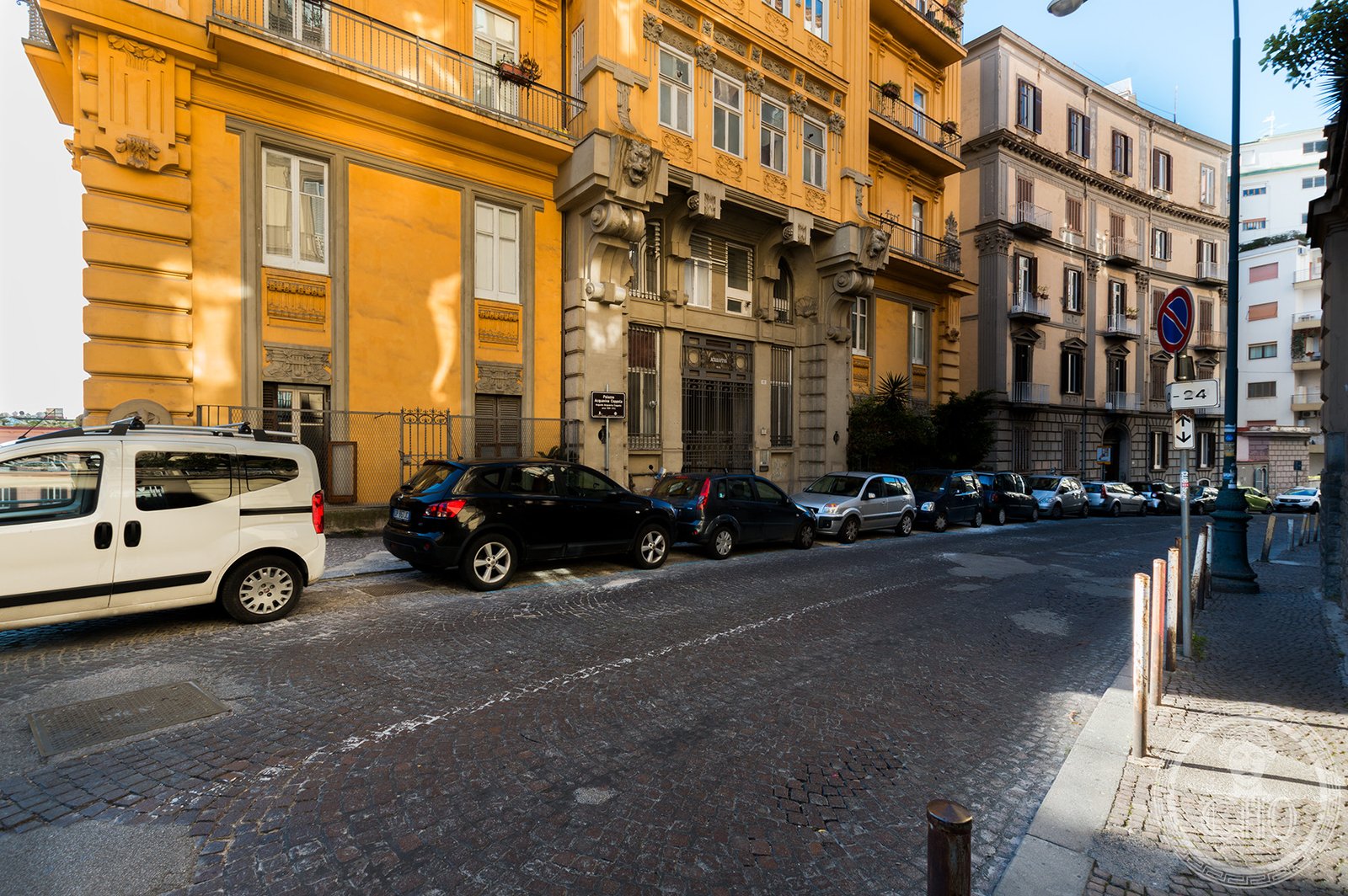
An Art Nouveau residence that merges Neapolitan design with Viennese Secession influences, ingeniously adapted to the sloping terrain of Naples’ Chiaia district.
At a glance
Acquaviva Coppola Palace is a landmark Art Nouveau residential building designed by Augusto Acquaviva Coppola in 1912. Straddling two streets at different elevations—via del Parco Margherita and via San Pasquale—the palace demonstrates bold architectural problem-solving, with each facade reflecting distinct aesthetic traditions.
History
Designed and built in 1912 by Augusto Acquaviva Coppola, the palace emerged during Naples’ vibrant Art Nouveau period. The architect drew on contemporary Viennese Secession principles, particularly the work of Otto Wagner, while maintaining strong connections to local Neapolitan architectural heritage. The building’s unique siting presented both challenge and creative opportunity.
What you see
The palace’s most distinctive feature is its response to topography. Standing on a slope served by two roads at different heights, the structure divides into two seemingly separate sections, each with its own character. Along via del Parco Margherita, classical motifs determine a symmetrical facade enhanced by Art Nouveau decoration. The via San Pasquale elevation adopts baroque characteristics, creating visual contrast. The entrance to the Sancarluccio Theater opens from via San Pasquale, adding cultural significance to the streetscape.
Cultural significance
The palace represents a pivotal moment in Naples’ architectural modernism, synthesizing international Art Nouveau ideals with regional tradition. Its dual-facade approach—balancing Viennese restraint with baroque exuberance—illustrates how early 20th-century architects adapted modernism to local context. The building exemplifies sophisticated design thinking applied to practical urban constraints.
Key facts
- Address: Via del Parco Margherita, 12, 80121 Naples
- Coordinates: 40.8375313, 14.236499
- Architect: Augusto Acquaviva Coppola
- Year completed: 1912
- Style: Art Nouveau with Viennese Secession influences
- Official website: https://www.beniculturalionline.it/
Practical information
The palace is a private residence and not open to the public. Views of the facades are accessible from the adjacent streets in the Chiaia district. Opening hours and visiting conditions are not listed; check the official cultural heritage website for current information.
Getting there
The palace is located in Naples’ Chiaia district, accessible via via del Parco Margherita or via San Pasquale. Public transport connects to central Naples; consult local transit maps for routes serving this area.
Sources & resources
Find it on the map
See this place and what’s around it →📷 Become a Cultural Heritage Online photographer
Share your photos of places: they stay published under your name as the author. The more they're seen, the more you get noticed — and soon a contest will reward the most appreciated photos.
Log in or sign up free to add a photoIs this page about you?
This page is read by travellers and heritage enthusiasts who find it on Google. Tell us how you are connected to this place and we will take it from there.